Which Faucet Types Work With a Brita Water Filter?
Most Brita faucet filters fit standard external-thread kitchen faucets, and they do not fit pullout, touchless or internal-thread faucets. Check your faucet's threads and its clearance before you buy, and keep a pitcher as a backup if your faucet type is unknown.
On this page (11 sections)
- How do I check my kitchen faucet threads first?
- Which regular kitchen faucets work best?
- Do pullout and pulldown faucets work with faucet filters?
- What about touchless, sensor and foot-pedal faucets?
- How much clearance does a faucet filter need?
- Can adapters make a Brita filter fit more faucets?
- What are the trade-offs of faucet filtration versus pitchers?
- When should you choose an under sink system instead?
- Brita or PUR: which faucet filter fits your sink?
- How do you install and care for a faucet filter?
- What is the final fit checklist for your sink?
Most faucets that work with a Brita water filter for sink faucet are standard kitchen faucets with external threads on the spout end. Pullout, touchless and internal-thread faucets usually do not work.
We compared faucet types against the fit rules that matter most. The checks below cover threads, pullout designs, clearance and adapters.
They also show when a pitcher or a dedicated filter faucet is a better plan.
Our score weighs specs, features and buyer feedback against what you are shopping for.
How do I check my kitchen faucet threads first?
Your first check is the threads on the end of your faucet spout. Most faucet filters screw onto those threads with an adapter.
Unscrew the aerator first. You may need the small key that came with the faucet, or a pair of pliers with a cloth to protect the finish.
External threads point outward, like the threads on a common jar lid. Internal threads point inward, like the threads inside a bottle cap.
External threads can accept a faucet filter adapter. Internal threads cannot.
Some faucets have no removable aerator at all. That design usually does not accept a faucet filter either.
Measure the spout diameter next. Many kitchen faucets use a standard size, but some use an oversized or undersized aerator housing.
An adapter set helps, but only when the threads are external.
This step matters more than brand. If the threads are wrong, no amount of tightening will make a Brita water filter for kitchen faucet safe to use.
Our best faucet water filter for kitchen sink guide lists models built for different thread types. Use it to compare filters once you know your thread type.
Firm rule: Buy a faucet filter only after you confirm external threads on a fixed spout.
Which regular kitchen faucets work best?
A fixed kitchen faucet with a straight or gooseneck spout is the most likely match for a faucet filter. The spout does not move, so the filter can stay attached.
Straight spouts give you the simplest fit. The filter hangs below the tip, and you can switch between filtered and unfiltered water with a lever or button on the filter body.
Gooseneck faucets also work when threads fit. Check the height first, because a gooseneck can give you more room under the arch.
The filter still hangs from the tip, not from the base of the faucet.
Low-profile faucets are harder. If the spout sits close to the sink, a long filter body can hit the basin or block a pot.
Measure from the spout tip down to the basin floor.
Bridge faucets and faucets with decorative caps can be tricky. The aerator housing may be recessed or shaped so a standard adapter cannot seat flat.
If you want a filter that stays in place without hanging from your faucet, consider an under sink system with its own faucet. That route avoids thread and clearance limits.
A drinking water filter guide can help you compare faucet filters with pitchers and under sink systems side by side.
Firm rule: A fixed spout with external threads and at least 10 inches of clearance below the tip is your best match.
Do pullout and pulldown faucets work with faucet filters?
Pullout and pulldown faucets almost never work with a faucet filter. The head moves, and the threads move with it.
In a pullout design, the spray head detaches from the spout and extends on a hose. There is no fixed end for a filter to screw onto.
The hose also bends, so a hanging filter would pull on the head.
In a pulldown design, the head docks into the spout. It may look fixed when docked, but it still releases for use.
A filter attached to the docked head would block the release and add weight to the hose.
Some homeowners try to attach a filter to the fixed spout behind the head. Most pullout faucets do not expose standard threads there.
The head assembly covers the spout end.
If your faucet has a pullout head, skip faucet filters. A pitcher, a countertop filter or a separate filter faucet will work better.
Our water filter for faucet with hose guide explains which filters can work with hose-based faucets and which cannot.
Firm rule: If the head pulls out or pulls down, do not buy a faucet filter for that faucet.
What about touchless, sensor and foot-pedal faucets?
Touchless faucets usually do not work with a faucet filter. The sensor controls the water flow, and the filter adds a second control point.
A sensor faucet turns on when your hand breaks an infrared beam. A faucet filter has its own lever or button for filtered versus unfiltered flow.
The two controls can conflict.
Some touchless spouts also have internal threads or a sealed aerator. Those designs leave no place for an adapter.
Foot-pedal and knee-pedal faucets have a similar issue. The pedal controls flow from below the sink, while the filter tries to control flow at the spout.
A filter can also block the sensor beam if it hangs in front of the sensor window. That can cause the faucet to run, stop or stutter in odd ways.
Kitchen faucets with a built-in soap dispenser or spray toggle on the spout tip can also be hard to fit. The filter may cover the toggle you need for spray mode.
If you have a touchless or pedal faucet, use a pitcher or a system with its own faucet. Do not remove or bypass the sensor or pedal to force a fit.
Firm rule: Keep sensor and pedal faucets filter-free, and use a separate filtered water source.
How much clearance does a faucet filter need?
A faucet filter needs room below the spout for its body and for your cup or pot. Measure before you buy, not after.
Measure from the tip of the spout down to the sink basin. Then measure from the tip down to the counter.
A filter body can extend 9 to 12 inches below the tip, depending on the model.
Check the widest point of the filter too. A large pot may not fit under the filter, even if the sink basin has room.
You may need to remove the filter to fill tall pots.
Check side clearance as well. A filter that hangs close to a backsplash can be hard to reach.
A filter that hangs close to a side wall can be hard to clean.
Low faucets under cabinets are a common problem. The filter body may hit the cabinet bottom when you swing it into place.
Measure the cabinet height above the sink.
Write down three numbers: tip to basin, tip to counter, and tip to cabinet. Compare those numbers with the filter length and width before you order.
Firm rule: If a tall pot cannot fit under the filter, pick a pitcher or a separate filter faucet.
Can adapters make a Brita filter fit more faucets?
Adapters can help with external threads, but they cannot fix internal threads or pullout heads. Use them only for the problem they solve.
Most faucet filters come with a set of adapters for common thread sizes. Match the adapter to your aerator size, then screw it onto the spout by hand.
Use only the adapter that fits your faucet. Forcing a mismatched adapter can cross the threads and cause leaks.
A washer helps seal the joint, so check that it is seated flat.
An adapter cannot create external threads where none exist. Internal-thread faucets need a different filter type or a different water source.
An adapter also cannot stop a pullout head from moving. It cannot add clearance under a low spout.
It cannot fix a sensor or pedal control.
If the adapter set does not include your size, measure the aerator housing with a ruler. Some faucet makers sell their own adapters for their models.
Firm rule: Use an adapter only for external threads, and stop if the adapter does not seat flat.
What should I do if the adapter leaks?
A leak at the adapter usually means the washer is missing, twisted or the wrong size. Remove the filter and check the washer first.
Dry the threads and reseat the washer so it sits flat in its groove. Screw the adapter on by hand until snug.
Do not use pliers on the filter body.
If the leak continues, try the next adapter size in the set. A size that feels loose will leak.
A size that cross-threads will also leak.
Replace a worn washer if it looks cracked or flattened. A new washer often solves a small drip at the joint.
Firm rule: Reseat the washer and try the correct size before you tighten harder.
What are the trade-offs of faucet filtration versus pitchers?
Faucet filtration gives you instant filtered water at the sink, with no waiting for a pitcher to refill. Pitchers give you more faucet flexibility and lower daily hassle in some kitchens.
A faucet filter gives filtered water on demand for tea, coffee and cooking. You do not need fridge space for a pitcher.
You do need to switch between filtered and unfiltered flow.
A pitcher works with every faucet type, including pullout and touchless designs. It needs fridge or counter space, and you need to wait for it to filter.
A faucet filter can reduce flow a little, because water passes through the filter cartridge. That matters if you fill large pots often.
A pitcher can hold 10 cups at once, which suits a household that fills bottles and jugs. A faucet filter is better for small, frequent uses at the sink.
The Brita Large 10 Cup Water Filter Pitcher is a good backup when your faucet does not fit a filter. It holds 10 cups, fits most fridge shelves, and includes 1 filter.
Brita says the pitcher is BPA-free and fits on refrigerator shelves. The filter should be replaced after 40 gallons or about 2 months for standard filters, or after 120 gallons or about 6 months for Longlast filters.
Firm rule: Pick faucet filtration for instant sink use, and pick a pitcher for full faucet freedom.
When should you choose an under sink system instead?
An under sink system is the best choice when your faucet type blocks a faucet filter. It adds its own faucet, so your kitchen faucet stays free.
An under sink system sits below the counter and sends filtered water through a separate faucet or an air gap faucet. You do not need to screw anything onto your existing spout.
That design works with pullout, touchless and internal-thread faucets. It also gives you more filter capacity than a small faucet cartridge.
The trade-off is installation. You need space under the sink, a hole for the filter faucet, and a drain connection in some systems.
Some systems also need power.
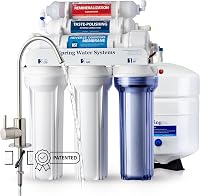
The iSpring RCC7AK-BN NSF Certified is a 6-stage reverse osmosis system with a top-mounted faucet for easier installation from above. It produces 75 gallons per day and includes a brushed nickel faucet and storage tank.
iSpring says the system reduces TDS by 93 to 98 percent and PFAS by 96 to 99 percent, among other contaminants. The transparent first-stage housing helps you see when a filter needs a change.
The Waterdrop G3P600 Tankless Reverse Osmosis Water Filter System uses 8-stage filtration and produces 600 gallons per day. It has a smart display faucet that shows TDS and filter life.
Waterdrop says the system fills an 8 ounce cup in about 8 seconds. It needs under sink electricity, and it measures 18.12 by 5.67 by 17.72 inches, so check your cabinet size first.
If you want to learn more about this route, read What Is an Under Sink Water Dispenser? A Fast Answer.
Our best under sink water filter with faucet guide compares systems with their own faucets.
Firm rule: If your faucet will not accept a filter, choose a system with its own faucet.
Brita or PUR: which faucet filter fits your sink?
The Brita versus PUR choice comes down to thread fit, cartridge size and flow, not brand name alone. Both brands make faucet filters for standard external-thread faucets.
Check which adapters each brand includes. A brand that includes your thread size in the box saves you a separate adapter search.
Check cartridge life in gallons. A longer life means fewer cartridge changes, but a larger cartridge can mean a longer filter body.
Check flow rate for your main use. A filter that is slow for filling a kettle may be fine for drinking glasses.
Our Brita vs PUR faucet filter guide compares the two brands in detail. Our best pur faucet water filter guide covers PUR models for PUR fans.
Our best faucet attached water filter guide covers other attachment styles.
Firm rule: Choose the brand whose adapter set and cartridge size fit your measured faucet, not the one with the louder claim.
How do you install and care for a faucet filter?
Install a faucet filter by hand, with the right adapter and a flat washer. Care for it on a fixed schedule, not when taste changes.
Remove the aerator and save it in a drawer. Screw the correct adapter onto the spout by hand until snug.
Attach the filter body to the adapter.
Run water through the filter for a few minutes before first use. That flushes loose carbon and helps the cartridge seat.
Check the joint for drips.
Switch to unfiltered flow when you fill large pots or wash dishes. That saves cartridge life for drinking and cooking.
Replace the cartridge on schedule. Brita standard cartridges last about 40 gallons or 2 months.
Longlast cartridges last about 120 gallons or 6 months.
Clean the filter body with a damp cloth. Do not use harsh cleaners on the cartridge or the adapter threads.
Firm rule: Flush a new cartridge, use unfiltered flow for big jobs, and replace on the gallon schedule.
What is the final fit checklist for your sink?
Your final check is threads, faucet type, clearance and adapter size, all confirmed before you buy. That one pass prevents most returns.
Write down your faucet type: fixed, pullout, pulldown, touchless or pedal. Write down external or internal threads.
Write down tip to basin and tip to counter numbers.
If any answer is pullout, touchless, internal threads or low clearance, skip the Brita water filter for sink faucet and choose a pitcher or an under sink system.
If every answer fits, buy the filter with the adapter set that includes your size. Keep the aerator and the key in a drawer.
Our best faucet water filter for kitchen sink guide can help you pick the exact model once your measurements are done.
Firm rule: Buy a faucet filter only when threads, type, clearance and adapter all pass, and keep a pitcher as backup when any check fails.
Frequently asked questions
Does a Brita faucet filter work on a pullout kitchen faucet?
Usually no. A pullout head has no fixed external threads for a faucet filter to screw onto, and the hose moves with the head.
Choose a pitcher, a countertop unit, or an under sink system with its own faucet instead.
How do I check faucet threads before buying a Brita filter?
Unscrew the aerator by hand or with its key, then look at the threads on the spout end. External threads face outward and can accept an adapter.
Internal threads face inward and do not work with most faucet filters.
Can a Brita faucet filter fit a faucet with a spray setting?
Some can, if the spout end has standard external threads and enough clearance below it. The filter body is long, so measure from the spout tip to the sink basin before you assume it fits.
What if my kitchen faucet does not fit a faucet filter?
Use a pitcher, a countertop filter, or a dedicated under sink faucet. Those options do not depend on your existing faucet threads or height, so they work with pullout and touchless designs.