Do Brita Water Filters Remove Lead?
Some Brita filters are designed to reduce lead, but not every Brita filter has the same lead-reduction claim. Check the specific filter's certification and the exact contaminant reduction it names before relying on it.
On this page (7 sections)
- Do Brita water filters remove lead?
- Which Brita filter claims to reduce lead?
- Does the Brita Large 10 Cup pitcher remove lead?
- What about Brita-compatible filters?
- How should you check a lead-reduction claim?
- What should you do if you suspect lead in your water?
- Which option makes sense for lead concerns?
Some Brita filters are designed to reduce lead, but the claim depends on the specific filter. Check the exact cartridge's lead-reduction claim and certification; a pitcher that reduces chlorine, copper, mercury, or cadmium does not automatically reduce lead.
The distinctions matter because a pitcher and a replacement cartridge can have different claims, even when they fit the same system. We compared the named contaminant information for these products so you can see what each one says about lead.
Do Brita water filters remove lead?
Some do, according to their stated contaminant claims, but the answer isn't the same for every Brita filter. Check the model and cartridge, not just the brand name.
The BRITA MAXTRA+ cartridge says its ion exchange pearls permanently absorb lead and copper. The Brita Large 10 Cup pitcher information names chlorine, copper, mercury, and cadmium reduction, but doesn't name lead.
These claims aren't interchangeable. If lead reduction is your reason for buying a filter, confirm that the exact filter model names lead and look for certification that covers that reduction.
For a wider overview of filter types and selection, see our drinking water filter guide. If you're comparing pitcher models, our best Brita water filters guide covers other buying factors.
Which Brita filter claims to reduce lead?
The BRITA MAXTRA+ replacement cartridge explicitly names lead reduction. Its product description says the filter reduces lead, and its bullets say ion exchange pearls permanently absorb lead and copper.
MAXTRA+ is described as compatible with BRITA jugs, including models with PerfectFit. Its cartridges last about 4 weeks, so follow the replacement guidance for the specific jug and cartridge you use.
This product data does not give a lead-reduction certification for MAXTRA+. The certification field names CE, which does not by itself guarantee a lead-reduction claim.
Verify the exact cartridge's contaminant claim and applicable certification before relying on it for lead.
Our Brita Elite water filter reviews can help when comparing another Brita filter model. Check its exact lead claim rather than assuming all Brita cartridges perform alike.
Does the Brita Large 10 Cup pitcher remove lead?
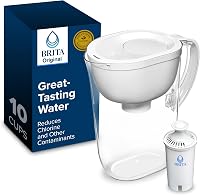
The supplied contaminant information for this pitcher does not name lead reduction. It names chlorine taste and odor, copper, mercury, and cadmium, so don't treat it as a lead-reduction filter based on those claims.
The pitcher is compatible with Longlast and Standard filters. The product information gives different replacement intervals for those filter types: about 120 gallons or 6 months for Longlast, and 40 gallons or about 2 months for Standard.
Those replacement details don't guarantee lead reduction. If your concern is lead, check the exact replacement cartridge and its certified contaminant claims before filling the pitcher.
The pitcher may suit someone choosing a freestanding 10 cup system for the named taste and contaminant claims. For a countertop serving option, compare glass water dispensers with filters.
For lead specifically, choose a model whose documentation clearly names lead.
What about Brita-compatible filters?
Compatibility with a Brita pitcher doesn't mean a replacement filter has the same contaminant claims as a Brita-branded cartridge. Check each replacement filter's own claims and certification.
The Amazon Basics Enhanced Water Filter says it is certified against NSF/ANSI 42, 53, 401, and 372 to reduce 9 contaminants. The named contaminants include chlorine taste and odor, zinc, copper, cadmium, mercury, benzene, atenolol, linuron, and trimethoprim.
Lead isn't among those named contaminants.
That means the standards list alone isn't enough to answer whether this particular filter reduces lead. Look for lead in the filter's specific contaminant claims or certification record.
This 6-pack is compatible with many Brita pitchers and dispensers, excluding Brita Stream. Each cartridge is described as lasting 40 gallons or about 2 months.
How should you check a lead-reduction claim?
Confirm the exact filter model, named contaminant, and certification scope before buying. Don't infer lead reduction from a brand name or a standards number alone.
Use this quick check:
- Identify the exact cartridge model that fits your pitcher.
- Find a claim that specifically names lead reduction.
- Confirm what certification applies to that model and reduction claim.
- Follow the cartridge's replacement schedule.
- If the information is unclear, contact the manufacturer or choose a filter with clear documentation.
NSF/ANSI 53 is associated with health-related contaminant reduction claims, but the number alone doesn't show which contaminants a given filter is certified to reduce. Confirm lead is named for the specific model.
If you want to compare other contaminants, see what Brita water filters remove. Our guide to Brita water filter microplastics covers a separate contaminant question, while Brita water filters and hard water discusses mineral concerns.
What should you do if you suspect lead in your water?
Use a filter with a clear lead-reduction claim and consider testing the water source. A pitcher filter does not tell you how much lead is present before or after filtering.
Lead can enter water through plumbing, so results can vary between homes and even between taps. Contact your local water utility or public health department for guidance on water testing and steps for your specific supply.
A filter's replacement schedule matters because overdue cartridges may no longer perform as intended. Replace the cartridge as directed, and don't use a filter for lead reduction unless its documentation covers that claim.
Which option makes sense for lead concerns?
If lead reduction is your priority, choose only a filter whose exact model documentation names lead reduction and supports it with relevant certification. The MAXTRA+ information explicitly names lead, while the Brita pitcher and Amazon Basics filter information here do not name it among their contaminants.
Choose the Brita pitcher if its stated chlorine, copper, mercury, and cadmium claims match your needs. Choose the Amazon Basics compatible filter for its named nine contaminant claims, but don't count on it for lead based on the details here.
For a direct comparison, use ZeroWater vs Brita and verify lead claims for the models you are considering. The best Brita lead water filter is the one with clear, model-specific evidence of lead reduction.
Frequently asked questions
Do Brita water filters remove lead?
Some filters sold under the Brita name have lead-reduction claims, but those claims vary by model and market. Check the exact cartridge packaging or manufacturer information for lead reduction and its certification.
A general claim that a pitcher improves taste or reduces chlorine does not confirm that it reduces lead.
Which Brita filter removes lead?
The filter must explicitly name lead as a reduced contaminant. The MAXTRA+ cartridge information here says its ion exchange pearls absorb lead and copper, while the Brita pitcher information names chlorine, copper, mercury, and cadmium but not lead.
Confirm the exact model and certification before buying.
Does a Brita filter remove all lead from water?
No filter should be assumed to remove all lead under every condition. Reduction depends on the specific filter, its certification, water conditions, and timely replacement.
If lead is a concern, use a filter certified for lead reduction and follow its instructions; consider testing your water to understand the remaining risk.
How can I tell if a water filter is certified to reduce lead?
Look for a certification that names lead reduction for the specific filter model, and verify the claim with the certifier or manufacturer. A standard number by itself does not show which contaminants a product reduces.
Check the model, contaminant claim, and replacement schedule together.