Stainless Steel Water Dispenser for 5 Gallon Bottles
Choose a stainless steel water dispenser for 5 gallon bottles by checking bottle support, water-contact materials, loading style and placement. Then match the temperature settings and care features to how you use water each day.
On this page (7 sections)
- What should you check before choosing a stainless steel water dispenser for 5 gallon bottles?
- Which loading style fits your space and routine?
- What water temperatures do you need?
- Which features make a floor dispenser easier to use?
- How do you compare water-contact materials?
- Where should you place a 5 gallon water dispenser?
- What should you choose?
A stainless steel water dispenser for 5 gallon bottles should match your bottle support, water-contact materials, loading style and available space. Those practical points shape daily use more than the finish alone.
Check them before choosing a look, because stainless steel can describe the cabinet while other parts use different materials. A careful check at the start helps you avoid a unit that looks right but fits poorly.
You should also decide whether you need hot, cold and room-temperature water. That choice affects power needs, placement and the care routine you will follow.
A powered floor dispenser suits a busy kitchen or office where several people want different temperatures through the day. It also suits a home where cold water on demand is a regular habit.
A compact stand can provide a simpler countertop setup without built-in temperature control. It suits a small space, a dorm room or a household that only needs room-temperature water.
Think about who will use the dispenser each day and how often. A shared office needs easy access for many people, while a single home user may value a smaller footprint.
Consider how you will replace the bottle when it runs empty. Bottom loading can reduce lifting strain, while a stand may ask you to lift and seat the jug by hand.
Set-up and care also matter from the first day. A powered unit needs a suitable outlet and regular cleaning, while a manual stand needs valve checks and simple washing.
The honest trade-off is between convenience and simplicity. More temperature control adds features to maintain, and a simpler setup gives you fewer options at the tap.
Choose the style that matches your space, your routine and the water you actually drink. That match will matter more than a polished exterior after the first week.
What should you check before choosing a stainless steel water dispenser for 5 gallon bottles?
Start with bottle fit and support. A 5 gallon bottle is heavy when full, so the dispenser or stand must support the bottle style you use and keep the container stable while water flows.
A unstable bottle can wobble, leak at the valve or make pouring awkward. Support should hold the jug firmly without making removal difficult when the bottle is empty.
Check whether the product accepts 3 gallon bottles as well as 5 gallon bottles. Some buyers switch sizes, and a unit that handles both can be more flexible.
Bottle caps and neck sizes can also matter, especially when you use a stand with a separate valve. A valve that does not match the cap may prevent a clean seal and lead to drips.
Look at the shape of the bottle base and the opening before you buy. A fit that seems close can still cause trouble during filling, pouring or cleaning.
Next, identify the loading position and how it affects your body. Bottom loading reduces the need to lift a full bottle onto the top of the unit.
That design can suit people who find overhead lifting difficult or who share the dispenser with others. You still need to slide or guide the bottle into the lower space.
A countertop stand may require you to place the bottle above the valves. That placement is simple, but it puts the full weight higher and needs enough headroom.
Measure the height from the surface to any cabinet above it. You also need room to lift the bottle clear, turn it and set it down without scraping the underside.
Water-contact materials deserve a separate check from the outside finish. A stainless cabinet does not automatically mean every internal part is stainless steel.
Look for clear material details for reservoirs, valves and other parts that touch the water. Those details tell you more about daily contact than a general product label.
Ask what you can remove for washing and what stays fixed inside the unit. Removable parts are often easier to rinse and inspect on a regular schedule.
Also check whether the care guide explains cleaning steps in plain terms. A clear guide can make routine care feel manageable rather than a chore you postpone.
For a broader comparison of cabinet styles and features, see our guide to the best stainless steel water dispenser.
Which loading style fits your space and routine?
Choose bottom loading for easier bottle changes, or choose a countertop stand when compact placement matters more than powered dispensing. The best option depends on how much lifting you can manage and where the bottle will sit.
A bottom-load cooler keeps the bottle in a lower cabinet. You still need enough room to open the cabinet and replace the bottle, but you do not need to raise the full jug onto the top of the dispenser.
A countertop stand takes less floor space, but the bottle sits above the valves. Measure the counter height and the space above it before buying.
Make sure the bottle can be placed and removed without hitting a cabinet or shelf.
The Brio stand below supports both 3 gallon and 5 gallon jugs and includes two valve sizes. It is a useful option when you want a compact, non-electric setup.
The Brio stand is made of stainless steel and has a black brushed finish. Its dimensions are 15 x 12 x 12 inches, so measure the intended counter or floor area first.
It includes two dispenser valves, one measuring 48mm and the other 55mm, plus 2 caps. The valves are described as dishwasher safe, which may simplify regular cleaning.
Choose it when you want a simple stand that supports both 3 gallon and 5 gallon bottles. It does not provide powered hot, cold or room-temperature dispensing, so it suits buyers who prefer a manual water station.
For more bottle choices, review the types of reusable water bottles guide. A compatible bottle or lid can make a stand easier to use, especially when your existing bottle has a different opening.
What water temperatures do you need?
Choose a dispenser with the temperature settings you will use often. Hot, cold and room-temperature outputs add convenience, but they also mean the unit needs electrical power and regular care.
The Avalon A4BLWTRCLR provides 3 temperature settings: hot, cold and room water. Its hot-water heating power is 420W, and its cold-water cooling power is 100W.
The Avalon has a stainless steel cabinet, a built-in nightlight and an empty-bottle indicator. The nightlight helps make the spouts visible at night, while the indicator signals when the bottle needs replacement.
It is a freestanding, corded electric unit with a 5 gallon capacity. Its dimensions are 12 in deep, 13 in wide and 41 in high, so check the floor space and overhead clearance before setup.
Choose it for a kitchen or office where bottle lifting is a concern and multiple water temperatures are useful. Skip the extra heating and cooling hardware if you only need room-temperature water from a bottle stand.
If hot water is a key reason for buying, read what is a hot water dispenser to compare the feature with your daily routine.
Which features make a floor dispenser easier to use?
Look for features that solve a problem you actually have, such as bottle lifting, low-light pouring, cleaning or hot-water safety. These features matter more than a general stainless appearance.
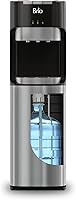
The Brio 520 Series is a bottom-loading, corded electric water cooler with 3 temperature settings. It provides hot, cold and room-temperature water, and its hot-water output is rated up to 200°F.
The Brio includes a UV self-cleaning feature that starts when you press the button. It also has an LED nightlight and an illuminated dispensing area, which can help you see the selected spout and drip tray area.
Its hot-water button uses a two-step dispensing process. The safety lock automatically relocks after dispensing, adding a useful control for homes where accidental hot-water activation is a concern.
The unit measures 15.6 in deep, 12.2 in wide and 41.4 in high. Its materials are listed as plastic and stainless steel, so do not assume that every water-contact part is stainless steel.
Choose this model when bottom loading, multiple temperatures and a self-cleaning cycle all fit your routine. Compare the cabinet depth with the Avalon before deciding where the cooler will stand.
How do you compare water-contact materials?
Read the material details for the parts that hold or direct water, not just the cabinet finish. A stainless steel exterior can improve the look and durability of the unit, but it does not identify every internal material.
That distinction matters because cabinets, reservoirs, valves and seals can each use a different material. A mixed material list does not make a product poor, but it should be clear.
For the Avalon, the material type is stainless steel. Its high-contact areas also have a BioGuard antimicrobial coating, according to the product information.
That coating is presented as a way to help prevent bacteria growth where contact is frequent. It still works best with regular cleaning and sensible bottle handling.
The Brio 520 Series lists plastic and stainless steel as its materials. Its description identifies food-grade 304 stainless steel for the water reservoirs, while the full product material information includes both materials.
That wording is a good example of why you should read beyond a short label. The reservoir material and the wider unit materials may not be exactly the same.
For daily use, focus on the parts that hold water for longer periods. Reservoirs, tanks and valves deserve more attention than a decorative outer panel.
The Brio stand is made of stainless steel, but its valves are separate components. Check that the valve size matches your bottle cap before setup.
A close match helps the valve seal properly and lets water flow without sputtering. Keep spare caps or valves in mind if your bottle supplier changes its neck style.
Clean the dispenser or stand according to its care instructions. Empty and rinse removable parts as directed, and keep the drip area clean.
Replace bottles before they are completely inconvenient to handle. An empty or near-empty jug can be awkward to remove and may leave residue in the valve area.
Wipe spills promptly so moisture does not collect around the base or cabinet. A dry dispensing area is easier to keep clean and easier to inspect.
If you already use Contigo bottles, our guide to the best Contigo water bottles can help you compare portable options. For damaged caps, see the best water bottle replacement lid guide.
Where should you place a 5 gallon water dispenser?
Place a floor dispenser on a level surface with enough room to change the bottle, open the cabinet and use the spouts. Keep the power cord and water area arranged so they do not create a trip or spill problem.
A level base helps the unit stand steady and keeps water flowing in the expected direction. Even a slight tilt can make a tall dispenser feel less secure.
Measure the dispenser's depth, width and height before moving it into place. Those three numbers help you plan the footprint and the space around it.
Check cabinet doors, shelves and nearby appliances that could block the bottle compartment or dispensing area. A unit can fit in a space yet still be hard to use if doors swing into it.
Allow room in front for a cup, a kettle or a reusable bottle. You also need space to stand comfortably while you fill a tall container.
A countertop stand needs a different measurement plan. Confirm that the counter can support the bottle and stand together, then check the vertical space above the bottle.
Counter depth matters as much as width, because the stand and bottle should not hang near the edge. Keep the setup away from heat, direct splash and busy work zones.
Leave enough clearance to remove the empty jug. That removal step often needs more room than you expect, especially if the bottle is tall.
Think about where the empty bottle will go after removal. A nearby floor space or storage area can prevent slips when you carry it away.
A bottom-load dispenser may suit a narrow kitchen better than a top-load model because the bottle sits inside the lower cabinet. However, the cabinet door still needs space to open fully during replacement.
Test the door swing before you commit to a final position if you can. Open it, reach inside and check that your hands have room to guide the bottle.
Keep the power cord short enough to avoid crossing a walkway. A tidy cord route also makes cleaning around the base easier.
For a countertop-focused comparison, see the best stainless steel countertop water dispenser. If lifting a full bottle is your main concern, read why choose a bottom load water dispenser before deciding.
What should you choose?
Choose the Avalon A4BLWTRCLR if you want a freestanding bottom-load cooler with hot, cold and room-temperature settings, a stainless steel cabinet, a nightlight and an empty-bottle indicator.
That mix suits a kitchen, office or break room where several people want different temperatures. Bottom loading also helps when lifting a full bottle onto a top opening would be difficult.
The Avalon fits a household that uses cold water often and wants hot water for drinks. It also fits a small office where a shared dispenser can reduce trips to a kettle or fridge.
Choose the Brio 520 Series if you want a bottom-load 5 gallon cooler with UV self-cleaning, 3 temperature settings, an illuminated dispensing area and a hot-water safety lock.
That combination may suit a home where cleaning routines matter and hot water needs a safety step. The light can help at night, and the lock can reduce accidental activation.
It may also suit a busy family kitchen where different people use the dispenser through the day. A self-cleaning feature can support a routine, but it does not replace ordinary care.
Choose the Brio stainless steel stand if you want a compact manual setup for 3 or 5 gallon bottles. Its 48mm and 55mm valves give you more bottle-cap flexibility, but it does not replace a powered cooler.
That stand suits a countertop, dorm room or small utility area where floor space is limited. It also suits a buyer who wants room-temperature water without extra power or heating hardware.
The trade-off is clear, because a manual stand cannot chill or heat water for you. If temperature control is important, a powered floor unit will serve you better.
If you carry water in a reusable bottle after filling it, compare the best stainless steel water bottle with straw for a portable option. The right dispenser is the one that supports your bottle, fits your space and provides only the features you will maintain and use.
Frequently asked questions
What should I check in a stainless steel water dispenser for 5 gallon bottles?
Check whether the unit supports your bottle size, where the bottle loads, which materials contact water, and whether the cabinet fits your space. Then review temperature settings, hot-water safety, cleaning steps and power needs.
These details affect daily use more than a stainless finish alone.
Is stainless steel better for a 5 gallon water dispenser?
Stainless steel can offer a durable cabinet and may be used in water-contact parts, but the finish alone does not tell you every material inside. Check the stated material details, especially for reservoirs and valves, and choose a unit whose care instructions fit your routine.
Should I choose a top-load or bottom-load dispenser?
Choose bottom loading if lifting and flipping a full bottle would be difficult. A top-load design can make the bottle position visible, while a bottom-load design keeps the jug in a lower cabinet.
Compare the loading method with your available floor space and bottle-changing routine.
Can a 5 gallon dispenser sit on a countertop?
A countertop setup can save floor space, but the dispenser or stand must support the bottle safely and leave room for pouring. Measure the counter, cabinet clearance and bottle height before setup.
A freestanding floor unit may be easier if you need hot, cold and room-temperature water.