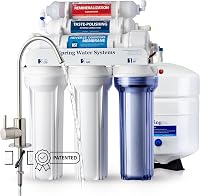
9 Best Countertop Water Filters (November 2026)
The best countertop water filters include the Brita Large 10 Cup Water Filter Pitcher for everyday fridge storage, the PUR 30-Cup Countertop Water Filter Dispenser for a large chilled reserve, and the Waterdrop G3P600 Tankless Reverse Osmosis Water Filter for high daily output.
On this page (7 sections)
- How to compare countertop water filters
- The best countertop water filters by household need
- Which countertop filtration format fits your kitchen?
- What should you check before choosing a countertop filter?
- Can countertop filters remove fluoride or other specific contaminants?
- More guides on this topic
- Which countertop water filter should you choose?
The best countertop water filter depends on whether you want a stored supply, direct faucet access or reverse osmosis. For a large chilled reserve, consider the PUR dispenser; for a compact RO setup without plumbing, look at the DREO 3L system.
A countertop filter can mean several different setups. Some sit in the fridge as pitchers or dispensers, while others connect to the faucet or use gravity to fill a separate chamber.
This roundup compares filtration format, capacity, installation and replacement needs. For a wider overview of choosing a drinking water filter, start with the basics of filtration methods and fit.
Our picks at a glance
-
1
 Best for everyday fridge storage
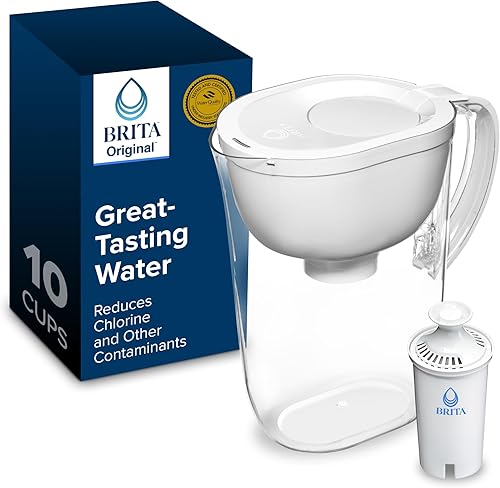
Brita Large 10 Cup Water Filter Pitcher
9.7/10 our score
See it on Amazon -
2
 Best for a large chilled reserve
PUR 30-Cup Countertop Water Filter Dispenser
9.6/10 our score
See it on Amazon -
3
 Best for high daily output
Waterdrop G3P600 Tankless Reverse Osmosis Water Filter
9.5/10 our score
See it on Amazon
- 4
 Check it
Brita Small 6-Cup Water Filter Pitcher
Best for a mini fridge - 5
 Check it
DREO Reverse Osmosis Water Filter System Countertop
Best for a compact RO setup - 6
 Check it
DREO Reverse Osmosis Water Filter Countertop System
Best for family-size RO batches - 7
 Check it
Purewell 3-Stage 0.01μm Ultra-Filtration Gravity Water Filter
Best for non-electric gravity filtration - 8
 Check it
Waterdrop WFD-40L Water Filter Dispenser
Best for a slim fridge dispenser - 9
 Check it
iSpring CKC1C Chlorine Removal Countertop Water Filter
Best for a faucet-connected carbon filter
How to compare countertop water filters
The best countertop water filter for your kitchen is the one whose filtration method, setup and stored capacity match how you get drinking water. We compared the stated features and certifications, then weighed them against common household needs.
A pitcher or refrigerator dispenser is simple to use, but it filters in batches and needs space in the fridge. A faucet-connected model provides water at the sink, though you need to confirm that its diverter fits your tap.
Countertop reverse osmosis systems have different installation needs. DREO’s models sit on the counter and do not need plumbing, while the Waterdrop G3P600 is an under-sink system that needs electricity and a dedicated faucet.
A gravity system avoids power and plumbing. It takes up vertical counter space and relies on gravity to move water between its chambers.
For a portable setup away from home, compare gravity water filters for backpacking.
Our score weighs specs, features and buyer feedback against what you’re shopping for. Check the specific filter’s claims and certification scope against your water report, since different filters reduce different substances.
If you are weighing filtration against hardness treatment, compare water softeners and water filters. For a point-of-entry carbon system, see whole-house carbon water filters.
| Product | Best for | Capacity | Setup | Filter change | Our score |
|---|---|---|---|---|---|
| Brita Large 10 Cup Water Filter Pitcher | everyday fridge storage | 10 cups | Freestanding pitcher | 40 gallons or about 2 months with Standard; 120 gallons or about 6 months with Longlast | 9.7 |
| PUR 30-Cup Countertop Water Filter Dispenser | a large chilled reserve | 30 cups | Countertop dispenser | Up to 40 gallons or 2 months | 9.6 |
| Waterdrop G3P600 Tankless Reverse Osmosis Water Filter | high daily output | 600 gallons per day | Under sink with dedicated faucet | 9.5 | |
| Brita Small 6-Cup Water Filter Pitcher | a mini fridge | 6 cups | Freestanding pitcher | 40 gallons or about 2 months with Standard filter | 9.4 |
| DREO Reverse Osmosis Water Filter System Countertop | a compact RO setup | 3 liters plus 1.1L pitcher | Countertop, no plumbing | 9.3 | |
| DREO Reverse Osmosis Water Filter Countertop System | family-size RO batches | 5 liters plus two 1.1L pitchers | Countertop, no plumbing | 9.2 | |
| Purewell 3-Stage 0.01μm Ultra-Filtration Gravity Water Filter | non-electric gravity filtration | 2.25 gallons | Countertop gravity system | Every 6 months for optimum performance | 9.1 |
| Waterdrop WFD-40L Water Filter Dispenser | a slim fridge dispenser | 35 cups | Freestanding dispenser | 200 gallons or 2 months stated | 9.0 |
| iSpring CKC1C Chlorine Removal Countertop Water Filter | a faucet-connected carbon filter | Faucet-connected countertop unit | 8.9 |
The best countertop water filters by household need
The Brita Large pitcher is the highest-scoring pick for everyday fridge storage, while the other options suit larger reserves, compact spaces or different filtration setups. Choose by the way you want to use filtered water.
Brita Large 10 Cup Water Filter Pitcher: Best for everyday fridge storage
- 10-cup capacity
- Fits refrigerator shelves
- Standard or Longlast filter compatibility
The 10-cup pitcher works for households that want to filter water in batches and keep it chilled. It fits refrigerator shelves and has an easy-fill locking lid.
Pros
- Larger capacity than the small Brita pitcher
- Fits refrigerator shelves
- Compatible with Standard and Longlast filters
Cons
- Water is filtered in batches
- Filter replacement timing depends on filter type
The Brita Large is a practical choice when you want a familiar pitcher that can stay on a refrigerator shelf. Its 10-cup capacity is enough to fill three 24-ounce reusable water bottles, and its easy-fill locking lid helps keep refilling simple.
You can use either a Standard or Longlast filter. Brita recommends changing a Standard filter after 40 gallons or about 2 months, while Longlast filters are changed after 120 gallons or about 6 months.
Brita says the filter reduces chlorine taste and odor, mercury, copper, zinc and cadmium. The pitcher is BPA-free, and its compact shape is designed to fit refrigerator shelves.
Choose it for batch filtering and chilled water storage. If you need more ready-to-pour volume, the PUR dispenser below holds more.
PUR 30-Cup Countertop Water Filter Dispenser: Best for a large chilled reserve
- 30-cup capacity
- Pull-down spout
- Dishwasher safe
A large reservoir suits households that want filtered water ready to pour from the fridge. The pull-down spout allows pouring while water is still filtering.
Pros
- Large stated capacity
- Pull-down spout
- Dishwasher safe
Cons
- Needs refrigerator space
- Uses compatible Genuine PUR filters
The PUR dispenser suits households that want a larger filtered-water reserve in the refrigerator. It holds 30 cups and has a pull-down spout, so you can pour while water is still filtering.
A carrying handle helps when you take it to the sink for refilling. PUR says the included Genuine PUR filter is certified for up to 40 gallons or 2 months of regular use, and the dispenser is dishwasher safe.
PUR says its filter is IAPMO certified to reduce chlorine, mercury, copper and zinc, among other substances. It is designed for refrigerator storage, so measure your available shelf space before choosing it.
Pick it for a shared chilled supply, especially if you refill several glasses through the day. A smaller pitcher is easier to fit when refrigerator space is tight.
Waterdrop G3P600 Tankless Reverse Osmosis Water Filter: Best for high daily output
- 600 gallons per day stated capacity
- Smart display faucet
- Under-sink installation
This tankless reverse osmosis system is an option for buyers who want a dedicated faucet and high stated daily output. It installs under the sink and needs electricity.
Pros
- Smart faucet shows TDS and filter life
- Tankless design
- NSF/ANSI 58 certification for TDS reduction
Cons
- Requires under-sink space and electricity
- Installation calls for drilling holes
The Waterdrop G3P600 is the choice here for buyers who want reverse osmosis with a dedicated faucet and high stated output. It produces up to 600 gallons per day, and its smart display faucet shows TDS and filter life.
This is an under-sink system, despite the broader countertop-water-filter search. It needs electricity, cabinet space and two drilled holes, one for the RO faucet and one for the drain connection.
Waterdrop says the system is certified to NSF/ANSI 58 for TDS reduction and NSF/ANSI 372 for lead-free material. It also lists testing and certification to NSF 42 for reducing chlorine, taste and odor.
Choose it if you want a fixed under-sink RO setup. For a system that sits on the counter without plumbing, compare the best countertop reverse osmosis system.
Brita Small 6-Cup Water Filter Pitcher: Best for a mini fridge
- 6-cup capacity
- Fits most mini-fridges
- SmartLight filter indicator
The compact pitcher suits dorm rooms and kitchens with limited refrigerator space. Its SmartLight indicator signals when the Standard filter needs replacing.
Pros
- Space-efficient size
- SmartLight replacement reminder
- Compatible with Standard and Elite filters
Cons
- Smaller reserve than larger pitchers
- Water is filtered in batches
The Brita Small pitcher is a better fit for a dorm, mini-fridge or kitchen with limited storage. Its 6-cup size and easy-fill lid make it a compact option for filtering a few servings at a time.
A SmartLight indicator signals when the Standard filter needs replacing. Brita recommends changing that filter after 40 gallons or about 2 months, and says it reduces chlorine taste and odor, copper, mercury and cadmium.
The pitcher also works with Brita Elite filters, which Brita recommends replacing after 120 gallons or about 6 months. Its smaller capacity means more frequent refills for a household that drinks a lot of water.
Pick it when fridge space matters more than volume. For a glass vessel, see the guide to the best countertop water filter glass.
DREO Reverse Osmosis Water Filter System Countertop: Best for a compact RO setup
- 3L tank and 1.1L pitcher
- TDS and filter life monitoring
- 3:1 pure-to-drain ratio stated
This countertop reverse osmosis system includes a 3L tank and one pitcher. Its slim footprint and monitoring display suit buyers who want an RO setup without plumbing.
Pros
- No plumbing installation
- Real-time TDS and filter life monitoring
- Self-cleaning system
Cons
- Requires counter space and power
- Smaller tank than the 5L version
The DREO 3L system suits one or two people who want countertop reverse osmosis without plumbing changes. It includes a 3L tank and one 1.1L pitcher, with a slim footprint for a kitchen counter or office.
The system monitors raw and filtered water TDS and shows filter-life reminders. DREO says its 7-in-1 RO filter reduces a range of substances, including 99% of lead, chromium, chlorine, PFOS and PFOA, plus 97% of fluoride under laboratory conditions.
DREO also states a 3:1 pure-to-drain ratio and a 265-gallon filter life. Its self-cleaning system flushes internal tubes, and the filter twists into place for replacement.
Choose this model for a compact on-counter RO setup. For more water storage and a second pitcher, compare it with the DREO 5L model below.
DREO Reverse Osmosis Water Filter Countertop System: Best for family-size RO batches
- 5L tank and two 1.1L pitchers
- TDS meter and filter life monitoring
- 3:1 pure-to-drain ratio stated
The 5L tank and two pitchers give this countertop RO system more stored water than the smaller DREO model. It is sized for households that want to serve several people.
Pros
- Larger tank than the 3L model
- Two included pitchers
- No plumbing installation
Cons
- Needs counter space and power
- Tank and pitchers need regular refilling
The DREO 5L system gives a household more stored water than the 3L model. Its 5L tank and two 1.1L pitchers are intended for daily use by three or four people.
It has a real-time TDS meter and filter-life reminders, along with the same stated 3:1 pure-to-drain ratio and 265-gallon filter life. DREO says the 7-in-1 filter was tested by SGS to meet NSF/ANSI 58 standards.
No plumbing is needed, but it still takes counter space and power. The system’s listed footprint is about 15.7 by 6.7 inches, so measure the space where you plan to place it.
Pick it for larger RO batches on the counter. For brand-specific details, see the guide to the best AquaTru countertop water filter.
Purewell 3-Stage 0.01μm Ultra-Filtration Gravity Water Filter: Best for non-electric gravity filtration
- 2.25-gallon capacity
- No electricity needed
- Stainless-steel housing
The gravity system holds water in upper and lower chambers and works without electricity. Its maker says the filters reduce chlorine and intercept rust, sediment, organic matter and heavy metals.
Pros
- No power needed
- Large stored-water capacity
- Stainless-steel housing and stand included
Cons
- Does not lower TDS
- Requires room for a tall two-chamber system
The Purewell gravity system suits buyers who want a larger reservoir without electricity. It has a 2.25-gallon capacity, upper and lower chambers, a stainless-steel housing and a stand.
Purewell says its three-stage filtration uses a 0.01-micron hollow-fiber membrane, silver-ion membrane and activated carbon block. The carbon filter has NSF/ANSI 42 certification, and the system has NSF/ANSI 372 certification.
The main limitation is that Purewell says the system does not lower TDS. It also needs enough vertical counter space for a 20-inch unit, and the maker recommends replacing the filters every 6 months for optimum performance.
Choose it for non-electric storage and dispensing. If your source is a private well, see our guide to the best countertop water filter for well water.
For whole-home treatment, compare whole-house water filters for well water.
Waterdrop WFD-40L Water Filter Dispenser: Best for a slim fridge dispenser
- 35-cup stated capacity
- Filter change indicator
- NSF 42 and 372 certified replacement filter
This slim dispenser is designed to fit in a refrigerator and store a larger volume of filtered water. Its carbon filter reduces chlorine, while the system does not lower TDS.
Pros
- Large stated capacity
- Slim refrigerator-friendly shape
- Filter replacement indicator
Cons
- Does not lower TDS
- Check refrigerator dimensions before choosing
The Waterdrop WFD-40L is built for households that want a slim, high-capacity dispenser in the refrigerator. It holds 35 cups and has a sliding cover, carry handle and filter replacement indicator.
Waterdrop says its replacement filter is NSF 42 and 372 certified and reduces residual chlorine. The stated filter life is 200 gallons or 2 months, and the design is intended to finish filtering within 5 minutes.
This dispenser does not lower TDS, so it is not the pick for buyers seeking TDS reduction. Check your refrigerator’s shelf height and depth before choosing it.
Pick it for a large chilled reserve in a narrow form. If hard water is your main concern, compare the options in our best countertop water filter for hard water guide.
iSpring CKC1C Chlorine Removal Countertop Water Filter: Best for a faucet-connected carbon filter
- Connects to most standard kitchen taps
- Clear housing
- No drilling required
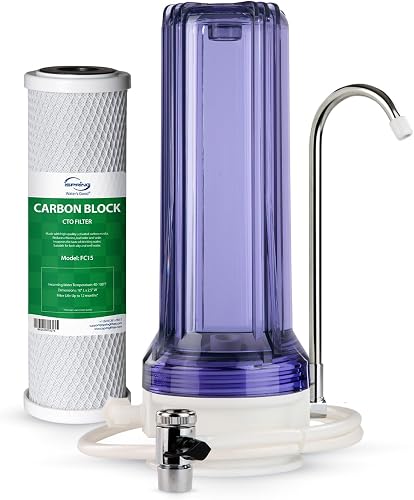
This carbon-block filter connects to most standard kitchen taps and switches between tap and filtered water. It reduces chlorine, odors, sand, silt, sediment and rust, but does not reduce TDS.
Pros
- No drilling required
- Clear housing lets you inspect the filter
- Includes adapters and diverter valve
Cons
- Does not reduce TDS
- Tap compatibility should be checked
The iSpring CKC1C connects to most standard kitchen taps and switches between regular and filtered water with a twist. It is a carbon-block filter with a clear housing that lets you inspect the cartridge.
iSpring says the 5-micron cartridge removes 95% of chlorine, odors, sand, silt, sediment and rust. The system does not reduce TDS, and its expected filter life is 6 to 12 months depending on local water quality.
No drilling is required, and the package includes tubing, a diverter valve, wrench and adapters. Check your faucet shape and thread before buying to confirm compatibility.
Choose it for direct faucet access without a permanent installation. For more options with a faucet connection, see the best countertop water filter with water line.
Which countertop filtration format fits your kitchen?
Pick a pitcher or dispenser if you want stored filtered water, a faucet-connected filter for direct tap access, a gravity system if you want to avoid electricity, or reverse osmosis if you want a method designed to reduce TDS. The space and upkeep differ as much as the filtration method.
A pitcher is easy to move and store, but it needs refilling and fridge space. A larger dispenser reduces refill frequency but takes up more shelf room.
A faucet-connected unit avoids waiting for a reservoir to filter, but compatibility matters. Check the faucet before choosing a countertop water filter with a water line.
Reverse osmosis systems can fit different kitchens in different ways. The DREO models sit on the counter and use removable tanks, while the Waterdrop G3P600 requires under-sink installation and electricity.
Gravity filtration needs no power, though a tall two-chamber unit can take up substantial counter height. Check the maker’s stated contaminant reductions and whether lowering TDS matters for your needs.
What should you check before choosing a countertop filter?
Check the substances you want reduced, the filter’s certification scope, the system’s setup and its replacement schedule. A broad phrase like “water filtration” does not tell you what a specific filter reduces.
Start with your local water report or a test from a qualified lab, especially for well water. Then compare the filter’s stated reduction claims and certifications for the substances you care about.
Measure the counter, refrigerator shelf or cabinet before ordering. For faucet-connected systems, confirm the tap shape and connection; for RO units, confirm the required power, plumbing and drain arrangements.
Plan for filter changes and daily refills. A larger tank can mean fewer trips to the sink, while an indicator or stated filter life can help you keep maintenance on schedule.
Can countertop filters remove fluoride or other specific contaminants?
Some can, but no single countertop filter should be assumed to reduce every contaminant. Match the system’s stated reduction claims and certification to your specific concern.
DREO says its RO filter reduces fluoride under laboratory conditions, and Waterdrop lists fluoride reduction for its G3P600 system. For NSF claims, check the scope of the certification rather than relying only on a certification number.
The best countertop water filter that removes fluoride guide focuses on that specific need. For NSF certified options, compare the best countertop water filter NSF certified guide.
More guides on this topic
- Best Waterdrop Countertop Water Filters
Which countertop water filter should you choose?
Choose the Brita Large for an everyday pitcher, the PUR for a larger chilled reserve, or the DREO 5L for countertop reverse osmosis with more stored water. If you want water from the tap, the iSpring is the faucet-connected option here.
For a compact fridge, the Brita Small is easier to place, while the Purewell gravity system avoids electricity. Compare your water concerns, available space and upkeep needs before deciding.
Our top 3 picks at a glance
-
1
Best for everyday fridge storage
Brita Large 10 Cup Water Filter Pitcher
9.7/10 our score
See it on Amazon -
2
Best for a large chilled reserve
PUR 30-Cup Countertop Water Filter Dispenser
9.6/10 our score
See it on Amazon -
3
Best for high daily output
Waterdrop G3P600 Tankless Reverse Osmosis Water Filter
9.5/10 our score
See it on Amazon
Frequently asked questions
What type of countertop water filter should I choose?
Choose by how you want to fill and store water. Pitchers and dispensers filter into a reservoir, gravity systems need no power, faucet-connected units send filtered water from the tap, and countertop reverse osmosis systems use a separate tank and pitcher.
Check the contaminants you want reduced and the filter’s stated certifications before deciding.
Do countertop water filters remove fluoride?
Some do, but filtration methods differ. The DREO countertop reverse osmosis systems state that they reduce fluoride, and Waterdrop G3P600 is an under-sink RO option that also lists fluoride reduction.
Check the specific system’s claims and certification scope for your water concerns.
Do countertop water filters lower TDS?
Not all countertop filters lower total dissolved solids (TDS). The Purewell gravity system and iSpring CKC1C explicitly do not lower TDS, while reverse osmosis systems are designed to reduce it.
A TDS reading alone does not identify which substances are present, so use it only for what it measures.
How often do countertop water filters need replacement?
Replacement timing depends on the filter and how much water you use. Brita Standard filters are recommended every 40 gallons or about 2 months, while DREO states 265 gallons for its RO filter.
Follow the instructions for your specific system and replace sooner if its indicator calls for it.
Is a countertop filter better than a faucet-connected filter?
A reservoir-style countertop filter stores filtered water for pouring, while a faucet-connected unit filters water at the tap. The right fit depends on whether you prefer a stored supply or direct access and whether your faucet is compatible.
For direct tap connection, compare the countertop water filter with a water line.