9 Best Countertop Reverse Osmosis Systems (November 2026)
The best countertop reverse osmosis systems include the iSpring RCC7AK-BN NSF Certified for permanent kitchen filtration, the DREO Reverse Osmosis Water Filter Countertop System for families and fewer refills, and the DREO Reverse Osmosis Water Filter System Countertop for one or two people.
On this page (6 sections)
- Which countertop reverse osmosis system is best for your setup?
- The best countertop reverse osmosis systems
- How should you choose a countertop RO water filter?
- Does countertop reverse osmosis need electricity?
- What maintenance does a countertop RO system need?
- What is the best countertop reverse osmosis system for you?
The best countertop reverse osmosis system for most homes is the DREO Reverse Osmosis Water Filter Countertop System 113, because its 5-liter tank and 2 autofill pitchers reduce refills for a household of 3 to 4 people. Choose the smaller DREO for 1 to 2 people, iSpring for a permanent under-sink setup, or AquaTru for glass-carafe water with alkaline minerals.
Countertop RO systems differ most in tank size, refill routine, power needs and installation style. Some use a refillable tank and a wall outlet, while Express Water connects to a faucet and iSpring needs under-sink installation.
If you're still deciding between RO and simpler filtration, compare these picks with our guide to the best countertop water filter.
Our picks at a glance
-
1
 Best for permanent kitchen filtration
iSpring RCC7AK-BN NSF Certified
9.7/10 our score
See it on Amazon -
2
 Best for families and fewer refills
DREO Reverse Osmosis Water Filter Countertop System
9.3/10 our score
See it on Amazon -
3
 Best for one or two people
DREO Reverse Osmosis Water Filter System Countertop
9.2/10 our score
See it on Amazon
- 4
 Check it
Bluevua RO100ROPOT Countertop Reverse Osmosis Water Filter
Best for glass and remineralized water - 5
 Check it
AquaTru Glass Carafe Alkaline Countertop Reverse Osmosis
Best for alkaline glass-carafe water - 6
 Check it
Natureflow Countertop Reverse Osmosis Water Filter System
Best for mineralized water and low waste - 7
 Check it
AquaTru Classic Alkaline Countertop Water Purifier
Best for apartment-friendly family use - 8
 Check it
Purevua PR1-A Countertop UV Reverse Osmosis Water
Best for UV features and preset volumes - 9
 Check it
Express Water Countertop Reverse Osmosis Water Filtration
Best for faucet-connected RO
Which countertop reverse osmosis system is best for your setup?
The best choice depends on how much water you use and whether you prefer a refillable tank or a permanent connection. Daily volume matters most, since a small tank gets annoying when you also make coffee and cook with the same water.
A large tank can be heavy to lift and refill, and it needs more counter and cabinet clearance. Installation style shapes the routine too, because a plug-in unit needs an outlet and space to pour in tap water.
The iSpring is the highest-scoring option, but it is an under-sink system rather than a plug-in countertop machine. That permanent setup suits homeowners who plan to stay in place, and it is a harder fit for renters or anyone who wants to move the system later.
The larger DREO is the strongest true countertop choice for a family, with a bigger tank and two pitchers to reduce refills. The smaller DREO and Bluevua suit lighter daily use by one or two people, including a desk, bedroom or kitchen with limited counter depth.
The glass-carafe AquaTru models suit buyers who prefer serving style and mineralized water. Power needs also separate the group, since corded units are ready once plugged in while Express Water and iSpring place more demands on your faucet or cabinet.
Use household size as the first filter, then check outlet access and counter space. Once those basics are set, stage count, minerals and waste ratio help narrow the shortlist.
| Product | Best for | Capacity | Size | Installation | Our score |
|---|---|---|---|---|---|
| iSpring RCC7AK-BN NSF Certified | permanent kitchen filtration | 75 gallons per day | 15.5 x 16 x 18 in | Under sink | 9.7 |
| DREO Reverse Osmosis Water Filter Countertop System | families and fewer refills | 5 liters | 15.7 x 6.7 x 13.4 in | Countertop | 9.3 |
| DREO Reverse Osmosis Water Filter System Countertop | one or two people | 3 liters | 14.5 x 6.7 x 13.4 in | Countertop | 9.2 |
| Bluevua RO100ROPOT Countertop Reverse Osmosis Water Filter | glass and remineralized water | 1,700 ml | 10.9 x 15.4 x 14.3 in | 9.2 | |
| AquaTru Glass Carafe Alkaline Countertop Reverse Osmosis | alkaline glass-carafe water | 14 x 7.5 x 13 in | 9.0 | ||
| Natureflow Countertop Reverse Osmosis Water Filter System | mineralized water and low waste | 5 liters | 18.5 x 8.58 x 13.9 in | 8.8 | |
| AquaTru Classic Alkaline Countertop Water Purifier | apartment-friendly family use | 2.7 liters | 14 x 12 x 14 in | 8.6 | |
| Purevua PR1-A Countertop UV Reverse Osmosis Water | UV features and preset volumes | 68 fluid ounces | 17.09 x 6.97 x 14.21 in | 8.3 | |
| Express Water Countertop Reverse Osmosis Water Filtration | faucet-connected RO | 12 gallons per day | 13.25 x 6.5 x 14 in | 8.0 |
The best countertop reverse osmosis systems
1. iSpring RCC7AK-BN NSF Certified: Best for permanent kitchen filtration
iSpring RCC7AK-BN NSF Certified: Best for permanent kitchen filtration
- 75 GPD capacity
- 6-stage filtration
- NSF/ANSI 58 certified
- Alkaline mineral stage
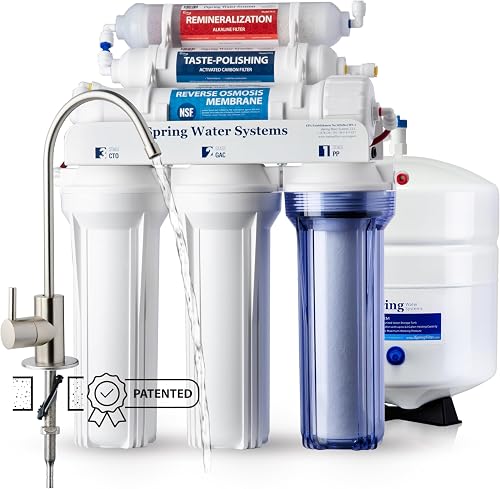
The iSpring is the strongest fit for a permanent kitchen system rather than a plug-in countertop unit. Its 6-stage design includes alkaline remineralization and a top-mounted faucet fastener.
Pros
- NSF/ANSI 58 certification
- Alkaline remineralization
- Transparent first-stage housing
Cons
- Requires under-sink installation
- No built-in electric operation
The iSpring RCC7AK-BN is an under-sink 6-stage reverse osmosis system with a 75-gallon-per-day capacity. Its alkaline AK stage adds minerals, while the NSF/ANSI 58 certification applies to the full RO system.
The transparent first-stage housing lets you see sediment buildup before changing that filter. That visual check helps you plan replacements based on your tap water rather than a fixed guess.
The top-mounted fastener is designed to make faucet installation easier from above the counter. This can help when access under the sink is tight, though the cabinet still needs room for the tank and tubing.
This system includes the RO unit, brushed nickel faucet, storage tank and extra tool set. It operates without electricity, which suits a kitchen with no spare outlet near the sink.
It measures 15.5 x 16 x 18 inches, so measure the cabinet before ordering. Storage tanks and housings need space to be removed, not just space to sit in place.
The 75-gallon-per-day figure speaks to production capacity, not how much water the storage tank holds at once. That distinction matters if you expect a steady supply for several people.
Choose iSpring when you want a lasting kitchen installation and a dedicated faucet. It is not the right pick if you need a portable countertop unit for a rental or office.
2. DREO Reverse Osmosis Water Filter Countertop System: Best for families and fewer refills
DREO Reverse Osmosis Water Filter Countertop System: Best for families and fewer refills
- 5-liter tank
- 2 autofill pitchers
- 7-in-1 filtration
- Real-time TDS monitoring
The 5-liter DREO gives households more water per fill than the smaller countertop picks. Its 2 autofill pitchers and filter reminders suit daily use by 3 to 4 people.
Pros
- Large 5-liter tank
- 2 autofill pitchers
- No plumbing required
Cons
- Needs a nearby outlet
- Takes more vertical space than a small pitcher filter
The 5-liter DREO RO Water Filter 113 is the best fit here for higher-volume countertop use. Its 7-in-1 RO system uses a 0.0001 μm membrane, and DREO says it reduces 99.9% of possible contaminants, including PFOA, PFOS, chlorine and fluoride.
The system includes 2 autofill water pitchers, which makes serving or storing purified water easier than using one small collection vessel. Real-time TDS monitoring and filter-life reminders give you more information about water quality and maintenance.
Its 15.7 x 6.7 x 13.4-inch body takes little width but needs enough height for the tank and pitchers. The 5-liter capacity suits the stated daily use of 3 to 4 people, while the 3:1 pure-to-drain ratio helps limit water waste.
Pick this DREO if repeated refilling is your main complaint. Its trade-off is the need for a nearby outlet and more filled-tank weight than the smaller model.
3. DREO Reverse Osmosis Water Filter System Countertop: Best for one or two people
DREO Reverse Osmosis Water Filter System Countertop: Best for one or two people
- 3-liter tank
- 1.1-liter autofill pitcher
- 7-in-1 filtration
- Real-time TDS monitoring
This smaller DREO keeps the same basic countertop approach while using a 3-liter tank and 1.1-liter pitcher. It suits 1 to 2 people who want installation-free RO filtration.
Pros
- Compact footprint
- Auto-fill pitcher
- Self-cleaning system
Cons
- Less storage than the 5-liter DREO
- Needs electrical power
The smaller DREO RO Water Filter 112 uses a 3-liter tank and 1.1-liter autofill pitcher for daily use by 1 to 2 people. Its 14.5 x 6.7 x 13.4-inch footprint is easier to fit on a crowded counter than the 5-liter version.
DREO describes the system as a 7-in-1 RO filter with a 0.0001 μm membrane. It says the unit reduces 99% of lead, hexavalent chromium, chlorine, PFOS and PFOA, plus 97% of fluoride under laboratory conditions.
The built-in TDS meter shows raw and purified water readings, while filter reminders help you plan replacements. Auto-fill and self-cleaning functions reduce the number of routine steps after the tank is filled.
Choose this countertop RO water filter for a small household, bedroom, office or kitchen with limited space. The 3-liter capacity is less convenient for several people who need purified water throughout the day.
4. Bluevua RO100ROPOT Countertop Reverse Osmosis Water Filter: Best for glass and remineralized water
Bluevua RO100ROPOT Countertop Reverse Osmosis Water Filter: Best for glass and remineralized water
- 6-stage filtration
- UV light
- Borosilicate glass carafe
- 2:1 pure-to-drain ratio
Bluevua combines a glass carafe with UV light and a remineralization filter. Its smaller water capacity works best when you prefer fresh batches and want to avoid a plastic carafe.
Pros
- Borosilicate glass carafe
- UV light and remineralization
- Filter-life monitor
Cons
- Smallest capacity among several top picks
- Corded electric operation
Bluevua stands out with a borosilicate glass carafe, UV light and a remineralization filter. The 6-stage system uses a 0.0001 μm RO membrane and is tested for reductions including TDS, PFOA, PFOS, chlorine, fluoride, arsenic and lead.
The 1,700 ml capacity works well when you prefer making smaller fresh batches. A smaller batch size can keep the carafe fresh, but it means more cycles across a full day of drinking and cooking.
Its stated flow rate is 0.26 liters per minute, so filling the carafe takes longer than a faster system. Speed matters most at breakfast and other busy moments, not during a quiet afternoon.
This model measures 10.9 x 15.4 x 14.3 inches and weighs 17.8 lb. The depth is the dimension to check first, especially on a narrow counter near a backsplash.
It includes the glass carafe, power adapter, cleaning brush, user guide, 4 filters and a mineral filter. The brush signals that the carafe and internal parts need regular care, not just occasional rinsing.
Filter life is listed at 12 months in the specs. The monitor display helps track replacement timing, which is useful when several stages are involved.
Choose Bluevua when glass contact and remineralized water matter more than maximum capacity. For more glass-focused options, see our guide to best glass countertop water filters.
5. AquaTru Glass Carafe Alkaline Countertop Reverse Osmosis: Best for alkaline glass-carafe water
AquaTru Glass Carafe Alkaline Countertop Reverse Osmosis: Best for alkaline glass-carafe water
- 4-stage RO filtration
- Reduces 84 contaminants
- Glass carafe with lid
- Alkaline mineral boost
AquaTru's glass-carafe model is a good match for buyers who want alkaline minerals and a removable borosilicate carafe. Its 4-stage system needs a standard outlet but no plumbing.
Pros
- Borosilicate glass carafe
- Alkaline mineral boost
- NSF-certified filtration
Cons
- Smaller clean-water tank
- Filter life varies by stage
The AquaTru Glass Carafe Alkaline uses 4-stage RO filtration and a borosilicate glass carafe with lid. AquaTru says it reduces 84 contaminants, including microplastics, arsenic, PFOA, PFOS and lead, and adds alkaline minerals through its mineral boost filter.
Its tap-water tank holds 0.66 gallons and the clean-water tank holds 0.5 gallons. That split means you need to watch both levels, since a full tap tank does not guarantee a full carafe.
The unit measures 14 x 7.5 x 13 inches, uses a standard outlet and does not need plumbing or drilling. The narrow width helps on a crowded counter, while the height still needs clearance from cabinets above.
The pre-carbon filter lasts up to 6 months or 300 gallons. The RO filter lasts up to 1 year or 600 gallons, while the VOC and pH mineral boost filter lasts up to 1 year or 300 gallons.
Those different cycles protect each stage, but they also spread maintenance across the year. The built-in indicators help, yet you still need to know which filter is due.
The glass carafe with lid suits serving at the table and storage in a fridge. It also means the carafe needs careful handling, since glass is heavier and more fragile than plastic.
This AquaTru fits buyers who want a glass carafe and mineralized taste in a compact countertop format. Its separate filter cycles mean maintenance is not as simple as replacing one combined cartridge.
6. Natureflow Countertop Reverse Osmosis Water Filter System: Best for mineralized water and low waste
Natureflow Countertop Reverse Osmosis Water Filter System: Best for mineralized water and low waste
- 10-stage filtration
- Natural mineralization
- 4:1 pure-to-drain ratio
- 5-liter capacity
Natureflow targets buyers who want a larger tank, mineralized water and a stated 4:1 pure-to-drain ratio. Its 18.5-inch length needs more counter depth than most of the group.
Pros
- 5-liter capacity
- 10-stage filtration
- Long stated filter cycle
Cons
- Longest footprint here
- Some operating details need confirmation before purchase
Natureflow's F40 SE is a 5-liter countertop RO system with 10-stage filtration and natural mineralization. The system uses activated carbon and RO filtration, and its stated process restores minerals including potassium, calcium, sodium, magnesium and strontium.
The maker states a 4:1 pure-to-drain ratio and a 2-year filter cycle. It also describes a digital display for temperature, volume, filter life and cleaning cycles, plus a child safety lock and automatic cleaning.
The 18.5 x 8.58 x 13.9-inch body is the longest option in this roundup. Plan for extra depth before choosing it, especially if your counter sits near a wall or cabinet edge.
Choose Natureflow when mineralized water and a large tank are priorities. If your water comes from a private well, our guide to the best countertop water filter for well water covers extra checks before buying.
7. AquaTru Classic Alkaline Countertop Water Purifier: Best for apartment-friendly family use
AquaTru Classic Alkaline Countertop Water Purifier: Best for apartment-friendly family use
- 4-stage RO filtration
- 2.7-liter capacity
- 1-gallon tap-water tank
- No plumbing
The AquaTru Classic provides a larger countertop body than a small pitcher filter while avoiding permanent installation. It suits renters and families that want a 1-gallon tap-water tank.
Pros
- No plumbing
- Alkaline filtration
- 4-stage RO system
Cons
- Heavier at 22.8 lb
- Uses more counter depth than compact models
The AquaTru Classic Alkaline is a 2.7-liter countertop purifier with 4-stage RO filtration and no plumbing requirement. AquaTru says the system reduces 84 contaminants, including lead, chromium 6, microplastics, PFOA and PFOS.
Its 1-gallon tap-water tank gives it more refill capacity than a small carafe system. The BPA-free plastic body measures 14 x 12 x 14 inches and weighs 22.8 lb, so it is portable in principle but not light to move while filled.
The unit includes the AquaTru system and filters. The filter set is designed for a 6-month to 2-year service range, depending on the filter stage, and AquaTru describes the design as suitable for apartments and renters.
Pick this model when you want a larger countertop water filter reverse osmosis setup without drilling or a permanent faucet. Its wider, heavier body needs more counter depth than the compact DREO models.
8. Purevua PR1-A Countertop UV Reverse Osmosis Water: Best for UV features and preset volumes
Purevua PR1-A Countertop UV Reverse Osmosis Water: Best for UV features and preset volumes
- 6-stage filtration
- UV light
- 68 fl oz capacity
- 17, 34 or 68 fl oz settings
Purevua adds UV light, automatic filter flushing and 3 preset water levels to a countertop RO design. Its glass pitcher can hold the full 68-fluid-ounce production cycle.
Pros
- UV light
- Preset volume controls
- High-borosilicate glass pitcher
Cons
- Needs 18 inches of vertical clearance
- Shorter CF filter cycle
Purevua's PR1-A combines 6-stage RO filtration with UV light, automatic filter flushing, TDS detection and 3 preset water levels. You can choose 17, 34 or 68 fluid ounces, with the largest cycle reaching 2 liters.
The preset volumes help you make only what you need. A smaller cycle suits a single glass or a coffee pot, while the full cycle can almost fill the included glass pitcher in one run.
The unit includes a CF filter, RO filter and high-borosilicate glass carafe. Purevua says the CF filter lasts 6 months and the RO filter lasts 12 months, so the 2 composite filters do not use the same replacement schedule.
That split is common in multi-stage systems, but it needs a simple calendar or note. The filter-life reminder and reset function help, though both filters still need checking.
Its 17.09 x 6.97 x 14.21-inch dimensions require at least 18 inches of vertical clearance for removing the original tank and reaching the controls. That clearance is easy to miss in a kitchen with low cabinets.
The 3:1 pure-to-drain ratio is useful when water waste matters. It describes the balance between purified water and drain water during production, not the total volume you will drink.
Automatic functions include flushing, UV activation, sleep mode and low-water reminders. Those features reduce routine checks, but the tank still needs refilling and the carafe still needs washing.
Choose Purevua if you want UV treatment and preset volume control in a countertop RO system. Check your cabinet clearance first, because the required height is greater than the unit's listed height.
9. Express Water Countertop Reverse Osmosis Water Filtration: Best for faucet-connected RO
Express Water Countertop Reverse Osmosis Water Filtration: Best for faucet-connected RO
- 4-stage filtration
- 12 GPD capacity
- 4-point installation
- Water-pressure powered
Express Water is the right style for buyers who prefer a faucet-connected countertop system instead of a powered tank. It requires a threaded removable aerator and uses a 1:3 pure-to-drain ratio.
Pros
- No electrical outlet needed
- 4-stage filtration
- Includes installation kit
Cons
- Not compatible with sprayer faucets
- Slower stated flow rate
Express Water uses a 4-stage faucet-connected RO design instead of a refillable powered tank. The system includes a sediment filter, granular carbon filter, RO membrane and post-activated carbon filter, with a stated capacity of 12 gallons per day.
Setup uses a 4-point installation and adapters for several standard faucet threads. The adapters cover common thread types, but the faucet still needs a threaded removable aerator.
The system is not compatible with sprayer faucets. That limit is worth checking before purchase, since a faucet that looks standard can still fail the aerator requirement.
The unit measures 13.25 x 6.5 x 14 inches and operates from water pressure rather than an electrical cord. This suits a counter with no free outlet, as long as water pressure is in the stated operating range.
Express Water states a flow rate of 0.5 to 1 gallon per hour and a 1:3 pure-to-drain ratio. The slower flow means you plan ahead, rather than waiting for a large batch on demand.
The 12-gallon-per-day capacity also sets expectations. It is a steady-use figure, not a promise of instant low flow at the faucet throughout the day.
Quick-connect cartridges keep replacement simpler than a large housing system. You still need to check the membrane cap and connections for leaks after setup.
Choose this countertop RO filter if you want to avoid plugging in a purifier and your faucet is compatible. It is less convenient than tank systems when you cannot use the kitchen faucet during filtration.
How should you choose a countertop RO water filter?
Choose a countertop RO system by capacity, refill style and installation needs, then compare filtration stages and maintenance. A larger tank reduces refills, but it also adds weight and needs more room.
A 3-liter system suits 1 to 2 people, while a 5-liter model is more practical for a family. The Bluevua's 1,700 ml carafe is better for smaller fresh batches than all-day storage.
Refillable systems need a nearby outlet and space to pour in tap water. Express Water avoids electrical power but requires a compatible faucet, and iSpring needs under-sink installation.
Consider the waste-water ratio too. DREO and Purevua state a 3:1 pure-to-drain ratio, Bluevua states 2:1, Natureflow states 4:1 and Express Water states 1:3.
These figures describe the relationship between purified water and drain water, not the total amount you will use.
Does countertop reverse osmosis need electricity?
Most countertop RO systems here need electricity because a pump, display, UV light or automated control runs the filtration cycle. Bluevua, AquaTru, DREO, Natureflow and Purevua are corded countertop units.
Power shapes where the unit can sit and whether features such as TDS readings, auto-flush and filter reminders are available. A powered unit usually needs a nearby outlet that stays accessible, since a cord stretched across a wet counter can become awkward.
Counter space matters at the same time as outlet distance. You need room for the body, refill tank, pitcher or carafe and cord, plus space to lift parts for cleaning.
Express Water is powered by water pressure instead of a cord. That removes the outlet question but moves the focus to faucet compatibility and water pressure.
iSpring also operates without electricity, but it is an under-sink system with a storage tank and dedicated faucet. Its lack of a cord does not make it portable, because the installation is fixed under the counter.
Renters often prefer a corded countertop unit because it can be unplugged and moved. Homeowners who stay in one kitchen may accept a fixed system if it gives them a dedicated faucet.
Before choosing a powered unit, check that the outlet is close enough and measure depth as well as width. A deep body can push pitchers too close to the edge, and small appliances nearby can crowd the refill area.
For a system that also supplies a dispenser, see What Is a Water Dispenser System? The Quick Version.
What maintenance does a countertop RO system need?
Countertop RO maintenance usually means replacing filters, rinsing tanks and following the cleaning cycle for the specific system. Filter life ranges from 6 months for some stages to 2 years for some complete filter cycles.
Those ranges reflect filter design and normal household use. A busy family may reach a gallon limit sooner than a single person, even if the calendar date is the same.
Use filter-life reminders when the unit has them, but do not ignore basic cleaning. A reminder tracks use, while rinsing deals with the tank, carafe and other parts that touch water every day.
Empty standing water rather than leaving it in the tank for long stretches. Rinse removable containers and flush a new filter before drinking the first batch, since the first run clears loose particles.
Descaling may also be part of care for some models, so check the manual for how often to clean the tank and internal paths. Keep the counter dry and check connections after moving the unit, since a small drip can damage a cabinet.
Do not extend a filter life because the water still tastes fine. RO can reduce many dissolved substances, but a water test gives clearer information than taste if you suspect lead, bacteria or another specific issue.
If lead is your concern, compare these systems with our guide to the best water filters for lead removal.
What is the best countertop reverse osmosis system for you?
Pick the 5-liter DREO 113 if your household wants the least frequent refilling from a true countertop unit. Its two autofill pitchers help with serving, while the larger tank suits 3 to 4 people.
Choose the 3-liter DREO 112 for 1 to 2 people. The smaller footprint and single pitcher suit a desk, bedroom, office or a kitchen with limited counter depth.
Bluevua or AquaTru fits glass-carafe and mineral-focused use. Bluevua adds UV light and remineralization, while AquaTru adds alkaline minerals through its boost filter.
Purevua matters when UV and preset volumes are priorities. The 17, 34 and 68 fluid ounce settings help you match production to one glass, a pot or a full pitcher.
Choose iSpring when you want a permanent under-sink system. It suits a homeowner who wants a dedicated faucet and does not need to move the unit.
Express Water fits a connected setup when the faucet has a threaded removable aerator. It avoids a cord, but the slower flow and faucet limit need checking first.
Natureflow and the AquaTru Classic sit in the middle for capacity and features. Check their footprint, weight and outlet needs before comparing single specs.
If you are comparing RO with a simpler cartridge filter, our guide to the best Brita water filter replacement cartridge explains a lower-complexity option.
Match the system to your daily routine, not just the longest feature list. Tank size, refill weight, counter depth and filter schedule will affect how often you use it.
Our top 3 picks at a glance
-
1
Best for permanent kitchen filtration
iSpring RCC7AK-BN NSF Certified
9.7/10 our score
See it on Amazon -
2
Best for families and fewer refills
DREO Reverse Osmosis Water Filter Countertop System
9.3/10 our score
See it on Amazon -
3
Best for one or two people
DREO Reverse Osmosis Water Filter System Countertop
9.2/10 our score
See it on Amazon
Frequently asked questions
What is the best countertop reverse osmosis system for most homes?
The DREO Reverse Osmosis Water Filter Countertop System 113 is the best fit for many homes because it has a 5-liter tank, 2 autofill pitchers and no plumbing installation. Choose the smaller DREO for 1 to 2 people, or iSpring if you want a permanent under-sink system.
Do countertop reverse osmosis systems need plumbing?
Most countertop RO systems here do not need plumbing. DREO, Bluevua, AquaTru, Natureflow and Purevua use refillable tanks and electrical power, while Express Water connects to a compatible faucet. iSpring is an under-sink system with a dedicated faucet.
How much water does a countertop reverse osmosis system hold?
Capacity varies from 1,700 ml on the Bluevua to 5 liters on the larger DREO and Natureflow systems. A smaller tank reduces refill weight and counter space, while a larger tank helps families avoid repeated filling during the day.
Is countertop reverse osmosis better than a regular countertop filter?
Reverse osmosis removes more dissolved substances than many basic carbon filters, but it usually needs more counter space, electricity or water handling. Compare the options with our drinking water filter guide before choosing the filtration method.