9 Best Reverse Osmosis Systems for Refrigerators (November 2026)
The best reverse osmosis system for fridge include the iSpring RCC7AK-BN NSF Certified for fridge water and ice lines, the iSpring RCC7-BN NSF Certified for simple trusted under sink setup, and the APEC Water ROES-50 for compact 50 GPD systems.
On this page (10 sections)
- How to choose a reverse osmosis system for a refrigerator
- The best reverse osmosis systems for refrigerators, compared
- How we compared these fridge RO systems
- Can a reverse osmosis system for the fridge use a tank?
- Is a tankless reverse osmosis system better for a fridge?
- What is a reverse osmosis system in a fridge?
- How do I connect an RO system to a refrigerator?
- What size RO system do I need for a fridge?
- Which RO system should I avoid for a refrigerator line?
- Verdict: best reverse osmosis system for refrigerator use
The best reverse osmosis system for refrigerator water and ice is the iSpring RCC7AK-BN NSF Certified, because it pairs a 75 GPD tank system with fridge compatibility and a dedicated faucet. Our score weighs specs, features and buyer feedback against what you are shopping for.
A reverse osmosis system for fridge use has a different job from a simple sink filter. It must hold enough filtered water for glasses, pitchers and ice cubes without long waits.
Storage, pressure and tubing matter as much as filtration stages.
Daily use puts more stress on a fridge line than on a sink faucet alone. The fridge may fill a tray, pause, then fill again while you also pour a glass.
That pattern favors stored water and steady pressure over raw membrane speed.
If you are new to RO, start with our drinking water filter guide and our best reverse osmosis systems roundup. Those pages explain how RO compares with carbon filters and pitchers.
Our picks at a glance
-
1
 Best for fridge water and ice lines
iSpring RCC7AK-BN NSF Certified
9.7/10 our score
See it on Amazon -
2

-
3

- 4
 Check it
Waterdrop G3P600 Tankless Reverse Osmosis Water Filter
Best for fast tankless flow - 5
 Check it
DREO Reverse Osmosis Water Filter System Countertop
Best for small countertop use - 6
 Best for higher daily outputCheck it
- 7
 Check it
DREO Reverse Osmosis Water Filter Countertop
Best for countertop with two pitchers - 8
 Check it
Bluevua RO100ROPOT Countertop Reverse Osmosis Water Filter
Best for portable glass carafe design - 9
 Best for value under sink packageCheck it
How to choose a reverse osmosis system for a refrigerator
The best reverse osmosis system for refrigerator use is the one that fits your cabinet, your water pressure and your ice habits. A large family making ice all day needs steady stored water.
A small home that uses fridge water for drinks may do well with a smaller tank.
Check whether you want a fixed line to the fridge or a separate faucet at the sink. Only the under sink systems here are built around a tank and tubing that can run to a fridge.
Countertop units fill pitchers and carafes instead.
Fridge fit also depends on where the water line enters the appliance. Some models take water at the back, while others need a line through a side panel.
Measure that path before you order valves, adapters or extra tubing.
Our team compared specs, included parts, certifications, output, footprint and power needs. We looked at what each maker says about fridge use, filter changes and included adapters.
We did not test these systems hands on.
What to measure before you buy
Measure cabinet width, height and depth, then compare those numbers with the system and tank size. Note the distance to the drain saddle point and to the fridge inlet.
Check household pressure against the range listed for each model.
Also check whether the cabinet has an outlet and whether the faucet hole already exists. A top-mounted faucet can help when access from below is tight.
A tankless model will not work well without power in that same space.
The best reverse osmosis systems for refrigerators, compared
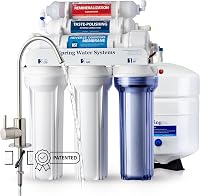
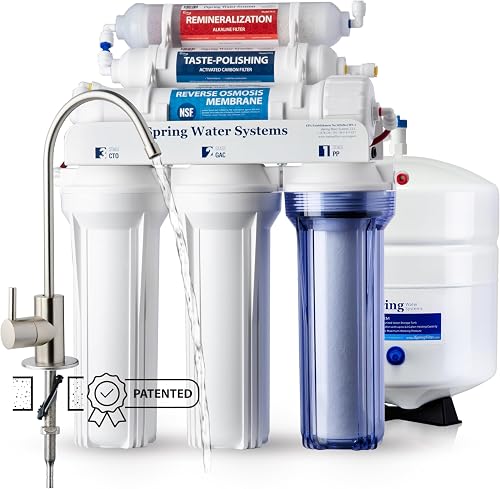
iSpring RCC7AK-BN NSF Certified: Best for fridge water and ice lines
- 75 GPD, 6-stage filtration
- Alkaline pH+ remineralization stage
- NSF/ANSI 58 certified system
- Storage tank and brushed nickel faucet
- Top-mounted faucet design
A tank fed under sink system with fridge adapter options and an alkaline stage for households that want filtered water at the sink and at the fridge.
Pros
- Fridge compatible design
- Transparent first-stage housing
- No electricity needed
Cons
- Under sink space needed
- Ice maker kit may be separate
This iSpring suits households that want one system for the sink faucet and the fridge line. It is a 75 GPD, 6-stage system with an alkaline pH+ stage, a storage tank and a brushed nickel faucet. iSpring says it is compatible with most fridges and notes an ice maker kit is available for purchase.
The top-mounted faucet design allows installation from above the counter. That helps in tight cabinets where reaching under the sink to tighten a nut is hard.
The transparent first-stage housing lets you see sediment build up before a change is due.
The 75 gallon rating means it can make up to 75 gallons per day under rated conditions. It runs without electricity, which suits cabinets with no outlet.
The convertible adapter fits 1/2 inch NPT and 3/8 inch compression fittings.
The trade-off is maintenance. The alkaline stage and extra hardware add parts to maintain.
If you prefer plain RO taste or a simpler schedule, the 5-stage iSpring below may be a cleaner fit. For fridge ice, the tank holds filtered water ready for fills.
iSpring RCC7-BN NSF Certified: Best for simple trusted under sink setup
- 75 GPD, 5-stage filtration
- NSF/ANSI 58 certified
- Brushed nickel faucet
- No power needed
- Tank included
A 5-stage version of the top pick without the alkaline stage, suited to buyers who want straightforward RO water for daily drinking and cooking.
Pros
- Straightforward 5-stage design
- Compact under sink fit
- Check valve helps prevent backflow
Cons
- No alkaline stage
- Tank takes cabinet space
This iSpring suits buyers who want a proven 5-stage setup without an alkaline stage. It is a 75 GPD system with NSF/ANSI 58 certification, a tank and a brushed nickel faucet.
The maker says filtration can reduce contaminants down to 0.0001 microns.
No power is needed, which helps in kitchens where the under sink area has no outlet. The compact design fits under most kitchen sinks.
A check valve helps prevent backflow, and the housing is made to resist impact. The three pre-filters protect the RO membrane from sediment, chlorine and chloramines before final polishing.
The listed maximum flow rate and supported TDS level help set expectations for daily use. A fine GAC final filter polishes taste for tea, coffee and ice cubes.
Push-to-connect fittings and O-rings simplify assembly and help seal joints without leaks. A clear manual and video resources support DIY fitting.
Against the top pick, you lose the mineral stage and the transparent housing detail and the brushed nickel top-mounted convenience. You gain a simpler path with fewer stages to track.
It is a strong choice when you want RO water for drinks, tea, coffee and ice without extra taste features.
APEC Water ROES-50: Best for compact 50 GPD systems
- 50 GPD, 5-stage filtration
- NSF certified 372 and 58
- Brushed nickel faucet
- Water tank included
- DIY quick connections
A slim 5-stage APEC system with filter set, tank and faucet in the box for homes that want certified RO water without a large cabinet footprint.
Pros
- Slim width
- Filter set included
- Quick connection fittings
Cons
- Lower daily output than 75 or 90 GPD picks
- Tank still needs space
This APEC suits homes that want a slim under sink system with the main parts in one box. It is a 50 GPD, 5-stage system that includes a filter set, tank, brushed nickel faucet and installation kit.
APEC says it is NSF certified for standards 372 and 58.
The 5.25 inch width helps in narrow cabinets. Quick connection fittings and colored tubing make setup easier to follow.
APEC recommends filter changes every 6 to 24 months based on incoming water quality. The system can be removed if you move.
The membrane squeezes water through a very fine barrier, which is why RO can reduce a wide list of dissolved impurities. APEC lists arsenic, chlorine, lead, fluoride and heavy metals among the contaminants addressed.
The included faucet gives you a dedicated tap even if the fridge line is the main goal.
The trade-off is output. At 50 GPD, it produces less per day than the 75 and 90 GPD picks.
For a fridge that makes a lot of ice, a higher-output tank system may be more comfortable. For daily drinking water, 50 GPD is often enough.
Waterdrop G3P600 Tankless Reverse Osmosis Water Filter: Best for fast tankless flow
- 600 GPD tankless system
- 8-stage filtration
- Smart display faucet
- 2:1 pure to drain ratio
- Requires under sink electricity
A tankless system built for fast dispensing and a small under sink footprint, with TDS and filter life shown on the faucet.
Pros
- Fast 600 GPD output
- Tankless design saves space
- Smart display faucet
Cons
- Needs electricity
- Fridge line setup needs care
This Waterdrop suits buyers who want tankless speed and a smart faucet. It produces 600 gallons per day with 8-stage filtration and a 2:1 pure to drain ratio.
The faucet shows TDS and filter life, which helps you plan changes.
The tankless design saves about 70% of under sink space compared with a tank layout. Filters change in seconds by twisting a used cartridge out and a new one in.
An 8 oz cup fills in about 8 seconds, according to Waterdrop. That speed suits busy mornings and filling bottles or pitchers at the sink.
Certifications listed include NSF/ANSI 58 for TDS reduction, NSF/ANSI 372 for lead-free material, and NSF 42 for chlorine, taste and odor. The 8-stage path is described as reducing TDS, chromium, PFAS, fluoride, arsenic, iron and calcium among other items.
A smart display faucet with a TDS monitor makes water quality visible at a glance.
The key trade-off is power. This system requires under sink electricity.
It also needs care if you plan a fridge line, because tankless flow and pressure differ from stored tank water. It is best when outlet access is easy and you value fast dispensing at the sink.
DREO Reverse Osmosis Water Filter System Countertop: Best for small countertop use
- 3L tank plus 1.1L pitcher
- 0.0001 micron RO membrane
- TDS and filter life monitor
- 3:1 pure to drain ratio
- Countertop, install-free
A compact countertop unit for 1 to 2 people who want RO water without plumbing, with real time TDS and filter reminders.
Pros
- No plumbing needed
- Compact footprint
- Auto-fill pitcher
Cons
- Small tank for large homes
- Not a direct fridge feed
This DREO suits 1 to 2 people who want RO water without plumbing. It has a 3L tank and a 1.1L autofill pitcher in a slim countertop footprint.
The 0.0001 micron RO membrane is tested by SGS to NSF/ANSI 58 standards, according to DREO.
Real time TDS and filter life monitoring remove guesswork. The 3:1 pure to drain ratio reduces waste compared with older tank systems.
The filter lasts 265 gallons and changes with a twist to install design. A slim footprint of about 14.5 by 6.7 by 13.4 inches helps it fit on a counter or in an office nook.
The auto-fill sensor provides hands-free refills, while the self-cleaning system auto-flushes internal tubes for upkeep. DREO lists reductions for lead, chromium, chlorine, PFOS and PFOA at 99 percent under lab conditions, plus 97 percent for fluoride.
The 3 liter tank plus pitcher suits daily use for a small household without repeated refills.
The main limit is fridge use. This is a countertop purifier for pouring, not a fixed line to a refrigerator.
If your fridge has a water and ice line, an under sink system will fit that job better. This pick wins for renters, offices and small kitchens.
APEC Water RO-90: Best for higher daily output
- 90 GPD, 5-stage filtration
- NSF certified 372 and 58
- WQA Gold Seal certified
- Lead-free chrome faucet
- Super capacity filters
A higher output APEC system for busy kitchens that want more daily RO capacity and larger filters for fewer early changes.
Pros
- 90 GPD output
- Large capacity filters
- JG Quick Connect fittings
Cons
- Larger tank and housing
- Manual water pressure operation
This APEC suits busy kitchens that want higher daily output. It is a 90 GPD, 5-stage system with super capacity filters and NSF certified filters.
APEC says it is WQA Gold Seal certified and can remove up to 99% of contaminants.
Larger filters mean fewer early change outs than smaller all-in-one cartridges. JG Quick Connect fittings help seal connections without extra lock clips.
The system includes a lead-free chrome faucet, tubing, drain saddle and wrenches. Stage one is sediment filtration, stages two and three are carbon blocks, stage four is the RO membrane, and stage five polishes residual taste.
The 90 gallon per day rating gives more buffer for households that fill bottles, pitchers and ice trays through the day. APEC notes testing for arsenic, chlorine, lead, fluoride and heavy metals.
The included parts cover a standard under sink fit, including feed water adapter and wrenches.
The trade-off is size and pressure. The tank and housings take more cabinet room than slim picks.
It runs on water pressure with a maximum feed pressure of 85 psi. For a fridge line, confirm pressure and line length before you choose this option.
DREO Reverse Osmosis Water Filter Countertop: Best for countertop with two pitchers
- 5 liter capacity
- 2 autofill pitchers
- 3:1 pure to drain ratio
- TDS and filter life monitor
- Self-cleaning, install-free
A larger countertop DREO unit with two pitchers for households that want portable RO water and easy refills away from the sink.
Pros
- Two pitchers included
- Larger 5L capacity
- Touch control and TDS meter
Cons
- Counter space needed
- Not a direct fridge feed
This DREO suits households that want a countertop system with more capacity and two pitchers. It has a 5 liter capacity and includes 2 autofill pitchers for easy sharing.
The 7-in-1 RO filter is tested by SGS to NSF/ANSI 58 standards, according to DREO.
A 3:1 pure to drain ratio helps limit waste. TDS, filter life and touch controls are built in.
The self-cleaning system auto-flushes internal tubes, which helps with daily upkeep. The body uses a footprint of about 15.7 by 6.7 by 13.4 inches, so it needs a clear stretch of counter.
Two pitchers help when one is in the fridge and one is in use. That setup suits couples, small families and shared workspaces where people fill bottles at different times.
The built-in TDS meter shows raw and pure water readings, so you can see when a filter change is near instead of guessing by taste.
Like the smaller DREO, this unit is not built to feed a refrigerator line. It is best for counters where you pour water into bottles, pitchers or coffee makers.
If fridge ice is your main goal, choose an under sink tank system instead.
Bluevua RO100ROPOT Countertop Reverse Osmosis Water Filter: Best for portable glass carafe design
- 12 liter capacity
- 5-stage RO filtration
- Remineralization filter
- Borosilicate glass carafe
- No installation required
A portable countertop RO system with a glass carafe and remineralization for renters or small kitchens that cannot add plumbing.
Pros
- Glass carafe design
- Portable and plug in
- Filter life monitor
Cons
- Needs power outlet
- Slower 0.26 liters per minute flow
This Bluevua suits renters and small kitchens that need portable RO water. It has a 12 liter capacity and a borosilicate glass carafe instead of a plastic pitcher.
No plumbing or installation is required, so you plug it in and fill it.
Five-stage filtration includes a remineralization filter. Bluevua says filters last 12 to 24 months and the monitor shows service life and water quality.
The 2:1 pure to drain ratio helps save water. The system enters power-saving standby when not in use.
A glass carafe reduces the risk of secondary pollution from plastic and gives a cleaner look on the counter. The supported TDS level is listed at 1000 ppm.
Included parts list a power adapter, cleaning brush, user guide and four filters plus a mineral filter, so setup is complete out of the box.
The trade-off is speed and fridge use. Flow is 0.26 liters per minute, so it is slower than tankless under sink systems.
It is also a countertop unit, not a fixed fridge feed. It works well for healthy drinking water on a counter, but not for a refrigerator ice line.
Express Water RO5DX: Best for value under sink package
- 50 GPD, 5-stage filtration
- NSF certified 372 and 58
- 4 gallon tank
- Extra filter set included
- No electricity required
A complete 5-stage under sink package with extra filters and a leak detector for buyers who want first year use covered in one box.
Pros
- Extra filter set included
- Leak detector included
- Compact 5 in width
Cons
- Tank capacity is 3.2 gallons usable
- Drain discharge varies with pressure
This Express Water suits buyers who want a complete under sink package at a mid-range tier. It is a 50 GPD, 5-stage system with a 4 gallon tank, extra filter set and leak detector included.
It is NSF certified for standards 372 and 58.
No electricity is required, and the 5 inch width fits compact cabinets. Express Water notes the tank holds 3.2 gallons of usable water.
The system can be wall mounted, cabinet mounted or freestanding. A fast flow faucet at 0.8 gpm helps with filling glasses and pitchers at the sink.
The maker lists reductions of up to 99.99 percent for lead, chlorine, fluoride, PFAs, calcium and arsenic among other items. It is also certified by an independent lab to NSF standard.
Included parts cover setup and the first year of use, and a filter housing wrench is in the box.
For fridge use, plan the tubing run with care. Express Water says you may need added tubing or a delivery pump if the system is far from the fridge.
Drain discharge is 1 to 3 gallons per gallon produced, depending on pressure and water quality. The system works on 40 to 80 psi, so check pressure before you commit.
How we compared these fridge RO systems
We compared output, storage, stages, certifications, included parts, footprint, power needs and fridge connection notes. Tank systems were weighed for steady fridge fills.
Tankless and countertop systems were weighed for speed, space and portability.
We checked maker claims for contaminant reduction and filter life. We also looked at what is in the box, because a fridge line may need extra tubing or an ice maker kit.
A low headline output can still work well if the tank stores enough water.
For broader context, see best reverse osmosis systems for well water if your home uses a well. A [What Is a Water Dispenser System?
The Quick Version](/what-is-a-water-dispenser-system/) page also helps if you are comparing storage and dispensing styles.
How scoring worked
Our score gives more weight to fridge-ready setups, clear certifications and complete included parts. Output matters, but only in context with tank size and pressure needs.
A 600 GPD tankless rating does not outrank a 75 GPD tank for ice making if the fridge needs stored water.
We also noted footprint and power needs because those can decide whether a system fits at all. A countertop unit may score well for renters even though it cannot feed a fridge.
That is why the verdict names a pick by use case rather than by one number alone.
Can a reverse osmosis system for the fridge use a tank?
Yes, a tank is the most common way to feed a fridge water and ice line. The tank stores filtered water so the fridge can fill glasses and ice trays without waiting for the membrane to make water on demand.
Tank systems need cabinet space for the tank and housings. They also need a drain connection for reject water.
That setup is normal for under sink RO systems and is described in most manuals.
Tank size and usable volume are not the same number. A 4 gallon tank may hold 3.2 gallons of usable water, and that usable figure is what matters for fridge fills.
Check that detail before you judge how often ice making will outrun supply.
Is a tankless reverse osmosis system better for a fridge?
Tankless systems are better for fast sink water and small cabinets. They are not always better for fridge ice making, because the fridge may need steady flow on a schedule.
A tankless unit also needs electricity under the sink. If your kitchen has no outlet there, installation gets harder.
A tank system with no power needed can be simpler in that space.
Waterdrop's 600 GPD output is strong for dispensing. For a fridge line, confirm that the maker allows that connection and that pressure stays in range.
If not, a tank system is the safer match.
What is a reverse osmosis system in a fridge?
A reverse osmosis system in a fridge usually means an under sink RO unit with a line running to the fridge. The fridge then uses that filtered water for its dispenser and ice maker.
Some fridges have their own built-in filter. That filter is different from a full RO system.
An RO system removes far more dissolved solids and contaminants than a basic carbon filter.
If you already have a fridge filter, check whether it adds taste or just reduces chlorine. RO water is a step beyond that for many buyers.
It can taste cleaner for coffee, tea and ice.
How do I connect an RO system to a refrigerator?
First, measure the run from the RO system to the fridge inlet. Add extra length for bends and for the fridge moving forward for service.
Short, direct runs are easier to keep pressure steady.
Second, confirm the tubing size. Many fridge lines use 1/4 inch tubing, but check your model.
The iSpring top pick notes a convertible adapter for 1/2 inch NPT and 3/8 inch compression fittings.
Third, shut off water, connect the line and flush before you use it for ice. Discard the first ice cubes after a new connection.
That helps clear any loose particles from the line.
If you want a black finish for a matching faucet, our best reverse osmosis system black guide covers that style path. Finish choice should come after fit and output, not before.
What size RO system do I need for a fridge?
A 50 GPD system fits many homes that use fridge water for drinks and modest ice. A 75 GPD system adds headroom for larger families.
A 90 GPD system suits heavy ice use or more people at home.
Tank size matters too. A 3.2 gallon usable tank can handle regular fills, but frequent ice making may empty it faster.
Larger tanks give more buffer, yet they need more cabinet space.
If your home uses well water, filter choice changes. Read our best reverse osmosis systems for well water guide before you order for a well.
Well water may need pre-treatment that city water does not.
Which RO system should I avoid for a refrigerator line?
Avoid countertop units if your main goal is a fixed fridge line. They are made for pouring and pitcher filling.
They do not store water in a tank for the fridge dispenser.
Also avoid a system that needs electricity if your cabinet has no outlet. Tankless systems are good, but power access is not optional.
A no-power tank system may be easier to install in that kitchen.
Avoid undersizing the line run as well. A long or kinked tube can starve the fridge of pressure even when the system rating looks fine.
Measure first and add length for service access.
For commercial needs, a home system may not be enough. Our best reverse osmosis system for commercial use guide covers larger setups.
A whole house option is different again, and our reverse osmosis system whole house page explains that path.
Verdict: best reverse osmosis system for refrigerator use
Pick the iSpring RCC7AK-BN if you want the best all-around fridge and sink setup with a tank and alkaline stage. Pick the iSpring RCC7-BN if you want the same proven base without the alkaline stage.
Pick Waterdrop G3P600 if fast tankless flow and a smart faucet matter most.
Pick APEC ROES-50 or APEC RO-90 if you prefer APEC's filter sets and fittings. Pick DREO or Bluevua countertop units if you rent or cannot change plumbing.
Pick Express Water RO5DX if you want extra filters and a leak detector in the box.
For most homes with a fridge ice line, a tank fed under sink system remains the safest match. It stores water for the fridge, runs without power in many cases, and gives you a dedicated faucet for testing taste.
Choose output based on ice habits, then check footprint and pressure.
For a different brand path, our best apec reverse osmosis system guide compares APEC models in more depth. That extra detail helps if you have already narrowed your choice to that brand.
Our top 3 picks at a glance
-
1
Best for fridge water and ice lines
iSpring RCC7AK-BN NSF Certified
9.7/10 our score
See it on Amazon -
2
-
3
Frequently asked questions
Can a reverse osmosis system feed a refrigerator water line?
Yes, many under sink RO systems can feed a fridge water and ice line when the tubing, adapter and pressure setup suit your model. Check that the system includes or allows a fridge connection before you plan the run.
Keep the line as short and direct as you can.
Is a tankless RO system better for a fridge than a tank system?
Tankless systems give fast flow and save space, but they need electricity and steady pressure. Tank systems store filtered water for steady fridge fills and ice making.
Choose based on your outlet access and how much ice you make.
Can a countertop RO system supply a refrigerator?
Most countertop RO units are made for pouring or pitcher filling, not for a fixed fridge line. They suit renters and small kitchens where plumbing changes are not possible.
For a fridge line, an under sink system is usually the practical choice.
How often should RO filters be changed?
Change pre-filters by the maker schedule, often about every 6 months, and the RO membrane less often. Express Water and APEC both note replacement timing based on water quality and use.
A monitor or clear housing helps you check condition.
What should I check before connecting RO water to a fridge?
Measure the distance from the system to the fridge and check cabinet space, water pressure and outlet access. Confirm the tubing size your fridge needs and whether an ice maker kit is required.
Shut off water before you connect any line.