9 Best Reverse Osmosis Systems (November 2026)
The best reverse osmosis systems for home include the iSpring RCC7AK-BN NSF Certified for most home kitchens, the iSpring RCC7-BN NSF Certified for a classic 5-stage setup, and the APEC Water ROES-50 for straightforward APEC filtration.
On this page (6 sections)
- How we chose the best reverse osmosis systems
- The best reverse osmosis systems for home use
- How do you choose a reverse osmosis system for home use?
- Which reverse osmosis features matter most?
- How should you plan reverse osmosis installation and care?
- What is the best reverse osmosis system for your home?
The best reverse osmosis system for most homes is the iSpring RCC7AK-BN, with NSF/ANSI 58 certification, 6-stage filtration, 75 GPD capacity and an alkaline remineralization stage. That mix suits typical kitchen use.
Choose the Waterdrop for a tankless design, or DREO for installation-free countertop filtration. The right choice often comes down to space and whether you want plumbing work.
We compared under-sink, tankless and countertop systems. Each format changes how water is stored, how fast it reaches the faucet and how much room you need for filters and tanks.
Your cabinet space, water demand, access to electricity and preference for a tank or no tank all matter. A large household may value high daily capacity, while a small household may prefer a compact unit that is easier to maintain.
A dedicated kitchen faucet suits daily cooking and drinking. A countertop unit can move between rooms and may suit a rental or office better.
Day to day care matters as much as the headline specs. Filters need changing on schedule, and easy access to housings, tubing and a storage tank shapes how simple each job feels.
For background on filter stages, membranes and installation, read our drinking water filter guide. For a smaller cabinet, see our small reverse osmosis system reviews and check dimensions and door clearance before choosing a tank based system.
Our picks at a glance
-
1
-
2

-
3

- 4
 Check it
Waterdrop G3P600 Tankless Reverse Osmosis Water Filter
Best for tankless high-volume use - 5
 Check it
DREO Reverse Osmosis Water Filter System Countertop
Best for 1–2 people - 6
 Check it
Aquatic Life RO Buddie 4-Stage Aquarium Water
Best for aquarium water - 7
 Check it
Bluevua RO100ROPOT Countertop Reverse Osmosis Water Filter
Best for glass-carafe countertop use - 8
 Best for a complete no-power kitCheck it
- 9
 Check it
DREO Reverse Osmosis Water Filter Countertop
Best for gray countertop styling
How we chose the best reverse osmosis systems
The best reverse osmosis systems balance filtration format, capacity, setup needs and day to day maintenance. No single model fits every kitchen, so we looked at how each system is meant to be used at home.
We checked stated stages, certifications, tank or tankless design, power source, capacity and included components. Those details separate a complete drinking water setup from a unit that may need extra parts or careful planning.
Certification was one point of comparison, but not the only one. We also looked for a clear filter life, a visible way to check filter condition and replacement parts that are easy to identify.
We gave the highest scores to systems that fit common home needs with clear information about filtration and maintenance. A system can score well for no power needed, a storage tank included or a compact size.
A more advanced model can score well for high daily output or a display that tracks filter life.
We did not treat a higher stage count as an automatic win. Extra stages add housings, filters and connections that you will need to service later.
A countertop system avoids plumbing but needs a permanent spot near power. Counter space, cord access and reservoir size affect daily use.
An under-sink system keeps the counter clear, but you must measure the cabinet and plan faucet and drain connections. You also need room to open housings, swap filters and check for leaks.
Tankless models save space by removing the storage tank, but they rely on electricity and need enough cabinet height and width. Color coded tubing, push to connect fittings, a transparent first stage housing and a built in TDS or filter life display can make setup and routine checks simpler.
For well water or higher TDS, stated pressure ranges and supported water levels matter more than a long feature list. We noted those limits so you can check them against your own water before you choose.
| Product | Best for | Installation | Capacity | Stages | Our score |
|---|---|---|---|---|---|
| iSpring RCC7AK-BN NSF Certified | most home kitchens | Under sink | 75 gallons per day | 6 | 9.7 |
| iSpring RCC7-BN NSF Certified | a classic 5-stage setup | Under sink | 75 gallons per day | 5 | 9.6 |
| APEC Water ROES-50 | straightforward APEC filtration | Under sink | 50 gallons per day | 9.5 | |
| Waterdrop G3P600 Tankless Reverse Osmosis Water Filter | tankless high-volume use | Under sink | 600 gallons per day | 9.5 | |
| DREO Reverse Osmosis Water Filter System Countertop | 1–2 people | Countertop | 3 liters | 9.3 | |
| Aquatic Life RO Buddie 4-Stage Aquarium Water | aquarium water | 50 gallons per day | 4 | 9.1 | |
| Bluevua RO100ROPOT Countertop Reverse Osmosis Water Filter | glass-carafe countertop use | Countertop | 8.9 | ||
| Express Water RO5DX | a complete no-power kit | Under sink | 50 gallons per day | 8.4 | |
| DREO Reverse Osmosis Water Filter Countertop | gray countertop styling | Countertop | 3 liters | 8.2 |
The best reverse osmosis systems for home use
The iSpring RCC7AK-BN is the strongest all-around choice, while the RCC7-BN and APEC ROES-50 offer simpler tank-based alternatives. Waterdrop is the high-capacity tankless option, and the countertop picks suit renters, offices and kitchens where plumbing changes are not practical.
iSpring RCC7AK-BN NSF Certified: Best for most home kitchens
- 75 GPD capacity
- 6-stage filtration
- NSF/ANSI 58 certified
- Alkaline remineralization stage
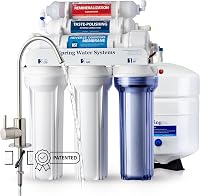
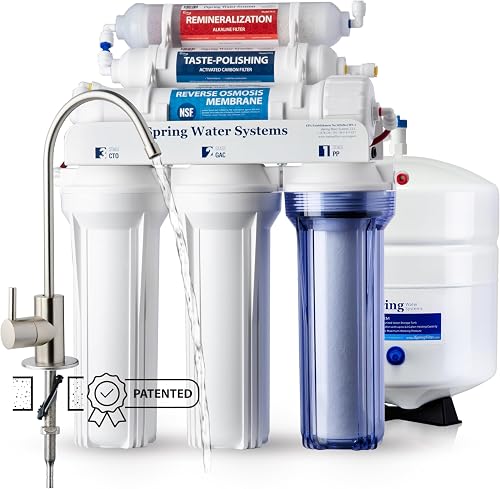
The iSpring RCC7AK-BN combines high daily capacity, full-system NSF/ANSI 58 certification and an alkaline mineral stage. Its top-mounted faucet design is useful when access below the sink is limited.
Pros
- Alkaline remineralization
- Transparent first-stage housing
- No electricity needed
Cons
- Needs under-sink space
- Replacement filters have different service intervals
The iSpring RCC7AK-BN is the best reverse osmosis system for most home kitchens because its 75 GPD capacity and 6-stage design cover a wide range of daily drinking and cooking needs. Its NSF/ANSI 58 certification applies to the entire filtration system.
The alkaline AK stage adds minerals after reverse osmosis. That makes this a useful pick if you prefer a remineralization stage instead of a basic RO output.
For a comparison, see alkaline water and reverse osmosis.
Its transparent first-stage housing lets you view sediment buildup before changing the filter. The top-mounted faucet fastener also helps when tightening hardware from below the sink would be awkward.
The system includes a brushed nickel faucet, storage tank and extra tool set. It does not need electricity, and iSpring identifies filter sets with 6-month, 1-year, 2-year and 3-year intervals.
Choose it for a permanent kitchen setup with a dedicated faucet. If you want a compact countertop unit or have no room for a storage tank, consider DREO or Bluevua instead.
iSpring RCC7-BN NSF Certified: Best for a classic 5-stage setup
- 75 GPD capacity
- 5-stage filtration
- NSF/ANSI 58 certified
- No power needed
The RCC7-BN uses a conventional 5-stage under-sink design with a tank, faucet and 75 GPD capacity. It suits buyers who want a certified system without a remineralization stage.
Pros
- Certified filtration system
- Transparent sediment housing
- DIY-friendly fittings
Cons
- Requires tank and cabinet space
- No remineralization stage
The iSpring RCC7-BN is a good fit if you want 75 GPD capacity and a familiar 5-stage under-sink layout. It uses reverse osmosis, activated carbon and carbon block filtration, with no power needed.
That no power design suits kitchens where an outlet under the sink is hard to reach. Water pressure drives the system, so setup means connecting the feed line, faucet, drain and storage tank.
The system includes housings, filters, tubing, a faucet and mounting bracket. Check that the faucet hole and drain route are ready before you start a DIY installation.
Its transparent first-stage housing makes sediment buildup easy to see early. That helps you change filters before flow drops or later filters wear faster.
The 3 pre-filters protect the RO membrane from particles and chemicals such as chlorine. The membrane handles fine reduction, and the fine GAC final filter polishes taste before the faucet.
Its stated maximum supported TDS level is 750 ppm, and it operates at up to 3.4 liters per minute. The tank and housings need cabinet space, with room left for filter changes.
Choose this model for certified under-sink filtration without an alkaline stage. For remineralized water, the RCC7AK-BN is the closer match.
APEC Water ROES-50: Best for straightforward APEC filtration
- 50 GPD capacity
- 5-stage filtration
- NSF/ANSI 58 certification
- Tank and installation kit included
The APEC ROES-50 is a 5-stage under-sink system with a 50 GPD capacity and a tank. Its colored tubing and quick connections are aimed at simpler setup and maintenance.
Pros
- Complete under-sink kit
- Large-capacity filters
- DIY-friendly fittings
Cons
- Lower capacity than the 75 GPD picks
- Needs tank space
The APEC Water ROES-50 suits homes that want a 50 GPD, 5-stage under-sink system with a tank and installation kit. It includes one filter set, a brushed nickel faucet, a tank, an owner manual and the installation parts.
Its operating pressure range is 40–85 psi, so check your home's water pressure before installation. APEC identifies NSF certifications for the system and says it reduces up to 99% of impurities.
The ROES-50 measures 15.5 x 5.25 x 17 in, giving it a narrower stated width than many tank-based systems. You still need room for the tank and access for filter changes.
APEC recommends replacing filters every 6–24 months based on incoming water quality, while the listed filter life cycle is 6 months. Plan for regular maintenance rather than waiting for taste changes.
Choose the ROES-50 for a straightforward APEC setup. For a higher stated daily capacity, move up to either iSpring system.
Waterdrop G3P600 Tankless Reverse Osmosis Water Filter: Best for tankless high-volume use
- 600 GPD capacity
- 8-stage filtration
- 2:1 pure-to-drain ratio
- Smart display faucet
The Waterdrop G3P600 uses a tankless cabinet, smart display faucet and 600 GPD capacity. It saves under-sink space compared with a tank-based layout but requires electricity.
Pros
- High capacity
- Smart TDS and filter-life display
- Fast filter changes
Cons
- Requires under-sink electricity
- Needs cabinet measurement before installation
The Waterdrop G3P600 is the best reverse osmosis system here for high-volume tankless use. Its 600 GPD capacity, 8-stage filtration and 2:1 pure-to-drain ratio suit households that use filtered water throughout the day.
The smart display faucet shows TDS and filter life. The tankless cabinet saves under-sink storage space, and Waterdrop says its filters can be changed in 3 seconds without tools or moving the system.
This system requires under-sink electricity. It measures 18.12 x 5.67 x 17.72 in, so measure the cabinet before ordering and leave room for the faucet and drain connection.
The system includes 3 pre-installed filters, a silver smart display faucet and a user manual. Its maximum flow rate is 0.42 GPM, and its operating pressure is listed as 87 psi.
Choose it when a tank would take up too much room and an outlet is available. For a no-power installation, choose iSpring, APEC or Express Water.
DREO Reverse Osmosis Water Filter System Countertop: Best for 1–2 people
- 3 L capacity
- 7-in-1 filtration
- 3:1 pure-to-drain ratio
- Auto-fill pitcher
This DREO countertop system avoids plumbing and includes a 3 L tank plus a 1.1 L auto-fill pitcher. Its footprint suits smaller kitchens, bedrooms, offices or daily use by 1–2 people.
Pros
- No installation
- Self-cleaning system
- Compact footprint
Cons
- Small tank capacity
- Counter space required
The DREO Reverse Osmosis Water Filter System Countertop is the best match for 1–2 people who want no plumbing. It has a 3 L tank, a 1.1 L auto-fill pitcher and a footprint of about 14.5 x 6.7 x 13.4 in.
Its 7-in-1 RO filtration uses a 0.0001 μm membrane. DREO says it reduces lead, chromium, chlorine, PFOS, PFOA and fluoride under laboratory conditions, and the system was tested by SGS against NSF/ANSI 58 standards.
The built-in display monitors raw and filtered-water TDS and shows filter-life reminders. A self-cleaning function flushes internal tubes, while the twist-in filter design keeps changes simple.
The stated filter life is 265 gallons, or about 1,000 L. The 3:1 pure-to-drain ratio also gives this countertop model a clear water-use advantage over systems with less favorable ratios.
Choose it when you rent, do not want to drill for a faucet or have limited under-sink access. Its 3 L tank is less suitable for a large household that fills many containers at once.
Aquatic Life RO Buddie 4-Stage Aquarium Water: Best for aquarium water
- 50 GPD membrane
- 4-stage RO/DI filtration
- Color-changing DI resin
- For fish tanks and fountains
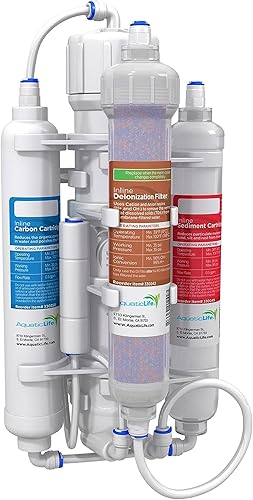
The Aquatic Life RO Buddie is designed for aquarium and fountain water, not drinking water. Its sediment, carbon, RO membrane and color-changing DI stages target low-TDS water for sensitive aquatic life.
Pros
- RO/DI filtration
- Color-changing resin
- 50 GPD membrane
Cons
- Not for drinking water
- Filter life depends on water use and quality
The Aquatic Life RO Buddie is the best choice here for aquarium water, not drinking water. Its 4-stage RO/DI layout is built for fish tanks, fountains, humidifiers and other non-drinking uses.
The system uses a sediment filter to catch dirt such as sand and silt. A carbon block helps remove chlorine and odors, while the RO membrane reduces most TDS before water passes through color-changing deionizing resin.
The resin changes from blue to tan as it is used, giving you a visual replacement signal. Aquatic Life says sediment and carbon filters typically last 3–6 months, RO membranes last 1–2 years depending on use, and DI resin should be replaced when its color changes.
The unit has a 50 GPD membrane and measures 14 x 4 x 7.5 in. Its compact size can help when you need RO/DI water for an aquarium setup.
Do not choose it for kitchen drinking water. Use one of the certified household systems above or a countertop drinking-water filter instead.
Bluevua RO100ROPOT Countertop Reverse Osmosis Water Filter: Best for glass-carafe countertop use
- 12 L capacity
- 5-stage filtration
- Remineralization filter
- 2:1 pure-to-drain ratio
The Bluevua RO100ROPOT is a countertop system with a borosilicate glass carafe, 12 L capacity and a remineralization stage. It suits buyers who want portable filtration without plumbing.
Pros
- Glass carafe
- Long filter cycle
- Filter-life monitor
Cons
- Needs countertop space
- Requires electricity
The Bluevua RO100ROPOT is the best countertop choice for buyers who want a borosilicate glass carafe and remineralization. Its 12 L capacity is larger than the 3 L DREO models, which can reduce refill frequency.
The 5-stage system includes a remineralization filter and a 2:1 pure-to-drain ratio. Bluevua says the system filters 99.9% of possible contaminants and adds minerals after RO filtration.
A filter-life monitor shows service information and water quality. The listed filter cycle is 24 months, and the package includes the glass carafe, power adapter, cleaning brush, user guide, 4 filters and a mineral filter.
This is a corded electric countertop system, measuring 10.9 x 15.4 x 14.3 in. The glass carafe may appeal to buyers who prefer borosilicate glass over a plastic water container.
Choose it for portable countertop filtration with a larger capacity. If you want no electricity, choose a tank-based under-sink model instead.
Express Water RO5DX: Best for a complete no-power kit
- 50 GPD capacity
- 5-stage filtration
- 4-gallon tank
- Extra filter set and leak detector
The Express Water RO5DX is a 5-stage, 50 GPD under-sink system with a 4-gallon tank. The package includes an extra filter set and leak detector, which can simplify first-year setup.
Pros
- No electricity
- Extra filter set
- Leak detector included
Cons
- Needs tank space
- Operating pressure may require checking
The Express Water RO5DX suits buyers who want a complete no-power under-sink kit. It has 5-stage filtration, a 50 GPD capacity and a 4-gallon tank.
The package includes the RO5DX system, an extra filter set and an owner manual. Express Water also identifies a leak detector and a chrome faucet as part of the system, along with the filters needed for setup and first-year use.
The unit measures 14 x 5 x 15 in and has a maximum flow rate of 0.8 GPM. It operates at 40–80 psi, so water pressure may affect installation and performance.
Express Water describes the system as suitable for kitchens, apartments, homes, offices, RVs and other locations. Longer tubing runs or refrigerator connections may need additional planning.
Choose it when you value included maintenance parts and no electrical connection. For a lower-profile cabinet, compare it with the tankless Waterdrop.
DREO Reverse Osmosis Water Filter Countertop: Best for gray countertop styling
- 3 L capacity
- 3:1 pure-to-drain ratio
- TDS and filter-life display
- Auto-fill pitcher
This gray DREO countertop system has a 3 L capacity, auto-fill pitcher and installation-free design. It fits the same compact format as the white DREO model while supporting a higher stated maximum TDS level.
Pros
- No plumbing
- Self-cleaning design
- Compact size
Cons
- Small tank capacity
- Requires countertop space
The gray DREO Reverse Osmosis Water Filter Countertop is the best fit for installation-free filtration with a gray finish. It has a 3 L capacity, an auto-fill pitcher and the same compact 14.5 x 6.7 x 13.4 in format as the white DREO model.
The system uses RO filtration and includes a TDS meter, filter-life indicator and touch control. DREO describes a 3:1 pure-to-drain ratio and a self-cleaning design for the internal water path.
Its supported maximum TDS level is 1200 ppm, higher than the white DREO model's stated 500 ppm. The package includes the DREO RO Water Filter 112 body, one RO filter and one auto-fill water pitcher.
This model requires countertop space but does not require a separate faucet or under-sink plumbing. The 3 L tank is best for personal use or a small household rather than heavy all-day demand.
Choose it when the gray model fits your kitchen better or when you want a simple countertop setup. For a glass carafe and larger capacity, choose Bluevua.
How do you choose a reverse osmosis system for home use?
Choose a reverse osmosis system for home use by matching the format to your space first. Under-sink systems keep the counter clear, countertop systems avoid plumbing, and tankless systems save cabinet space but need electricity.
Should you choose an under-sink or countertop system?
Choose under-sink filtration when you want a dedicated faucet and have room for a tank, filters and drain tubing. The iSpring, APEC and Express Water models all use this format.
Choose countertop filtration when you rent, cannot modify the sink or want a portable setup. DREO avoids plumbing, while Bluevua adds a glass carafe and 12 L capacity.
Our guide to best reverse osmosis systems for apartments covers space and installation limits in more detail.
Is a tankless reverse osmosis system better?
A tankless system is better when cabinet space and fast access matter more than a no-power setup. The Waterdrop G3P600 has a 600 GPD capacity, saves under-sink space and includes a smart display faucet.
Tank-based systems can be a better fit when you want a simpler installation with no electrical connection. Measure the cabinet, confirm the outlet location and plan access to filters before choosing.
Do you need remineralization?
A remineralization stage can suit buyers who prefer minerals added after RO filtration. The iSpring RCC7AK-BN and Bluevua RO100ROPOT include remineralization, while the standard iSpring RCC7-BN and APEC ROES-50 use conventional RO layouts.
Read our comparison of reverse osmosis vs water softener if your main concern is hard water, scale or whole-home treatment rather than drinking water.
What if your home uses well water?
Well water may need a system chosen around its source-water conditions, pressure and contaminant concerns. The Express Water RO5DX supports a stated range of 40–80 psi, while the APEC ROES-50 lists 40–85 psi.
For a more focused comparison, see our guide to the best reverse osmosis systems for well water. Check the system's supported water conditions before installation.
Which reverse osmosis features matter most?
The most useful features are clear filter-change signals, accessible replacement filters, a suitable capacity and a format that matches your installation space. A higher stage count alone does not decide which system fits your home.
Look for a transparent first-stage housing if you want to see sediment buildup. The iSpring systems include this feature, while Waterdrop and DREO provide electronic filter-life or TDS information.
Consider the water-to-drain ratio if water use matters to you. Waterdrop and Bluevua list a 2:1 pure-to-drain ratio, while both DREO countertop models list a 3:1 ratio.
For a black finish, see our guide to the best black reverse osmosis systems. If you prefer a specific brand, compare the best iSpring reverse osmosis system and best APEC reverse osmosis system guides.
How should you plan reverse osmosis installation and care?
Plan installation around cabinet clearance, water pressure, faucet access, drain routing and filter replacement space. Follow the system instructions, check every connection for leaks and replace filters at the stated service interval.
Under-sink systems may connect to a refrigerator or ice maker, but the route can require extra tubing or a separate kit. The iSpring RCC7AK-BN description identifies refrigerator compatibility and an available ice maker kit.
If you want to learn about a dedicated in-house setup, read what is an in-house water dispenser. For a comparison of home and business systems, see Residential vs Commercial Water Dispenser: What Matters.
Buyers who need business-scale filtration should review the best reverse osmosis system for commercial use. RV owners can compare the best reverse osmosis system for RV, while refrigerator owners can see the best reverse osmosis system for refrigerator.
For special installation needs, compare systems without a separate faucet in our guide to the best reverse osmosis system without faucet. If ultraviolet treatment matters, see the best reverse osmosis system with UV.
You can also compare best reverse osmosis systems under sink models, systems for fluoride in the best reverse osmosis water filter fluoride guide, or units with mineral stages in our best reverse osmosis system with remineralization roundup.
What is the best reverse osmosis system for your home?
The best reverse osmosis system for your home depends on the installation decision you make first. Start with the space you have, the water you use each day and whether you want a tank, a tankless unit or a countertop setup.
Pick the iSpring RCC7AK-BN for the strongest all-around under-sink combination, the Waterdrop G3P600 for tankless capacity, or DREO for installation-free countertop filtration. Each one covers a different need, from a permanent kitchen faucet to a portable unit for a smaller space.
If cabinet depth is tight, check the size of tank based models before you commit. A unit that fits on paper can still be awkward if the doors, pipes or cleaning supplies take up the room you need for filters.
If power is not available under the sink, a no power under-sink system may be simpler than a tankless model. If an outlet is close by and space matters most, a tankless design can keep more of the cabinet free.
For renters or anyone who cannot drill for a faucet, a countertop system avoids plumbing changes. The trade off is counter space, a power cord and a smaller reservoir that needs refilling more often.
Choose the Aquatic Life RO Buddie only for aquarium and fountain water. It is built around RO and DI filtration for sensitive aquatic setups, not for kitchen drinking water.
For a glass carafe, larger countertop capacity and remineralization, choose the Bluevua RO100ROPOT. That combination suits buyers who want portable filtration with a bigger tank than the compact 3 L models.
Before you order, measure the cabinet or counter, confirm the power source and check the filter change routine. Those three checks will narrow the list faster than stage counts alone.
Our top 3 picks at a glance
-
1
-
2
-
3
Frequently asked questions
What is the best reverse osmosis system for home use?
The iSpring RCC7AK-BN is the best reverse osmosis system for most homes in this comparison because it combines 75 GPD capacity, 6-stage filtration, NSF/ANSI 58 certification and alkaline remineralization.
Choose a tankless Waterdrop system if cabinet space matters, or a countertop DREO if you want to avoid plumbing.
Are reverse osmosis systems worth it?
A reverse osmosis system can make sense when you want filtered drinking water from a dedicated faucet, refrigerator connection or countertop unit. Under-sink systems need cabinet space and filter changes, while countertop systems need counter space and electricity.
Compare water use, installation and replacement-filter access before choosing.
What is the difference between tank and tankless reverse osmosis?
Tank systems store filtered water for use at the faucet, while tankless systems filter water as needed. Tankless models can save cabinet space, but they need electricity and may require more careful cabinet measurements.
A tank system may suit a home that wants a simpler no-power setup.
Can reverse osmosis water go to a refrigerator?
Some under-sink reverse osmosis systems can connect to a refrigerator or ice maker, but the tubing route and required kit depend on the system and kitchen layout. The iSpring RCC7AK-BN description says it works with most refrigerators and identifies an ice maker kit as an available accessory.
Measure the route before installation.
Is the Aquatic Life RO Buddie safe for drinking water?
No. Aquatic Life states that the RO Buddie is not for drinking water.
It is an RO/DI system for aquariums, fountains, humidifiers and similar uses, with a color-changing deionizing resin stage.
Choose a drinking-water system from the other picks for kitchen use.