Alkaline vs Reverse Osmosis Water: Differences (November 2026)
Reverse osmosis removes more dissolved contaminants, while alkaline filtration adds minerals back after RO. Choose based on water quality, mineral preference, maintenance and whether you need UV protection.
On this page (11 sections)
- Alkaline vs reverse osmosis water: what is the difference?
- Is reverse osmosis water alkaline?
- How do filtration and remineralization work together?
- Should you choose alkaline remineralization or standard RO?
- Does UV filtration change the choice?
- Which system is easiest to install?
- Do alkaline and RO systems waste water?
- How does RO compare with distilled water?
- Is reverse osmosis water bad for you?
- What else should you filter from drinking water?
- Which alkaline vs reverse osmosis water system should you choose?
Reverse osmosis removes more dissolved contaminants, while alkaline filtration adds minerals back after RO. The best choice depends on filtration, mineral content, pH, maintenance or added UV protection.
Alkaline and reverse osmosis describe different parts of a system. Reverse osmosis is a filtration method, while alkaline usually refers to higher pH water or minerals added after filtration.
That distinction matters because a system can be both alkaline and RO. The alkaline part usually comes after the membrane, when a separate stage adds minerals back into treated water.
Standard RO focuses on reducing dissolved substances. Alkaline RO tries to reduce those substances and then restore a mineral profile that some households prefer for taste.
pH is only part of the decision. Source water quality, the contaminants you want reduced and final taste all shape whether remineralization is worth the extra stage.
Maintenance also changes with an added alkaline stage. You still need to replace pre-filters and the RO membrane on schedule, and the mineral stage becomes another part to check.
Power needs can matter as much as pH. Some systems here run without electricity, while a UV model needs a power connection, so check the sink layout and nearby outlet first.
This comparison covers 4 under-sink systems from iSpring. We checked filtration stages, certifications, power needs, faucet designs and remineralization features.
The lineup includes systems with and without an alkaline stage, plus one with UV. That range helps you match a system to a specific concern instead of buying on the word alkaline alone.
Use the sections below to work through the trade-offs in order. You will see how filtration and remineralization fit together, and when standard RO or UV changes the choice.
Also check cabinet space, faucet style and filter access before you decide. A system must fit your sink and plumbing, not only your water goals.

Alkaline vs reverse osmosis water: what is the difference?
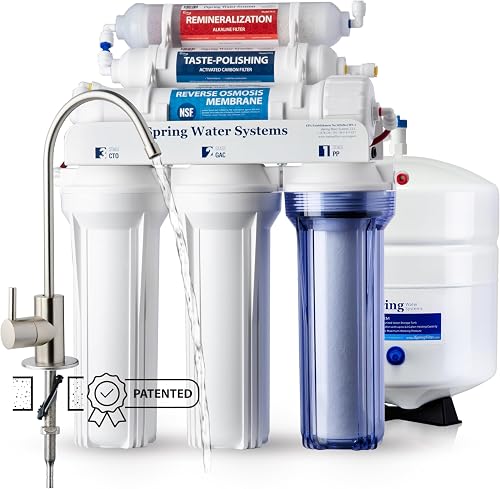
Reverse osmosis focuses on reducing dissolved contaminants, while alkaline filtration focuses on mineral content and pH. A single system can do both when it uses an RO membrane followed by an alkaline remineralization filter.
A standard RO system usually sends water through sediment and carbon filters before the RO membrane. The membrane then reduces many dissolved substances, and a final carbon filter can polish the taste.
An alkaline RO system adds an AK or similar remineralization stage after the membrane. That stage changes the final water by adding minerals, so the system is not simply producing untreated alkaline water.
The drinking water filter guide explains how sediment, carbon, RO and other filter types fit different household needs.
Is reverse osmosis water alkaline?
Reverse osmosis water is not automatically alkaline. RO removes many dissolved minerals, so the water coming directly from the membrane should not be assumed to have a high pH.
The final pH can change after water passes through a post-filter or sits in a storage tank. Source water, filter condition and the system design also affect the result.
An alkaline RO system adds a separate stage after the RO membrane. The purpose is to restore minerals and create a different taste and pH profile from standard RO water.
Read what reverse osmosis water is if you want a closer look at the membrane process and where it fits in a complete system.
How do filtration and remineralization work together?
Filtration removes or reduces substances, while remineralization adds selected minerals after filtration. These steps solve different problems and should be judged separately.
The iSpring RCC7AK-BN NSF Certified uses 6-stage filtration with an AK mineral stage. Its 75 GPD design is intended for under-sink use, and NSF/ANSI 58 certification applies to the full RO system.
The iSpring RCC7AK-BLK also combines 6-stage RO filtration with alkaline remineralization. Its black RO faucet gives it a different kitchen appearance, while the transparent first-stage housing helps you see sediment buildup.
Both systems use a 0.0001-micron RO membrane according to their product information. That does not mean every dissolved substance is handled identically, so check the stated reduction claims for the exact system you choose.
Should you choose alkaline remineralization or standard RO?
Choose alkaline remineralization if you want minerals added after RO; choose standard RO if you want a simpler filtration path. The right choice is mainly about the water characteristics you prefer and the extra stage you are willing to maintain.
The iSpring RCC7-BN NSF Certified uses 5-stage RO filtration and does not include an alkaline stage. It has a 75 GPD capacity, a brushed nickel faucet and no power requirement.
A standard RO system can make sense when your main goal is reducing dissolved contaminants and you prefer not to add another treatment stage. It also avoids the question of how much mineral content you want restored.
An alkaline RO system can make sense when you prefer the taste or mineral profile associated with remineralized water. It still requires routine filter changes, and the alkaline stage does not replace the RO membrane.
Does UV filtration change the choice?
UV adds a different type of treatment from alkaline remineralization. It is meant to provide an added protection stage, while the alkaline filter changes the mineral and pH profile after RO.
The iSpring RCC7AK-UV uses 7 stages, including reverse osmosis, activated carbon, alkaline filtration and an LED UV filter. It is NSF 58 and 372 certified and uses a corded electric power source.
This model has more parts and a power requirement than the no-power systems in this comparison. Check the location of the outlet and the available cabinet space before choosing it.
The product information recommends a booster-pump model when feed water pressure is below 45 PSI. Measure or confirm your water pressure if low pressure may affect an RO installation.
Which system is easiest to install?
All 4 systems are designed for under-sink installation, so cabinet space and plumbing access matter more than countertop appearance. Measure the cabinet before ordering and leave room to inspect filters and reach shutoff points.
The RCC7AK-BN and RCC7AK-UV use a patented top-mounted faucet fastener. This design lets you tighten the faucet from above the countertop, which can help when access under the sink is limited.
The RCC7-BN measures 23.62 x 15.75 x 11.81 inches. The RCC7AK-BN and RCC7AK-BLK are listed at 15.5 x 16 x 18 inches, while the RCC7AK-UV measures 15 x 8 x 18 inches.
These measurements describe the systems, not the full working space. Include room for tubing, the faucet, the storage tank where applicable and filter changes.
Follow the installation instructions for the exact model. Don't improvise connections or place the system where a leak would be hidden.
Do alkaline and RO systems waste water?
RO systems can send some water to a drain during filtration, while alkaline remineralization does not by itself determine the waste-water rate. The membrane, water pressure, flow restrictor and system design affect how much water is discharged.
An alkaline stage comes after RO, so adding minerals does not remove the need to manage RO reject water. A standard RO unit and an alkaline RO unit may have different practical water-use patterns.
See do reverse osmosis systems waste water for the main causes of drain flow and ways to think about water use.
Your installation should include the correct drain connection and air-gap or non-air-gap arrangement required by the system. A poor connection can cause leaks or prevent the RO unit from working as intended.
How does RO compare with distilled water?
RO and distillation both reduce dissolved substances, but they use different processes and installation needs. RO pushes water through a membrane, while distillation heats water and collects condensed vapor.
An under-sink RO system supplies filtered water from a dedicated faucet. Distillation usually involves a separate appliance, so compare counter space, speed, energy use and maintenance.
RO is point-of-use treatment that fits into kitchen plumbing. It needs under-sink space, a feed-water connection, a drain connection and room for a storage tank where the design calls for one.
Distillation tends to use a countertop appliance instead. You fill a chamber, wait for heating and cooling, and then store the finished water for later use.
That difference affects daily habits as much as water chemistry. An RO faucet gives filtered water on demand, while distilled water is usually made in batches and kept in a clean container.
Energy use is another trade-off. Distillation relies on heat, while RO relies on household water pressure and, in some designs, a pump or power for an added stage such as UV.
Our guide to reverse osmosis vs distilled water compares the two methods in more detail.
Do not choose either method by pH language alone. Start with your source water and the substances you want reduced, then decide whether remineralization helps taste or preference.
If you choose RO, consider minerals added back after the membrane. If you choose distillation, consider storage and how often you will clean the chamber.
Is reverse osmosis water bad for you?
Reverse osmosis water is not automatically unsafe because it contains fewer dissolved minerals. The more useful questions are whether the system is suitable for your source water, maintained on schedule and installed correctly.
A remineralization stage can add minerals after RO, but it does not make an incorrectly maintained system safe. Replace filters according to the system's instructions and watch for changes in taste, flow or leaks.
Read is reverse osmosis water bad for you for a careful look at mineral content, maintenance and common concerns.
If you have a medical condition or a prescribed mineral restriction, ask a qualified health professional which water treatment fits your needs.
What else should you filter from drinking water?
Choose a system based on contaminants in your water source, not only on the word alkaline. City water and well water raise different concerns, and a water test can guide the right treatment.
Alkaline describes a mineral and pH profile, not a full list of what a system removes. A filter that changes pH may leave many dissolved substances largely untouched without RO or another suitable stage.
Check the filtration method, stated stages and reduction claims for the exact model. Also confirm whether certification covers the full system or only individual parts.
City water often raises questions about chlorine taste, sediment and regulated contaminants. Well water can raise questions about hardness and sediment load that need identification before treatment.
A water test helps you avoid guessing. It can show which substances are present and help you judge whether RO, carbon filtration or another approach fits.
For nitrate concerns, see do reverse osmosis systems remove nitrates. The answer depends on the exact system, installation and maintenance.
Nitrates show why model specific information matters. Do not assume every RO or alkaline unit handles the same substance to the same degree.
Other dissolved substances need the same check. Lead, fluoride, arsenic, PFAS and TDS are often discussed with RO, but stated reduction can vary by model and test conditions.
Sediment and chlorine are handled earlier by pre-filters and carbon stages in many systems. Those stages protect the membrane and improve taste, but they do not replace the membrane for dissolved substances.
A refrigerator filter may solve a narrower taste or sediment problem, but it is not equivalent to a full under-sink RO system. If you need one, compare the best Samsung refrigerator water filter replacement with your current refrigerator model.
Match the filter to the exact model before ordering, since a filter that fits one Samsung refrigerator may not fit another. For wider use, an under-sink RO system may make more sense than a refrigerator cartridge.
An under-sink system can provide a dedicated faucet for drinking and cooking while other taps stay on the normal supply. Think about where filtered water will be used most, such as drinking, tea, coffee, cooking and baby formula.
If mineral taste matters, compare standard RO with alkaline RO after checking contaminant reduction. Remineralization can change taste, but it should not distract from filtration you need.
Factor in upkeep and space as well. Filters need replacement, tubing must stay secure, and the cabinet needs room for service without hiding leaks.
Which alkaline vs reverse osmosis water system should you choose?
Pick the RCC7AK-BN for certified alkaline RO without electricity, the RCC7AK-BLK for the black faucet, the RCC7-BN for standard RO, and the RCC7AK-UV for added UV filtration. Each reflects a different balance of minerals, stages, power and maintenance.
For most shoppers, the key decision is whether you want remineralization after RO. Choose standard RO for a simpler path, or alkaline RO when restored minerals and taste matter to you.
If certification is a priority, the RCC7AK-BN is the clearest starting point here. It combines 75 GPD capacity, 6-stage filtration, AK remineralization and NSF/ANSI 58 certification for the full system.
That model also suits kitchens with no power source under the sink. Its top-mounted faucet fastener and transparent first-stage housing can ease installation and filter checks.
Choose the RCC7AK-BLK when faucet appearance matters. It keeps alkaline RO and NSF/ANSI 58 certification, while the black faucet may suit a modern kitchen better than brushed nickel.
Before choosing either alkaline model, measure the cabinet and plan filter changes. The system needs room for tubing, the tank where applicable, and access to shutoff points.
Choose the RCC7-BN for standard 5-stage RO without an alkaline stage. It has 75 GPD capacity, a brushed nickel faucet and no power requirement.
That simpler path can suit households focused on reducing dissolved contaminants. It may also suit shoppers who prefer not to maintain an extra mineral stage.
Choose the RCC7AK-UV when an added UV stage matters more than avoiding a powered unit. It combines 7-stage treatment with alkaline remineralization and LED UV protection under the sink.
For that model, check the outlet location and leave room for the extra stage. More stages can mean more parts to maintain, so plan for future filter access.
In short, match the system to the water profile you want and the space you have. Start with contaminant reduction, then decide on minerals, faucet style, power and UV.
Frequently asked questions
Is alkaline water the same as reverse osmosis water?
Alkaline water and reverse osmosis water are not the same. Reverse osmosis is a filtration process that reduces dissolved substances, while alkaline water describes water with a higher pH.
An RO system can include an alkaline remineralization stage that adds minerals after the RO membrane.
Is reverse osmosis water alkaline?
Reverse osmosis water is not automatically alkaline. The RO membrane reduces many dissolved minerals, and the resulting water may have a lower mineral content.
An alkaline post-filter can add minerals back and raise pH, but the final result depends on the system and source water.
Which is better, alkaline water or reverse osmosis water?
Neither is best for every home. Choose reverse osmosis when dissolved contaminant reduction is your main goal, or choose an RO system with alkaline remineralization if you also prefer minerals and a higher-pH taste.
Check the exact certification and filter stages before buying.
Do alkaline water filters remove contaminants?
Some alkaline systems also use RO or other filtration stages, while a simple alkaline filter may focus mainly on adding minerals or changing pH. Check the stated filtration method and contaminant reductions.
Alkaline performance alone does not describe the system's ability to reduce contaminants.
Does reverse osmosis remove minerals?
Reverse osmosis reduces many dissolved minerals along with other dissolved substances. That is why some RO systems add a remineralization stage after the membrane.
If mineral content matters to you, compare a standard RO system with an alkaline RO system rather than assuming every RO unit produces the same water.