Do Reverse Osmosis Systems Remove Nitrates?
Reverse osmosis systems can reduce nitrates, but performance depends on the membrane, water conditions, system design, and maintenance. Verify nitrate reduction with current test results and the manufacturer's documentation.
On this page (9 sections)
- How do reverse osmosis systems remove nitrates?
- Can every reverse osmosis system remove nitrates?
- What should you check before buying a nitrate filter?
- How do you verify nitrate reduction after installation?
- Can bottled reverse osmosis water solve a nitrate problem?
- Do carbon filters remove nitrates?
- What maintenance does a nitrate-focused RO system need?
- Does reverse osmosis remove other contaminants too?
- What is the best way to choose a reverse osmosis system that removes nitrates?
Reverse osmosis systems can reduce nitrates, but you should not assume every RO unit removes the same amount. The membrane, source-water conditions, operating limits, and filter maintenance all affect the result.
Nitrates can enter groundwater and private wells through fertilizer, septic systems, animal waste, and other sources. If a water test shows nitrate contamination, use the test result to choose treatment rather than relying on a broad phrase such as “multi-contaminant filtration.”
How do reverse osmosis systems remove nitrates?
Reverse osmosis reduces nitrates by forcing water through a semipermeable membrane. The membrane allows much of the water to pass while retaining many dissolved substances in the reject stream.
RO is different from a standard carbon filter. Carbon can improve taste and reduce some chemicals, but it should not be treated as a nitrate solution unless the specific filter has a verified nitrate claim.
Your water pressure, temperature, total dissolved solids, membrane condition, and system design can affect output. A unit that performs well in one home may produce a different result when the source water or operating conditions change.
If you want the basic process explained first, read what is reverse osmosis water. It covers the membrane process and how RO water differs from untreated tap water.
Can every reverse osmosis system remove nitrates?
No. A reverse osmosis label alone does not prove a specific nitrate reduction level.
Look for model-specific performance information that names nitrate, along with the test conditions and any certification that applies.
A system may advertise reduction of many contaminants without naming nitrate. That broad wording can still be useful, but it does not tell you how the unit performs against the nitrate level in your water.
Check these details before choosing a system:
- The exact nitrate reduction claim.
- The membrane type and replacement schedule.
- The source-water TDS and pressure limits.
- Whether the claim applies to the complete system or only one stage.
- Whether the certification covers nitrate reduction.
- How you will test the treated water after installation.
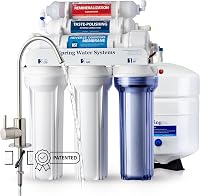
The iSpring RCC7-BN uses a 5-stage reverse osmosis process, with a 75 GPD capacity, no power requirement, and NSF/ANSI 58 certification. Its published contaminant examples include PFAS, chlorine, fluoride, lead, arsenic, asbestos, calcium, and sodium, but nitrate is not named in the supplied product information.
This system suits a household that wants an under-sink drinking-water unit with a tank, a 100% lead-free designer faucet, food-grade tubing, and a transparent first-stage housing for visual inspection. It needs no power source and has a maximum supported source-water TDS level of 750 ppm.
The iSpring system is a better fit for readers who will test their water and maintain the filters on schedule. Its 5 stages include sediment, GAC carbon, carbon block, RO membrane, and fine GAC polishing.
Those stages support overall water treatment, but you should confirm nitrate results with a water test.
What should you check before buying a nitrate filter?
Start with a recent water test, then match the treatment to the measured nitrate level. A test gives you a baseline and helps you judge whether the system is working after installation.
For municipal water, check the latest utility report and consider an independent test when you need a current result. For a private well, test the well water through a qualified laboratory and repeat testing when local guidance recommends it or when conditions change.
Look beyond the main nitrate number. TDS, hardness, iron, manganese, chlorine, pressure, and microbial concerns can affect how you choose and maintain treatment.
A system with an RO membrane may also reduce minerals and change the water's taste. That is one reason some people compare RO with other approaches in alkaline vs reverse osmosis water.
Alkaline treatment does not replace verified nitrate reduction.
How do you verify nitrate reduction after installation?
Test the treated water after installation and compare the result with the untreated source water. Use the same type of test when possible, and record the date, sample location, and result.
Collect the sample according to the laboratory's instructions. A sample from the RO faucet is more useful for checking treatment than a sample from another tap.
Retest when the membrane or filters are due for replacement, when flow changes, or when the water's taste changes unexpectedly. A rise in TDS can signal that maintenance is needed, although TDS alone cannot tell you the nitrate level.
The iSpring system includes a transparent first-stage housing, which helps you inspect that filter visually. A clear housing does not measure nitrate, so pair visual checks with actual water testing.
Can bottled reverse osmosis water solve a nitrate problem?
Bottled RO water can provide a ready-to-drink alternative, but it does not treat the water coming from your tap. It may be useful for temporary drinking needs while you arrange testing or install a suitable system.
Essentia Ionized Alkaline Water is purified with microfiltration and reverse osmosis, then enhanced with electrolytes and ionized to a pH of 9.5 or higher. The 24-pack contains twenty-four 20 Fl Oz bottles and is described as 99.9% pure.
This option suits someone who needs packaged drinking water rather than a permanent under-sink treatment system. It does not give you control over the water entering your home, and the supplied product information does not provide a nitrate-specific reduction claim.
The 12 x 1L version has the same 9.5+ pH and 99.9% purity descriptions, with a larger bottle format for people who prefer 1 L portions.
Choose between the 20 Fl Oz and 1 L formats based on how you store and use bottled water. Neither product replaces a verified nitrate treatment system for a home's tap water.
Do carbon filters remove nitrates?
Most ordinary carbon filters should not be your first choice for nitrate reduction. Carbon is commonly used for taste, odor, chlorine, and some organic compounds, but nitrate requires a treatment method designed and documented for it.
This matters when shopping for a pitcher or faucet filter. A filter that improves taste can still leave nitrate levels largely unchanged.
Use the exact contaminant claim, not the filter's general category, as your guide.
Our drinking water filter guide explains how to compare filter types, certifications, replacement needs, and contaminant claims. If lead is also a concern, see best water filter pitcher for lead removal for a separate treatment question.
What maintenance does a nitrate-focused RO system need?
Replace prefilters and the RO membrane according to the system's instructions, and confirm performance with testing. A neglected membrane can reduce flow and may no longer deliver the expected treatment result.
Keep track of installation and replacement dates. Check for leaks, unusual noise, reduced flow, and changes in taste, but do not use taste alone to judge nitrate safety.
If you are comparing membrane options, best reverse osmosis membrane replacement can help you think through replacement compatibility and maintenance planning. Use the correct part for your system and follow its installation instructions.
RO also produces reject water and may lower mineral content. Those trade-offs are separate from nitrate safety, so decide based on your water test, household use, and maintenance capacity.
Does reverse osmosis remove other contaminants too?
RO can reduce many dissolved contaminants, but performance varies by substance and system. A nitrate-focused decision should still include the other contaminants found in your water test.
The iSpring RCC7-BN publishes reduction claims for contaminants such as fluoride, lead, arsenic, and sodium. For fluoride specifically, read do reverse osmosis systems remove fluoride and check the model's own documentation.
Bacteria are a separate concern because a membrane system's performance depends on the complete design, sanitation, and installation. See does reverse osmosis remove bacteria if microbial contamination is part of your water problem.
What is the best way to choose a reverse osmosis system that removes nitrates?
Choose the system with a nitrate-specific performance claim that matches your tested water. Confirm the certification, operating limits, replacement plan, and a practical way to test the treated water.
The iSpring RCC7-BN is the strongest fit here for a permanent under-sink setup because it combines a 5-stage RO design, 75 GPD capacity, NSF/ANSI 58 certification, and no required power source. Its information does not name nitrate, so verify that point before relying on it for nitrate treatment.
Choose Essentia 20 Fl Oz bottles or Essentia 1 L bottles when you need ready-to-drink water while testing or planning treatment. They are convenient packaged options, not replacements for a system that treats household tap water.
For a broader system comparison, see best reverse osmosis systems under sink. The decision rule is simple: test first, choose a nitrate-specific claim, maintain the system, and retest the treated water.
Frequently asked questions
Do reverse osmosis systems remove nitrates?
Reverse osmosis can reduce nitrates by pushing water through a semipermeable membrane, but the amount removed depends on the system and source water. Check the exact nitrate claim, certification, and operating limits before relying on an RO system for nitrate control.
How do I know if my RO system removes nitrates?
Check the model's official performance data for nitrate reduction and compare it with your water test. A general claim about contaminant reduction does not prove nitrate performance, so look for a specific nitrate claim, certification, or test method tied to that system.
Can a water filter remove nitrates?
Some water treatment systems reduce nitrates, but ordinary carbon filters are not a dependable choice for nitrate removal. Reverse osmosis, anion exchange, and distillation are treatment options to research, with the right choice depending on nitrate levels and other water conditions.
How often should I test for nitrates after installing RO?
Test after installation and again according to your local water guidance or treatment professional's advice. Also test if the source changes, the membrane is overdue for replacement, or a post-filter change affects taste or flow, because maintenance can affect performance.