9 Best Reverse Osmosis Systems for Well Water (November 2026)
The best reverse osmosis systems for well water include the iSpring T32M Pressurized Water Storage Tank for adding storage to an RO system, the iSpring RCC7AK-BN NSF Certified for traditional tank systems with remineralization, and the Waterdrop G2 Reverse Osmosis System for simple tankless filtration.
On this page (9 sections)
- The best reverse osmosis systems for well water, ranked by score
- How the best reverse osmosis systems for well water compare
- How we compared these systems
- What should you test in well water before you buy RO?
- Tank, tankless or countertop: which fits your home?
- How does pretreatment protect an RO membrane?
- Does RO remove minerals, and should you add them back?
- What setup and care steps should you plan for?
- Verdict: which best reverse osmosis system for well water should you buy?
The best reverse osmosis systems for well water are the iSpring RCC7AK-BN for a traditional tank setup and the Waterdrop G3P800 for fast tankless flow. If you want no plumbing, the DREO and Bluevua countertop units are the practical picks here.
Well water changes the shopping logic. Most city water arrives already treated, while well water can carry sediment, iron, hardness, tannins and bacteria that stress an RO membrane.
A reverse osmosis system for well water works best when you test first and add pretreatment where needed.
Our score weighs specs, features and buyer feedback against what a well water household actually needs. That means membrane protection, output speed, drain ratio, certification and daily ease of use all count.
Start with our drinking water filter guide if you are new to filtration terms. It explains how RO compares with carbon and sediment filters before you spend on a system.
Our picks at a glance
-
1
 Best for adding storage to an RO system
iSpring T32M Pressurized Water Storage Tank
9.7/10 our score
See it on Amazon -
2
 Best for traditional tank systems with remineralization
iSpring RCC7AK-BN NSF Certified
9.7/10 our score
See it on Amazon -
3
 Best for simple tankless filtration
Waterdrop G2 Reverse Osmosis System
9.6/10 our score
See it on Amazon
- 4
 Check it
Waterdrop G3P600 Tankless Reverse Osmosis Water Filter
Best for smart faucet monitoring - 5
 Check it
DREO Reverse Osmosis Water Filter System Countertop
Best for countertop use with no installation - 6
 Check it
Bluevua RO100ROPOT Countertop Reverse Osmosis Water Filter
Best for portable countertop filtration - 7
 Best for high-capacity traditional filtrationCheck it
- 8
 Best for a complete system with extra filtersCheck it
- 9
 Check it
Waterdrop G3P800 Tankless Reverse Osmosis Water Filter
Best for high volume tankless flow
The best reverse osmosis systems for well water, ranked by score
The top picks split into three clear groups. Traditional tank systems store water and need no electricity.
Tankless systems give faster flow and save space but need power. Countertop systems need no installation and suit small households.
iSpring T32M Pressurized Water Storage Tank: Best for adding storage to an RO system
- 4 gallon tank size with up to 3.2 gallon holding capacity
- Food grade butyl diaphragm
- Stainless steel 1/4 inch NPT valve thread
- 1/4 inch tank valve included
- Pre-pressurized between 7 and 10 psi
A pressurized storage tank that works in vertical or horizontal position so you can add reserve water to a tank RO system.
Pros
- 3.2 gallon holding capacity
- Works vertical or horizontal
- Tank valve included
Cons
- Storage tank only, not a complete filtration system
- Needs a compatible RO system to pair with
The iSpring T32M is a storage tank, not a complete filter. It suits a well owner who already has a tank RO system and wants more reserve capacity or a replacement tank in a tight cabinet.
It holds up to 3.2 gallons in a 4 gallon tank body. That reserve helps when several people draw water in a row, because the tank refills the faucet while the membrane keeps working at its own pace.
The tank has a food grade butyl diaphragm and a stainless steel 1/4 inch NPT valve thread. A 1/4 inch tank valve is included, so you can connect it without a separate valve purchase on install day.
It discharges in vertical or horizontal position. That flexibility helps in a crowded under-sink cabinet or a basement install, but measure the 11 x 11 x 14 inch body first and leave room for tubing bends.
It is pre-pressurized between 7 and 10 psi. That range suits common household use, and the 8 pound weight makes wall or floor placement manageable for one person.
The trade-off is scope. This tank adds storage only, so pair it with a complete RO system such as the iSpring RCC7AK-BN in this roundup.
It cannot filter sediment or iron on its own.
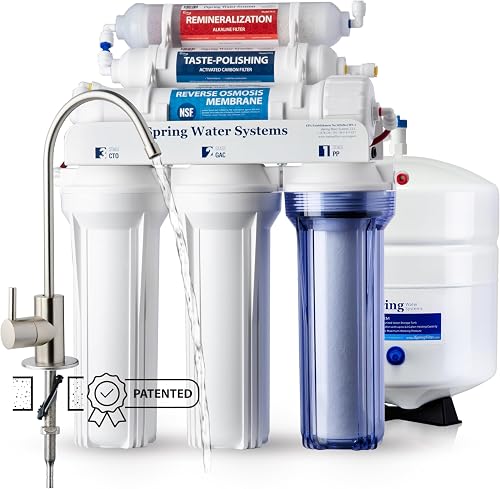
iSpring RCC7AK-BN NSF Certified: Best for traditional tank systems with remineralization
- 75 GPD, 6-stage reverse osmosis system
- Alkaline AK stage with pH plus remineralization
- NSF/ANSI 58 certified RO system
- Top-mounted faucet design for installation from above
- Transparent first-stage filter housing
A 6-stage under-sink system with a mineral stage, a storage tank and a brushed nickel faucet included in the box.
Pros
- Includes storage tank and faucet
- Transparent first-stage housing
- No electricity needed to operate
Cons
- 75 GPD is slower than tankless options here
- Under-sink footprint is larger than tankless models
The iSpring RCC7AK-BN suits a well household that wants a traditional under-sink system with a storage tank and remineralization. It is a complete system, not an add-on part.
It runs at 75 GPD through 6 stages. The alkaline AK stage adds minerals and balances pH after RO strips them out, which many buyers prefer for taste in daily drinking and cooking.
iSpring says the system is NSF/ANSI 58 certified for the entire system. It also lists reductions for TDS, PFAS, chlorine, lead, fluoride and more than 1,000 other contaminants in its product data.
The top-mounted faucet design lets you install from above the counter. That helps if tightening a nut from inside a low cabinet is difficult in your kitchen layout.
The transparent first-stage housing lets you see sediment buildup. For well water, that visual check helps you change the first filter before sediment reaches the membrane.
The box includes the RO system, a brushed nickel faucet, a storage tank and an extra tool set. It needs no electricity, which helps in a basement or outbuilding without an outlet.
The trade-off is speed and space. At 75 GPD with a tank, flow is steadier than fast but slower than the tankless models here, and the 15.5 x 16 x 18 inch footprint is larger.
Waterdrop G2 Reverse Osmosis System: Best for simple tankless filtration
- 400 GPD tankless RO system
- 7-stage filtration
- 1:1 pure to drain ratio
- NSF/ANSI 372 certified for lead-free materials
- Two filters included in the package
A tankless under-sink system with 400 GPD output, two pre-installed filters and a mechanical faucet.
Pros
- Saves under-sink storage space
- Twist-and-pull filter replacement
- Low 1:1 drain ratio
Cons
- Requires under-sink electricity
- Needs a drilled faucet hole
The Waterdrop G2 suits a well home with limited under-sink space and reliable power under the sink. It is the simpler tankless option in this group.
It produces 400 GPD with a 1:1 pure to drain ratio. Waterdrop says a cup fills in about 12 seconds, which suits drinking and cooking use for a small to mid-size household.
It uses 7-stage filtration with a composite filter and an RO membrane. The system is NSF/ANSI 372 certified for lead-free materials, which matters for parts that touch drinking water.
Two filters are included in the package and come pre-installed. Replacement filters use a twist-and-pull design that Waterdrop says takes about 3 seconds, so you do not need tools.
The tankless design saves more than 70% of under-sink storage space compared with a tank system. That helps if you store cleaning supplies under the same sink.
It includes a mechanical faucet and a user manual. Installation needs an electrical outlet and a drilled faucet hole, so plan both before you order.
The trade-off is power and output. It needs electricity, and 400 GPD is slower than the G3P600 and G3P800 in this roundup.
It sits at 17.3 x 5.9 x 14 inches.
Waterdrop G3P600 Tankless Reverse Osmosis Water Filter: Best for smart faucet monitoring
- 600 gallons per day capacity
- 8-stage filtration
- 2:1 pure to drain ratio
- Smart display faucet with TDS monitor
- Filter life tracker on the faucet
A tankless system with a smart faucet that shows TDS and filter life, plus 3 pre-installed filters.
Pros
- 600 GPD output
- TDS monitor on faucet
- Filter changes without moving the system
Cons
- Requires under-sink electricity
- Cabinet must be larger than the unit
The Waterdrop G3P600 suits a well household that wants tankless speed plus a readout on water quality. The smart faucet is the main reason to pick it over the G2.
It produces 600 gallons per day with a 2:1 pure to drain ratio. Waterdrop says an 8 oz cup fills in 8 seconds, which helps when filling pots or bottles in a busy kitchen.
It uses 8-stage filtration and is certified against NSF/ANSI 58 for TDS reduction and NSF/ANSI 372 for lead-free materials. It is also certified against NSF 42 for chlorine, taste and odor.
The smart display faucet shows TDS and filter life. For well water, that feedback helps you spot a rising TDS trend after a heavy rain or a filter change.
It includes 3 pre-installed filters and a silver smart faucet. Filter changes take about 3 seconds without moving the system, which keeps the unit fixed under the sink.
The tankless design saves 70% of under-sink space. Measure your cabinet first, because the unit is 18.12 x 5.67 x 17.72 inches and the cabinet must be larger.
The trade-off is power and cabinet size. It requires under-sink electricity, and the flush function and pump need that outlet to run on demand.
DREO Reverse Osmosis Water Filter System Countertop: Best for countertop use with no installation
- Countertop installation type
- 3L tank plus 1.1L pitcher
- Real-time TDS and filter life monitoring
- 3:1 pure-to-drain ratio
- 0.0001 um RO membrane
A countertop unit with a 3L tank, a 1.1L auto-fill pitcher and touch control for 1 to 2 people.
Pros
- No plumbing or installation required
- Slim countertop footprint
- Realtime TDS display
Cons
- 3L tank suits 1 to 2 people
- Needs a power source on the counter
The DREO countertop system suits a renter, a small well home or a secondary kitchen where plumbing work is not an option. It filters on the counter, not under the sink.
It has a 3L tank plus a 1.1L pitcher. DREO positions that capacity for daily use by 1 to 2 people, so it fits a couple or a single person well.
It uses a 0.0001 um RO membrane in a 7-in-1 system. DREO says it was tested by SGS meeting NSF/ANSI 58 standards and reduces lead, chromium, chlorine, PFOS, PFOA and fluoride under lab conditions.
Real-time TDS and filter life monitoring show raw and pure water quality. That helps a well owner track performance between lab tests without guessing when to change the filter.
It has a 3:1 pure-to-drain ratio and auto-flush self-cleaning. The footprint is slim at 14.51 x 6.73 x 13.35 inches, so it fits a small counter or an office nook.
The trade-off is capacity. A 3L tank needs refills through the day, and the unit needs a countertop power source.
The filter lasts 265 gallons in the listed data.
Bluevua RO100ROPOT Countertop Reverse Osmosis Water Filter: Best for portable countertop filtration
- 6-stage filtration with UV light
- 0.0001 um RO membrane
- Remineralization filter included
- Borosilicate glass carafe, 1700 ml
- No plumbing or installation required
A portable countertop system with a glass carafe, UV light, remineralization and a filter life monitor.
Pros
- Glass carafe instead of plastic
- Portable, plug-in design
- Filters last 12 to 24 months
Cons
- 1700 ml carafe is small for a household
- Heavier than the DREO countertop unit
The Bluevua RO100ROPOT suits a well household that wants portable RO with a glass carafe. It is a plug-in countertop unit with no plumbing at all.
It uses 6-stage filtration with UV light and a 0.0001 um RO membrane. It also includes a remineralization filter to add minerals back for taste after RO removes them.
The water container is a high borosilicate glass carafe with 1700 ml capacity. That material choice avoids a plastic carafe for daily drinking water and suits people who prefer glass.
It is certified by WQA against NSF/ANSI/CAN 372 for lead-free materials and tested by SGS. Bluevua lists reductions for TDS, PFOA, PFOS, chlorine, fluoride, arsenic and lead.
Filters last 12 to 24 months, which is longer than most countertop options here. A monitor display shows filter service life and water quality, plus a built-in TDS meter.
The trade-off is size and weight. At 17.8 pounds with a 1700 ml carafe, it suits portability and small households more than large family demand.
APEC Water RO-90: Best for high-capacity traditional filtration
- 5-stage under-sink system, 90 GPD
- NSF certified 372 and 58
- WQA Gold Seal certified
- Large super capacity filters
- Lead-free chrome faucet included
A 5-stage, 90 GPD under-sink system with tank, faucet, tubing and wrenches included.
Pros
- Higher 90 GPD output than older tank models
- Includes tank, faucet and tubing
- Manual operation with water pressure
Cons
- Largest weight in this group at 25 pounds
- No smart faucet or TDS display
The APEC Water RO-90 suits a well household that wants a traditional system with higher output than older 50 GPD models. It is a complete under-sink kit.
It runs at 90 GPD through 5 stages. That output is higher than the RCC7AK-BN and RO5DX here, so the tank refills faster between draws in a larger household.
It is WQA Gold Seal certified and NSF certified 372 and 58. APEC says it removes up to 99% of contaminants including arsenic, chlorine, lead, fluoride and heavy metals.
The system uses large super capacity filters that APEC says last twice as long as smaller all-in-one filters. For well water with sediment, that capacity can reduce change frequency.
The box includes a filter set, tank, faucet, tubing, drain saddle, feed water adapter and wrenches. The faucet is 100% lead-free with JG quick connect fittings for a secure seal.
It operates manually with water pressure, with a maximum feed water pressure of 85 psi. That means no electricity is needed for homes without an under-sink outlet.
The trade-off is weight and features. At 25 pounds it is heavy to mount, and it has no smart faucet or TDS display to track well water changes.
Express Water RO5DX: Best for a complete system with extra filters
- 5-stage under-sink system, 50 GPD
- NSF certified 372 and 58
- 4 gallon tank with 3.2 gallon water capacity
- Extra filter set included
- Leak detector included
A complete 5-stage system with a 4 gallon tank, an extra filter set and a leak detector in the box.
Pros
- Extra filter set included
- Leak detector included
- No electricity required
Cons
- 50 GPD is the lowest output here
- 31 pounds is the heaviest unit in this group
The Express Water RO5DX suits a well household that wants a complete traditional system with spares in the box. It is the value pick for included extras.
It runs at 50 GPD through 5 stages. Express Water says it reduces up to 99.99% of lead, chlorine, fluoride, PFAs, calcium, arsenic and more in its product data.
It includes a 4 gallon tank with 3.2 gallon water capacity and a tank stand. The system is NSF certified 372 and 58 with a deluxe chrome faucet for the counter.
The box includes an extra filter set and a leak detector. That matters for well water, where sediment can load the first filter faster than city water does.
It needs no electricity and operates on 40 to 80 psi water pressure. It can be wall mounted, cabinet mounted or freestanding for indoor use in different layouts.
The trade-off is output and weight. At 50 GPD it is the slowest system here, and at 31 pounds it is the heaviest, so cabinet mounting needs a solid support.
Waterdrop G3P800 Tankless Reverse Osmosis Water Filter: Best for high volume tankless flow
- 800 GPD high capacity
- 10-stage filtration
- 3:1 pure to drain ratio
- Smart faucet with LED function
- NSF/ANSI 42, 53, 58 and 372 certified
The fastest tankless option here at 800 GPD, with 10-stage filtration and a smart faucet showing TDS.
Pros
- Fastest flow in this group
- 3:1 pure to drain ratio
- Smart faucet with TDS readout
Cons
- Requires under-sink electricity
- Same large cabinet footprint as the G3P600
The Waterdrop G3P800 suits a larger well household that wants the fastest tankless flow in this group. It is built for heavy daily draws.
It produces 800 GPD with a 3:1 pure to drain ratio. Waterdrop says it filters one cup in about 5 seconds, which is the fastest claim here.
It uses 10-stage filtration, more stages than any other tankless model here. It is certified by IAPMO R&T against NSF/ANSI 58 for TDS and NSF 42 and 53 for chlorine, taste and odor.
The smart faucet shows TDS and water quality at a glance. The LED lamp turns on automatically when water flows, so you can read it in low light under a cabinet.
It includes 3 pre-installed filters, a smart faucet and a user manual. The front-pull filter design allows quick replacement without moving the system.
The trade-off is power and footprint. It is corded electric, and at 18.12 x 5.67 x 17.72 inches it needs a large cabinet.
It also lists NSF/ANSI 372 for lead-free materials.
How the best reverse osmosis systems for well water compare
Tank systems win on storage and no power. Tankless systems win on flow and space.
Countertop systems win on portability and no installation.
| Product | Best for | Capacity | Size | Weight | Our score |
|---|---|---|---|---|---|
| iSpring T32M Pressurized Water Storage Tank | adding storage to an RO system | 3.2 gallons | 11 x 11 x 14 in | 8 pounds | 9.7 |
| iSpring RCC7AK-BN NSF Certified | traditional tank systems with remineralization | 75 gallons | 15.5 x 16 x 18 in | 12.5 kg | 9.7 |
| Waterdrop G2 Reverse Osmosis System | simple tankless filtration | 400 gallons | 17.3 x 5.9 x 14 in | 9.6 | |
| Waterdrop G3P600 Tankless Reverse Osmosis Water Filter | smart faucet monitoring | 600 gallons | 18.12 x 5.67 x 17.72 in | 15.4 pounds | 9.5 |
| DREO Reverse Osmosis Water Filter System Countertop | countertop use with no installation | 3 liters | 14.5 x 6.7 x 13.4 in | 9.5 pounds | 9.3 |
| Bluevua RO100ROPOT Countertop Reverse Osmosis Water Filter | portable countertop filtration | 1700 ml | 10.9 x 15.4 x 14.3 in | 17.8 pounds | 9.2 |
| APEC Water RO-90 | high-capacity traditional filtration | 90 gallons per day | 16 x 5.25 x 17.5 in | 25 pounds | 9.1 |
| Express Water RO5DX | a complete system with extra filters | 4 gallons | 14 x 5 x 15 in | 31 pounds | 8.4 |
| Waterdrop G3P800 Tankless Reverse Osmosis Water Filter | high volume tankless flow | 800 gallons | 18.12 x 5.67 x 17.72 in | 15.3 kg | 8.2 |
For well water, TDS limits and supported pressure matter as much as headline output. Several under-sink models here list a 300 ppm supported TDS level, while the countertop picks list 500 ppm.
Drain ratio is the next split. The G2 uses 1:1, the G3P600 uses 2:1, and the G3P800 and DREO use 3:1, so waste water per cup falls as you move up that list.
Which specs should you compare first?
Compare supported TDS, operating pressure, drain ratio and filter life before you compare stage counts. Those four specs tell you more about fit for well water than a stage count alone.
How we compared these systems
We compared specs, features and buyer feedback against well water needs. We checked output, drain ratio, certification, filter stages and what is included in each box.
We looked at TDS limits where stated, because well water often has higher dissolved solids than city water. We also weighed whether a system needs electricity, a drill or a large cabinet.
We did not test these systems. Maker claims are labeled as claims, and buyer patterns come from review summaries rather than our own use.
Our best reverse osmosis systems guide covers the same brands for city water. Use it to compare features, then return here to apply well water pretreatment advice.
What should you test in well water before you buy RO?
Test first, then buy. A lab test tells you TDS, iron, hardness, pH, sediment load, tannins and bacteria risk.
Which tests matter most?
Start with TDS, iron, hardness, pH and a bacteria screen. Those five results decide whether RO alone is enough or pretreatment comes first.
What if iron is high?
High iron can stain fixtures and clog prefilters. Oxidation or iron filtration often comes before RO, so ask a water professional to match treatment to your iron type and level.
What if hardness is high?
Hardness raises TDS and can foul a membrane faster. A water softener or anti-scale pretreatment may sit ahead of RO in hard water areas.
Our reverse osmosis vs water softener guide explains when softening and RO work together. Many well homes use both, in that order.
Tank, tankless or countertop: which fits your home?
Choose by space, power and daily use. Each type solves a different problem for a well household.
Tank systems
Tank systems store filtered water for steady faucet flow. They need no electricity and suit basements or outbuildings without an outlet.
The iSpring RCC7AK-BN, APEC RO-90 and Express Water RO5DX are the tank picks here. The iSpring T32M tank can add storage to a compatible system.
Tankless systems
Tankless systems filter on demand and save under-sink space. They need under-sink electricity and a drilled faucet hole.
The Waterdrop G2, G3P600 and G3P800 are the tankless picks here. Output rises from 400 GPD to 800 GPD across those three models.
Countertop systems
Countertop systems need no plumbing and move between homes. They suit renters, small households and secondary kitchens.
The DREO and Bluevua units are the countertop picks here. Both need a power outlet, and both hold only a few liters at a time.
How does pretreatment protect an RO membrane?
Pretreatment protects the membrane from sediment, iron and hardness. That protection extends filter life and keeps flow steady.
Sediment prefiltration
A sediment prefilter catches sand, silt and rust before they reach finer filters. Well water often loads this stage faster than city water.
Carbon prefiltration
Carbon reduces chlorine and some organics that can damage an RO membrane. It also helps with taste and odor from tannins.
Softening and iron treatment
Softening reduces hardness minerals that raise TDS. Iron treatment removes iron that can stain and clog.
The order depends on your test results.
If a system lists a supported TDS limit, respect it. Several models here list 300 ppm, while the DREO and Bluevua list 500 ppm.
Does RO remove minerals, and should you add them back?
RO removes most dissolved minerals along with TDS. That includes calcium and magnesium that affect taste.
Some buyers like the flat taste of pure RO water. Others prefer remineralization for a more balanced taste.
The iSpring RCC7AK-BN has an alkaline mineral stage. The Bluevua includes a remineralization filter.
Our does reverse osmosis remove minerals guide covers the taste and health trade-offs in more depth.
What setup and care steps should you plan for?
Plan space, power, drain and filter changes before you order. Good setup prevents leaks and early filter failure.
Under-sink setup
Measure cabinet width, height and depth, then check power access for tankless models. Confirm drain access and faucet hole drilling before installation day.
Countertop setup
Place the unit near an outlet and a water source. Fill the tank, run a first cycle as directed, and keep the pitcher or carafe clean.
Ongoing care
Change prefilters on schedule, especially the first stage on well water. Watch TDS trends where a smart faucet shows them, and keep spare filters on hand.
If you need a system for a business or larger property, our best reverse osmosis system for commercial use guide covers higher volume options. For a style-focused pick, see the best reverse osmosis system black guide.
You can also learn what a What Is a Water Dispenser System? The Quick Version covers if you are comparing RO with a full dispensing setup.
For hiking or emergency use, the best gravity water filter for backpacking guide is a separate category.
Verdict: which best reverse osmosis system for well water should you buy?
Pick the iSpring RCC7AK-BN if you want a complete tank system with remineralization and no power requirement. Pick the Waterdrop G3P800 if you want the fastest tankless flow and a smart TDS faucet.
Pick the DREO or Bluevua if you rent or want no installation. Add the iSpring T32M tank only if you already own a compatible RO system and need more storage.
Test your well water before you order, then add sediment, iron or softening pretreatment as your results require. That order of steps protects the membrane and gives you the best result from any system here.
Our top 3 picks at a glance
-
1
Best for adding storage to an RO system
iSpring T32M Pressurized Water Storage Tank
9.7/10 our score
See it on Amazon -
2
Best for traditional tank systems with remineralization
iSpring RCC7AK-BN NSF Certified
9.7/10 our score
See it on Amazon -
3
Best for simple tankless filtration
Waterdrop G2 Reverse Osmosis System
9.6/10 our score
See it on Amazon
Frequently asked questions
Do I need pretreatment before a reverse osmosis system on well water?
Often yes. Many wells carry sediment, iron, hardness or tannins that can clog prefilters and foul an RO membrane faster.
Test your water first, then add sediment, carbon or softening pretreatment as the results require before the RO unit.
Will reverse osmosis remove iron from well water?
Reverse osmosis can reduce dissolved iron, but high iron often needs oxidation or filtration first so it does not stain or clog the system. Check your iron level and type, then match pretreatment to that result rather than relying on RO alone.
Tank or tankless, which suits a well home better?
Tank systems store water for steady flow and need no electricity. Tankless systems give faster flow and save space but need power under the sink.
Choose by your cabinet space, power access and how much water you draw at once.
Does reverse osmosis remove minerals from water?
Yes, RO removes most dissolved minerals along with TDS. Some systems add a remineralization stage to put back calcium and magnesium for taste.
Check whether you prefer that taste before you buy an RO-only model.
Can I use a countertop RO system on well water?
You can for drinking water if your well water meets the unit's supported TDS limit and you change filters on schedule. Countertop units suit renters or small households, but heavy sediment or iron may need pretreatment first.