9 Best Portable Water Filters for Camping (November 2026)
The best portable water filters for camping include the Camco Tastepure RV Water Filter 2-pk for hose-fed campsites, the Membrane Solutions Personal Water Filter Straw S1 for backpacking portability, and the LifeStraw Personal Water Filter for Hiking for simple trail use.
On this page (8 sections)
- Best water filters for camping by trip type
- Camco vs GLACIER FRESH vs straws and gravity systems
- How we compared these water filters for camping
- What type of camping water filter do you need?
- How do you size capacity and flow for camping?
- How should you set up and care for camping filters?
- What filtration claims should you check?
- Which camping water filter should you buy?
The best water filters for camping are the Camco Tastepure RV Water Filter 2-pk for hose-fed sites and the Membrane Solutions Personal Water Filter Straw S1 for backpacking. They solve the two most common camping problems in different ways.
Campsite water often needs taste and chlorine reduction. Trail water often needs bacteria and parasite reduction.
A single filter rarely does both jobs well.
Our score weighs specs, features and buyer feedback against what you are shopping for. That is why hose filters and straws both score high here, even though they work in opposite settings.
If you are new to this category, start with our drinking water filter guide to learn the basic types. Then come back here to match a type to your trip.
Our picks at a glance
-
1

-
2
 Best for backpacking portability
Membrane Solutions Personal Water Filter Straw S1
9.7/10 our score
See it on Amazon -
3
 Best for simple trail use
LifeStraw Personal Water Filter for Hiking
9.5/10 our score
See it on Amazon
- 4
 Check it
Waterdrop Gravity Water Filter Straw
Best for gravity-fed groups - 5
 Check it
Membrane Solutions 6L Gravity Water Filter Pro
Best for basecamp volume - 6
 Check it
Practical Survival Reusable Emergency Water Filter Straws
Best for emergency kits - 7
 Best for multi-person straw packsCheck it
- 8
 Check it
GRAYL GeoPress 24 oz Water Purifier
Best for fast press purification - 9
 Check it
GLACIER FRESH RV/Marine Water Filter
Best for RV hose seasons
Best water filters for camping by trip type
The best portable drinking water filter depends on your campsite setup first. Hose hookup, backpack weight limits and group size matter more than small spec differences.
Trail campers need something light. Car campers need volume and flow.
RV campers need hose compatibility.
The picks below cover all three patterns. Read the trade-offs before you compare capacity numbers.
Camco Tastepure RV Water Filter 2-pk: Best for hose-fed campsites
- GAC and KDF filtration
- 6-step filtration with Hex-Flow Technology
- 20-micron sediment filter
- 2-pack
- Made in the USA
A two-pack inline hose filter for campers and boats that reduces chlorine, taste, odor and sediment. It suits campsites where you connect to a hose supply.
Pros
- Two filters in one pack
- Wide-body design for high flow
- Attaches to standard hoses
Cons
- Needs a hose supply at camp
- Not a backpacking straw
Camco suits car camping, RV camping and boat camping where you connect to a hose. Its GAC and KDF filtration targets chlorine, taste, odor and sediment, which are the main complaints about many campsite taps.
The 20-micron internal sediment filter blocks silt before it reaches your cup. That matters when you fill a kettle, a water jug or several bottles at once after a day out.
The wide-body design helps keep flow high for that kind of filling. You are not waiting on a slow trickle while dinner prep waits on the stove.
Camco says the filters are made in the USA and listed to NSF/ANSI 42 and 53. They are also CSA lead-free certified to NSF/ANSI 372.
KDF helps control bacteria and mold growth when filters sit unused between trips.
This is a drinking water filter portable option only in the hose sense. It stays at the tap, not in your backpack.
The trade-off is clear. You get easy, high-volume water at camp, but you get no help at a stream or lake.
Membrane Solutions Personal Water Filter Straw S1: Best for backpacking portability
- 0.1 micron hollow fiber membrane
- 5-stage filtration
- 1,320 gallon capacity
- 2 ounces
- Fits 28mm threaded bottles
A light personal straw that fits a pocket or pack and connects to 28mm threaded bottles. It suits solo hikers who want long capacity in a small size.
Pros
- Very light and compact
- Long stated capacity
- Backflush design
Cons
- Personal use, not group volume
- Does not lower TDS
Membrane Solutions S1 suits solo backpackers and hikers who count ounces. At 2 ounces and 7.1 inches long, it fits a pocket, gym bag or survival pack without changing how you pack.
Its 5-stage system includes a coarse screen, double layer PP cotton fiber, coconut shell activated carbon and hollow fiber ultrafiltration membranes. Each stage has a daily job you can feel in use.
The coarse screen and PP layers catch grit and sediment first. The carbon helps with chlorine, taste and odor.
The hollow fiber membrane does the fine work at a 0.1 micron pore size.
Membrane Solutions says it meets NSF/ANSI 42, 372 and 401 standards. It states removal of 99.9999 percent of total coliforms, including E. coli.
It does not lower TDS, so mineral balance stays in the water.
Capacity is stated at 1,320 gallons, which is far more than most campers will use in a season. Flow is up to 16.9 fl oz per minute, a balance of speed and precision.
The trade-off is personal use. It does not fill a group reservoir, and it does not lower TDS.
LifeStraw Personal Water Filter for Hiking: Best for simple trail use
- Hollow fiber membrane
- 1,000 gallon capacity
- Removes bacteria and parasites
- BPA-free materials
- No power needed
A simple personal straw for hiking, travel and emergencies that removes bacteria, parasites and microplastics. It suits drinkers who want a no-setup option.
Pros
- Light and simple
- Long capacity
- Drink directly from sources
Cons
- One person at a time
- No storage reservoir
LifeStraw suits drinkers who want the simplest trail setup. You drink directly from a source or fill a container and drink through the straw, with no bag to hang or bottle to press.
Its hollow fiber membrane removes 99.999999 percent of bacteria and 99.999 percent of parasites, according to LifeStraw. That includes E. coli, salmonella, giardia and cryptosporidium, the organisms most people worry about in streams.
It also removes microplastics down to 1 micron and reduces turbidity. That helps when a source looks cloudy after rain or foot traffic stirs up sediment.
Capacity is stated at 1,000 gallons or 4,000 liters. The straw weighs 1.62 ounces and needs no electricity or battery power, so it works the same on day one and day one hundred.
LifeStraw says claims are verified with laboratories using EPA, NSF and ASTM protocols. Materials are BPA-free, a useful detail for daily drinking.
The trade-off is volume. One person drinks at a time, and there is no bag for cooking or group use.
Waterdrop Gravity Water Filter Straw: Best for gravity-fed groups
- 0.1 micron ultrafiltration membrane
- 1.5 gallon gravity bag included
- 1,400 gallon capacity
- 700 ml/min flow
- 16 oz water pouch included
A straw paired with a 1.5 gallon gravity bag and pouch for group camping. It suits camps where hands-free filtered water matters.
Pros
- Includes bag and pouch
- High flow rate
- Backwash function
Cons
- More pieces to carry
- Needs hanging or elevation
Waterdrop Gravity Straw suits small groups at a fixed camp. It pairs the straw with a 1.5 gallon gravity-fed bag and a 16 oz water pouch, so you get a system rather than a single straw.
The 0.1 micron ultrafiltration membrane reduces chlorine, particulates, sediment, stones, sand, dirt, bad taste and odor. That mix covers both safety concerns and drinking comfort at camp.
Flow is up to 700 ml per minute, which is quick for filling cups, bottles and cook pots. Capacity is stated at 1,400 gallons, well beyond a single trip.
Both ends disassemble for cleaning and backwashing. You can remove the mouthpiece and flush with clean water when flow drops, using a standard bag or a 27.5mm threaded bottle.
You hang the bag, let gravity do the work, and fill cups or bottles below. That beats sucking through a straw all day for a group at basecamp.
The trade-off is packing. Bag, straw and pouch take more room than a single straw, and you need a hang point.
Membrane Solutions 6L Gravity Water Filter Pro: Best for basecamp volume
- 6 liter gravity bag
- 4-stage filtration
- 0.1 micron membrane
- 1,320 gallon capacity
- Adjustable tree strap
A 6 liter gravity system for 3 to 6 people at basecamp. It suits group trips where you want a shared supply without pumping.
Pros
- Large shared reservoir
- No pumping or power
- Collapsible for packing
Cons
- Needs a hang point
- Slower than press bottles for single drinks
Membrane Solutions 6L Pro suits basecamp for 3 to 6 people. The 6 liter bag holds enough for drinking and cooking for a group without constant refills.
Its 4-stage system uses a 0.1 micron hollow fiber membrane, coconut shell activated carbon and dual PP pre-filters. The pre-filters protect the membrane from larger particles that would slow it down.
Flow is up to 0.5 liter per minute, steady enough to fill bottles while you cook. That rate suits a shared tap at camp rather than a fast single drink.
Membrane Solutions says it meets NSF/ANSI 42, 372 and 401 standards. It helps reduce chlorine, sediment and odor from lakes, rivers and streams.
Filter life is stated at 1,320 gallons.
The bag is puncture-resistant, BPA-free and collapsible. An adjustable tree strap helps you hang it at camp, and the packed size stays manageable in a car or large pack.
The trade-off is setup. You need a tree or pole, and gravity flow is slower than pressing a bottle for one drink.
Practical Survival Reusable Emergency Water Filter Straws: Best for emergency kits
- 2-pack
- 0.1 micron filtration
- Up to 1,800 gallons per filter highlight
- 2 ounces each
- Backflushing plunger per filter
A two-pack of light straws for camping, hiking and emergency kits. It suits buyers who want a spare for a car or bug-out bag.
Pros
- Two straws for sharing or backup
- Lightweight
- Each sealed with a plunger
Cons
- No reservoir included
- Personal flow only
Practical Survival suits emergency kits, car camping and backup use. The 2-pack gives you a spare straw or one for a partner, which helps when a group trips together.
Each straw weighs 2 ounces and measures 8 inches long. That size fits a glove box, a daypack side pocket or a bug-out bag without much thought.
Filtration is down to 0.1 micron through a hollow fiber membrane. Practical Survival says each filter removes over 99.99 percent of bacteria and parasites, including E. coli, legionella, giardia and cryptosporidium.
It also states removal of microplastics down to 0.1 micron. The material is BPA-free and FDA-compliant, with individual sealing for storage.
Capacity is stated at up to 1,800 gallons in the highlight, with a 10 year life cycle. Each filter comes sealed with its own backflushing plunger, so you can clean it without extra tools.
The trade-off is system scope. There is no reservoir, so group cooking still needs another plan.
Waterdrop Water Filter Straw: Best for multi-person straw packs
- 0.1 micron ultrafiltration membrane
- 1,400 gallon capacity
- 700 ml/min flow
- 4-pack
- 0.19 pounds each
A four-pack of straws for hiking, camping and backpacking groups. It suits families who want one straw per person.
Pros
- Four straws in one pack
- High flow rate
- Connects to bags or bottles
Cons
- No bag included
- Requires priming before first use
Waterdrop Straw suits families and groups who want one straw per person. The 4-pack covers four drinkers without sharing a mouthpiece, a hygiene point many families care about.
Its 0.1 micron ultrafiltration membrane reduces chlorine, particulates, sediment, stones, sand, dirt, bad taste and odor. Flow is up to 700 ml per minute, fast for trail use.
Capacity is stated at 1,400 gallons. Each straw weighs 0.19 pounds, so four straws still pack lighter than many single bottles.
Both ends disassemble for backwashing with clean water. Waterdrop says to prime the filter in clean water for 10 seconds before first use, letting the membrane wet through.
That priming step is easy to skip and costly to skip. A dry membrane flows poorly, and a short soak fixes it before you need water fast.
The trade-off is that no bag is included. You connect it to a bag or bottle you already own.
GRAYL GeoPress 24 oz Water Purifier: Best for fast press purification
- 24 oz bottle
- 65 gallon cartridge
- Removes viruses, bacteria and protozoa
- 8 second press
- Electroadsorption and activated carbon
A 24 oz press bottle that purifies a full bottle in seconds. It suits campers who want speed and virus removal in one bottle.
Pros
- Fast press action
- Removes viruses
- Complete bottle system
Cons
- Heavier than straws
- Shorter cartridge life
GRAYL GeoPress suits campers who want speed and broad purification. You fill the 24 oz bottle, press, and drink, with no hoses or long waits.
GRAYL says it removes all pathogens, including viruses, bacteria and protozoa. That includes rotavirus, norovirus, hepatitis A, E. coli, salmonella, giardia and cryptosporidium, plus amoebae.
It also filters particulates and adsorbs VOCs, PFAS, chemicals, pesticides, heavy metals, flavors and odors. The method uses electroadsorption and activated carbon through multiple layers.
The cartridge is good for 65 gallons. The bottle purifies 24 oz in about 8 seconds, at a flow of 5 liters per minute when pressed.
That speed changes daily use. You can fill and press at a spigot, a hotel sink or a murky source, then fill a hydration reservoir or cook pot from the bottle.
The trade-off is weight and cartridge life. At 15.9 ounces, it is heavier than straws, and cartridges need replacement sooner.
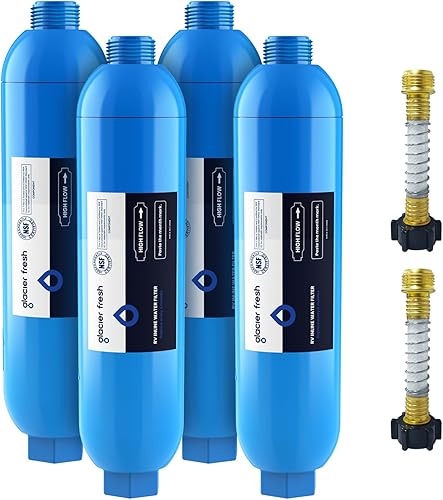
GLACIER FRESH RV/Marine Water Filter: Best for RV hose seasons
- GAC and KDF filtration
- 20 micron rating
- 4-pack
- 2 flexible hose protectors included
- For standard hoses
A four-pack of inline hose filters for RVs, boats and campers. It suits buyers who want several filters for a camping season.
Pros
- Four filters per pack
- Hose protectors included
- High durability housing
Cons
- Needs a hose supply
- Not for backpacking
GLACIER FRESH suits RV, marine and car camping with a hose hookup. The 4-pack gives you filters for a full season or several rigs, which spreads the cost across trips.
It uses GAC granular activated carbon and KDF. The micron rating is 20 microns, the same level as the Camco pick for sediment protection.
GLACIER FRESH says independent lab testing showed 97.9 percent chlorine removal. It also states a three month durability for a camping season, a practical way to think about replacement.
Two flexible hose protectors are included to reduce strain on connections. That helps when you bend a hose into a tight RV bay or a boat dock connection.
The housing is food-grade plastic, strengthened to prevent bursting. The material is lead-free and BPA-free, which matters for daily drinking use.
The trade-off is use case. Like the Camco pick, it needs a hose supply and does nothing at a backcountry stream.
Camco vs GLACIER FRESH vs straws and gravity systems
Hose filters win for campsite convenience. Straws win for trail weight.
Gravity systems win for group volume. Press bottles win for speed.
| Product | Best for | Pack | Filtration | Sediment rating | Our score |
|---|---|---|---|---|---|
| Camco Tastepure RV Water Filter 2-pk | hose-fed campsites | 2 filters | GAC and KDF | 20 microns | 9.7 |
| Membrane Solutions Personal Water Filter Straw S1 | backpacking portability | 9.7 | |||
| LifeStraw Personal Water Filter for Hiking | simple trail use | 9.5 | |||
| Waterdrop Gravity Water Filter Straw | gravity-fed groups | 9.4 | |||
| Membrane Solutions 6L Gravity Water Filter Pro | basecamp volume | 9.1 | |||
| Practical Survival Reusable Emergency Water Filter Straws | emergency kits | 2 filters | 0.1 micron | 8.9 | |
| Waterdrop Water Filter Straw | multi-person straw packs | 4 straws | 8.6 | ||
| GRAYL GeoPress 24 oz Water Purifier | fast press purification | 8.4 | |||
| GLACIER FRESH RV/Marine Water Filter | RV hose seasons | 4 filters | GAC and KDF | 20 microns | 8.2 |
Camco and GLACIER FRESH both use GAC and KDF in an inline hose format. Camco offers a 2-pack with a 20-micron sediment filter.
GLACIER FRESH offers a 4-pack with hose protectors.
Straws like LifeStraw and Membrane Solutions S1 use hollow fiber membranes for bacteria and parasite reduction. They are lighter, but they serve one drinker at a time.
Gravity systems like Waterdrop and Membrane Solutions 6L Pro add a reservoir. That helps groups, but adds setup and pack volume.
GRAYL sits alone as a press bottle. It is the only pick here that states virus removal.
Think about where your water comes from before you compare these types. A hose filter cannot treat a stream, and a straw cannot improve a chlorinated tap for a whole RV.
That source question settles most of the decision. If you have a tap, hose filters are simple.
If you have a stream, straws and gravity systems do the work.
How we compared these water filters for camping
We compared specs, features and buyer feedback against camping use cases. We looked at filtration type, capacity, flow, weight and pack size.
We checked what each product actually filters. Hose filters focus on chlorine, taste, odor and sediment.
Straws and gravity systems focus on bacteria, parasites and particulates.
We also checked flow and daily use. A filter that flows slowly gets skipped at camp, even if its capacity looks good on paper.
Scores reflect how well the specs fit each camping pattern.
How pack size and weight changed the scores
Pack size mattered in scoring because camping gear competes for space. A 2 ounce straw adds almost nothing to a pack, while a 15.9 ounce press bottle or a gravity bag adds real weight.
We also weighed how many pieces you must carry and clean. A single straw is simple to rinse and dry.
A bag, straw and pouch need more care at the end of a trip.
Capacity was compared against trip length, not treated as a contest. A filter rated for 1,000 gallons and one rated for 1,400 gallons both outlast most camping seasons by a wide margin.
Flow, weight and filtration type therefore carried more weight than small capacity gaps. That is why a fast press bottle can score well despite a 65 gallon cartridge.
What type of camping water filter do you need?
Straws are best for backpacking, gravity bags are best for groups, hose filters are best for RV sites, and press bottles are best for fast purification.
Straws for backpacking
Straws weigh about 2 ounces and fit in a pack pocket. LifeStraw, Membrane Solutions S1 and Practical Survival all follow this pattern.
They are ideal for drinking from streams and lakes on the move. They are poor for filling a cook pot for four people.
Their strength is independence. Each person carries their own protection and drinks when they want, without waiting for a bag to drip.
Gravity systems for basecamp
Gravity systems hang above a tap and fill cups without sucking or squeezing. Waterdrop and Membrane Solutions 6L Pro are the group picks here.
Our best gravity water filter for camping guide covers this style in more depth. It helps if you camp with a family or a group.
A 1.5 gallon bag suits a small group for a day. A 6 liter bag suits longer basecamp stays where cooking water matters as much as drinking water.
Hose filters for RV and car camping
Hose filters attach to a standard garden or drinking water hose. Camco and GLACIER FRESH are inline models for taps at camp.
If you use an RV, also check our best drinking water filter for RV guide. It covers permanent RV installs and hose options.
These filters shine when you fill jugs and bottles at the site. They keep taste and chlorine down without any sucking or pressing.
Press bottles for speed
Press bottles purify one bottle in seconds. GRAYL is the press option here, with virus removal that straws do not state.
That speed helps at busy campsites where you fill bottles between hikes.
It also helps in travel, where you may fill from a sink and want a full bottle ready fast.
How do you size capacity and flow for camping?
Capacity matters less than flow for most campers, because even 65 gallons covers many trips.
A 24 oz bottle at 65 gallons gives you about 350 fills. A straw at 1,000 gallons gives you thousands of fills.
Flow matters daily. Waterdrop straws state 700 ml per minute.
Membrane Solutions S1 states 500 ml per minute. Gravity bags state about 0.5 liter per minute.
Slow flow annoys you when you are thirsty. Fast flow helps when you fill bottles for a hike.
Check supported TDS limits too. Some straws list 300 to 1,000 ppm maximums.
That tells you what water sources they are designed for.
A 300 ppm limit suits cleaner sources. A 1,000 ppm limit gives you more room for mineral-heavy water, though taste still depends on the source.
Weight also shapes flow in practice. A light straw you carry everywhere beats a heavier system you leave in the car.
How should you set up and care for camping filters?
Prime before first use, backflush when flow drops, and dry fully before storage.
Waterdrop says to infiltrate its straw in clean water for 10 seconds to prime the membrane. Membrane Solutions S1 says to stand it in drinking water for 1 to 2 minutes when dry.
Backflush with clean water from the mouthpiece side. That pushes debris out of the membrane instead of deeper into it.
For gravity bags, hang the bag high enough for steady flow. Rinse the bag and let it dry before packing.
For hose filters, let water run through before drinking. Store them dry so KDF and GAC do not sit in stagnant water.
Never use these filters on seawater. The product data for straws specifically warns against seawater use.
Drying matters more than it sounds. A damp membrane stored in a pack can grow the odor you were trying to avoid.
Backflushing with the cleanest water you have works best. That is why Membrane Solutions suggests fresh water for backwashing after each use.
What filtration claims should you check?
Look for the specific contaminant, the pore size and the standard, not just the word purifier.
Hose filters with GAC reduce chlorine, taste and odor. KDF helps control bacteria and mold in the filter itself.
Membrane straws with 0.1 micron pores target bacteria and parasites. LifeStraw states 99.999999 percent bacteria removal and 99.999 percent parasite removal.
GRAYL states virus removal in addition to bacteria and protozoa. That is a broader claim than most straws make.
NSF/ANSI 42 covers taste and chlorine. NSF/ANSI 372 covers lead-free materials.
NSF/ANSI 401 covers microplastics and particulate reduction.
Certificates matter, but they do not mean the filter removes everything. Match the claim to your water source.
For hose use, our best drinking water filter for hose guide breaks down inline options. It pairs well with the RV and marine picks here.
For hiking-specific gravity options, see our best gravity water filter for hiking guide. It focuses on lighter bags for trails.
For emergency kits, our best gravity water filter for survival guide covers disaster and bug-out use. Backpacking-focused buyers should also read our best gravity water filter for backpacking guide.
If you already own an RV, our best inline water filter for RV guide covers hose-line options in more detail.
Which camping water filter should you buy?
Pick Camco for hose-fed campsites, Membrane Solutions S1 for backpacking, Waterdrop Gravity for small groups, and GRAYL for fast press purification.
For RV and car camping with a hose hookup, Camco or GLACIER FRESH gives you easy water for drinking and cooking. Camco is the better known 2-pack.
GLACIER FRESH gives you four filters and hose protectors.
For backpacking, Membrane Solutions S1 and LifeStraw are the lightest picks. S1 offers higher stated capacity and 28mm bottle fit.
LifeStraw offers simple direct drinking.
For groups at basecamp, Waterdrop Gravity and Membrane Solutions 6L Pro give you a shared reservoir. Waterdrop includes a pouch.
The 6L Pro holds more for 3 to 6 people.
For speed and virus removal, GRAYL GeoPress is the only press bottle here. Accept the heavier weight and shorter cartridge life.
For a family pack, the Waterdrop 4-pack straws give each person their own filter. For an emergency kit, the Practical Survival 2-pack is easy to store.
Match the filter to your water source and campsite setup. That match matters more than chasing the highest capacity number.
Our top 3 picks at a glance
-
1
-
2
Best for backpacking portability
Membrane Solutions Personal Water Filter Straw S1
9.7/10 our score
See it on Amazon -
3
Best for simple trail use
LifeStraw Personal Water Filter for Hiking
9.5/10 our score
See it on Amazon
Frequently asked questions
What is the best portable water filter for camping?
For most campsites, an inline hose filter is best when you have a hose supply, and a personal straw is best for backpacking. Gravity systems suit groups who want a shared reservoir at basecamp.
Choose by how you get water at camp, not by capacity alone.
Can you drink stream water with a camping filter?
Many camping straws and gravity systems are designed to reduce bacteria, parasites, sediment and chlorine from freshwater sources. GRAYL also states virus removal, while hose filters focus on taste, odor and sediment.
Always follow the brand instructions for the source and filter type you choose.
How often should you backflush a straw filter?
Backflush when flow slows or after use in silty water, using clean water from the mouthpiece side. Let the straw dry before storage.
Priming and backflushing help protect the membrane and keep flow steady on later trips.
Do hose filters work for tent camping?
Hose filters work when your campsite has a hose hookup you can connect to, such as an RV site or a cabin with an outdoor tap. They are not useful on a trail with no hose supply.
Tent campers usually carry a straw, gravity bag or press bottle instead.