Do Brita Water Filters Remove Microplastics?
Brita water filters should not be assumed to remove microplastics unless the exact model has a verified microplastic reduction claim. Brita certifications and contaminant claims apply to specific substances and models, not automatically to every filter.
On this page (7 sections)
- Do Brita water filters remove microplastics?
- Why do model-specific claims matter?
- Does certification prove microplastic reduction?
- What does the BRITA MAXTRA+ filter claim?
- How should you check a Brita microplastic claim?
- Can hard water or a refrigerator filter change the answer?
- What is the practical choice?
Brita water filters should not be assumed to remove microplastics unless the exact model has a verified microplastic reduction claim. A filter may improve taste or reduce listed contaminants while offering no published proof for microplastic reduction.
That distinction is easy to miss because the same pitcher can carry several clear claims for taste and named substances. Chlorine taste and odor, copper, mercury, cadmium, zinc, lead, and limescale are not interchangeable with plastic particles.
Microplastics are small plastic particles that can vary in size, shape, and material. Fibres, fragments, and rounded pellets can behave differently as they move through a filter bed.
That variation matters because a filter that catches larger sediment may not be tested for smaller particles or for every type of plastic. A fine mesh or carbon bed may affect particles in one test setup and still lack a verified claim for the size range you care about.
It also matters at home because pitchers are used passively between refills. Water sits in the reservoir, the cartridge stays wet, and performance depends on the whole cartridge and pitcher combination rather than on the brand alone.
For daily use, the practical risk is overreading a broad word such as impurities. That word can cover many different substances, and it does not tell you which particles were tested, at what size, or to what reduction level.
Set a plain rule before you shop or refill. If the exact pitcher and cartridge do not name microplastics in a verified claim, treat removal as unconfirmed and choose the filter for its named benefits instead.
Those named benefits still have value in a kitchen. A pitcher filter can suit taste, odour, and the specific metals or minerals listed for that model, provided you follow its change schedule.
Care affects those claims too. An overdue cartridge may no longer match the stated life for its listed reductions, so it cannot be treated as a reliable microplastic barrier by default.
If you are comparing filter types, start with this drinking water filter buying guide. It explains how filter claims, capacity, replacement schedules, and certifications affect a buying decision.
Use that guide to separate pitcher filters from other household options before you narrow the choice. Capacity and change intervals shape daily habits, while the contaminant list tells you what the maker actually claims.
Then return to the exact model in hand. Check the cartridge name, the certified reductions, and the stated replacement interval as one set.
That approach keeps the decision honest. You can still choose a Brita pitcher for taste and its listed reductions without assuming a microplastic benefit that has not been verified for that model.
Do Brita water filters remove microplastics?
There is no blanket answer for every Brita filter. Microplastic performance must be tied to the exact Brita model, cartridge, test method, and certified reduction claim.
Brita sells several filter types with different materials, designs, and stated contaminant reductions. A claim for chlorine, copper, mercury, cadmium, lead, limescale, or taste does not automatically include microplastics.
The safest rule is simple: if the exact model does not name microplastics in its verified performance claims, treat microplastic removal as unconfirmed. Do not infer it from the Brita brand name or from a general statement that the filter reduces impurities.
Compatibility also needs care in daily use. A cartridge that fits a pitcher mechanically may still carry a different change interval and a different list of certified reductions from another cartridge.
Replacement timing matters for the same reason. The stated life for chlorine, taste, or metal reduction should not be stretched into an assumed life for plastic particles that were never named.
Our guide to the best Brita water filters can help you compare the product type and stated use before you focus on a single contaminant.
Why do model-specific claims matter?
A water filter's claims belong to its specific model and cartridge combination. Two filters from the same brand can use different media, fit different pitchers, and carry different certified reduction claims.
For example, one Brita pitcher may be designed around a standard filter, while another uses a Longlast filter or a different replacement format. The compatible cartridge affects the claims you should review.
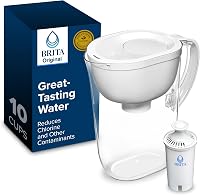
The Brita Large 10 Cup Water Filter Pitcher is a BPA-free plastic pitcher with a 10-cup capacity and 1 filter included. Its stated reductions include chlorine taste and odor, mercury, copper, zinc, and cadmium, but those claims do not guarantee microplastic reduction.
Its manual design, easy-fill locking lid, and refrigerator-friendly shape suit routine drinking water use. The filter change guidance is 40 gallons or about 2 months for a Standard filter, while a Longlast filter is described as lasting 120 gallons or about 6 months.
Choose this pitcher when your main goal is taste and the listed metal reductions. Choose another model only when its verified claims match a specific concern, such as microplastics.
Does certification prove microplastic reduction?
Certification proves only what the relevant standard and product evaluation cover. It does not turn every certified filter into a general-purpose microplastic filter.
NSF standards can address different areas, such as aesthetic effects, health-related contaminant reduction, emerging contaminants, or material safety. You can review the general role of NSF water filter testing and treatment standards before comparing a certification mark.
A certification number or label should be read alongside the contaminant list and the exact model. Look for the named substance, the reduction claim, and the product or cartridge covered by the certification.
NSF/ANSI 42, for example, is commonly associated with aesthetic effects such as taste and odor. NSF/ANSI 53 addresses certain health-related contaminants, while NSF/ANSI 401 can cover selected emerging contaminants.
None of those numbers alone means microplastics are reduced.
NSF/ANSI 372 relates to lead content in plumbing components rather than proving that a pitcher removes lead or microplastics from water. That is why certification labels need context.
For another example, the Amazon Basics Enhanced Water Filter is WQA certified against NSF/ANSI 42, 53, 401, and 372. Its stated reductions include chlorine taste and odor, zinc, copper, cadmium, mercury, benzene, atenolol, linuron, and trimethoprim, not microplastics.
Each filter is described as lasting 40 gallons or about 2 months. This option suits households that want several replacement filters and a wider named contaminant list, but the certification details still should not be read as proof of microplastic removal.
What does the BRITA MAXTRA+ filter claim?
BRITA MAXTRA+ claims reductions for chlorine, limescale, lead, copper, and other impurities, but its supplied claims do not name microplastics. That makes it a taste and mineral-focused replacement choice rather than a confirmed microplastic filter.
The cartridge is compatible with BRITA jugs, including models with the PerfectFit feature such as Aluna, Marella, and Style. Its Micro Carbon Pearls are described as reducing chlorine and impurities, while Ion Exchange Pearls absorb lead and copper and reduce limescale.
This cartridge suits people who already use a compatible BRITA jug and want the stated taste, limescale, lead, and copper benefits. It should not be chosen specifically for microplastics unless the exact current product documentation provides that claim.
Check compatibility before replacing a cartridge. A filter that fits a jug mechanically may still have different change intervals and contaminant claims from another BRITA cartridge.
How should you check a Brita microplastic claim?
Check the exact model number, cartridge name, certification record, and contaminant claim together. A general product description or a broad phrase such as “reduces impurities” is not enough.
Use this checklist:
- Identify the exact pitcher and replacement cartridge.
- Find the named microplastic claim, if one exists.
- Check whether the claim is certified or only a general manufacturer statement.
- Look for the test conditions and particle size covered.
- Confirm that the certification applies to the cartridge you plan to use.
- Follow the stated replacement schedule.
Avoid treating a fine mesh, activated carbon, or ion exchange material as automatic proof of microplastic removal. Those materials may support other filtration functions, but performance depends on the complete filter design and test results.
If your main concern is lead, read do Brita water filters remove lead for a separate look at lead claims and certification. For a broader contaminant overview, see what Brita water filters remove.
Can hard water or a refrigerator filter change the answer?
Hard water and refrigerator filtration are separate questions from microplastic reduction. A filter that reduces limescale may improve kettle or tea use without being tested for plastic particles.
The BRITA MAXTRA+ cartridge has a stated limescale reduction claim, so it may suit readers focused on mineral buildup in drinks or appliances. Read can a Brita water filter help with hard water before choosing a cartridge for that problem.
A refrigerator filter also needs its own model-specific claim. Do not assume that bypassing a refrigerator filter improves or worsens microplastic performance.
If you are troubleshooting a refrigerator setup, see how to bypass a refrigerator water filter and follow the appliance instructions.
Portable filtration is different again. A gravity system made for outdoor use may have different particle claims, flow rates, and care needs than a Brita pitcher.
Compare the best gravity water filters for camping if your use is away from a kitchen.
What is the practical choice?
Choose a Brita filter for the contaminants it specifically names, not for an assumed microplastic benefit. The Brita Large 10 Cup Water Filter Pitcher fits daily household use with a 10-cup capacity, while BRITA MAXTRA+ focuses on compatible jugs and stated chlorine, limescale, lead, and copper reductions.
Choose the Amazon Basics Enhanced Water Filter if you want a 6-pack for compatible Brita pitchers and dispensers, excluding Brita Stream, plus its named WQA and NSF certification standards. Choose the BRITA MAXTRA+ cartridge if you already use a compatible BRITA jug and want its stated taste and limescale benefits.
If microplastic reduction is the deciding factor, look for a verified claim for the exact cartridge and particle range. Until that evidence is clear, describe Brita water filter microplastics performance as unconfirmed, not guaranteed.
Frequently asked questions
Do Brita water filters remove microplastics?
Brita water filters should not be treated as microplastic filters unless the exact model has a verified claim for microplastic reduction. Standard contaminant claims for chlorine, metals, taste, or other substances do not automatically prove that the filter removes microplastics.
Does NSF certification mean a water filter removes microplastics?
No. NSF certification applies to the specific standard, contaminant, reduction level, and product model evaluated.
A filter certified to NSF/ANSI 42, 53, 401, or 372 may address listed substances under that standard, but the certification alone does not prove microplastic reduction.
Can a Brita pitcher filter plastic particles?
A Brita pitcher filter may catch some particles based on its filter design, but that is not the same as a verified microplastic reduction claim. Check the exact model's certified claims and use a filter designed and tested for the particle size and reduction level you need.
Which Brita filter removes the most contaminants?
The answer depends on the exact model and the contaminants you want to reduce. Compare the certified claims for that cartridge or pitcher instead of assuming every Brita filter has the same performance.
Replacement filters may also have different compatibility and change intervals.