How to Check if a Gravity Water Filter Is Made in USA
A gravity water filter is made in the USA only when reliable evidence supports the full manufacturing claim. Check the maker's country-of-origin statement, distinguish assembly from manufacturing, and verify the origin of the filter elements and system parts.
On this page (10 sections)
- What does “made in the USA” mean for a gravity water filter?
- Which country-of-origin claims should you separate?
- How do you check the brand's own evidence?
- Does the filter element need separate verification?
- What should you check on packaging and product labels?
- How can certifications help verify the system?
- How do you compare a gravity filter with a portable filter?
- What are warning signs of a weak origin claim?
- How should you record your verification?
- What should you do before buying?
A gravity water filter is made in the USA only when reliable evidence supports the full manufacturing claim. Check the maker's country-of-origin statement, distinguish assembly from manufacturing, and verify the origin of the filter elements and system parts.
A brand's American address, customer support team, or domestic warehouse doesn't prove that the filter was made in the United States. You need evidence about the actual system and its replacement elements.
If you are still comparing filter types, start with this drinking water filter guide to review the main filtration methods and buying factors.
What does “made in the USA” mean for a gravity water filter?
“Made in the USA” should describe substantial manufacturing in the United States, not just an American brand name or a domestic shipping address. The claim should also make clear whether it applies to the complete filter system or only one component.
A gravity system may contain a metal or plastic housing, filter elements, seals, taps, stands, lids, and packaging. Those parts can come from different countries, so a broad claim may need closer checking.
The Federal Trade Commission's Made in USA guidance explains how businesses should support unqualified origin claims. Use it as a reference when a brand says a complete product is made in the USA.
Which country-of-origin claims should you separate?
Separate “made in the USA,” “assembled in the USA,” “designed in the USA,” and “American-owned.” These phrases describe different activities and don't prove the same thing.
“Designed in the USA” refers to product design. “Assembled in the USA” may mean that imported parts were put together domestically.
“American-owned” describes ownership, not manufacturing.
Ask the brand whether its statement covers:
- The complete gravity filter system
- The filter elements or cartridges
- The filtration media
- The housing, lid, tap, and seals
- Replacement parts sold separately
- Packaging and accessories
A clear answer should identify the manufacturing location and the parts covered by the claim.
How do you check the brand's own evidence?
Start with the manufacturer's official origin statement, then ask a specific follow-up question. Avoid relying on a product name, flag graphic, American city address, or general statement about quality.
Look for a country-of-origin page, FAQ, package image, or technical document. The strongest wording identifies the product line and says whether the claim applies to the full system or only selected parts.
Send a short question such as: “Are the complete gravity filter system and replacement elements manufactured in the United States? If not, which parts are imported, and where are they made?”
Save the reply with the date and the exact model name. A clear answer about one system doesn't automatically cover a different model or replacement element.
Does the filter element need separate verification?
Yes. The filter element deserves separate attention because it performs the filtration and may be made in a different place from the container.
A USA-made stainless steel housing doesn't prove that the filter media or ceramic element was made domestically.
Check the element's brand, model number, material, and replacement instructions. Ask whether the same origin applies to the first element included with the system and to later replacement elements.
The best gravity water filter elements guide can help you compare replacement choices. Keep the origin question separate from performance claims, because a filter's country of manufacture doesn't prove how well it removes a particular contaminant.
For fluoride questions, see can a Berkey water filter remove fluoride. Fluoride reduction depends on the specific filtration media and the evidence supporting that claim.
What should you check on packaging and product labels?
Look for a specific country-of-origin mark on the package or product, then compare it with the brand's written explanation. A small flag or “American” wording without a clear manufacturing statement is not enough.
Check the box, instruction manual, filter element wrapper, and product label for phrases such as:
- Made in USA
- Made in USA with imported parts
- Assembled in USA
- Made in another country
- Country of origin
Photograph the wording if you are checking a filter in a store. For an online order, ask for a current package photo if the origin information is unclear.
Don't treat a company address as manufacturing proof. A mailing address can represent sales, support, or distribution rather than production.
How can certifications help verify the system?
A certification can support a product's safety or performance claim, but it doesn't automatically prove American manufacturing. Check what the certification covers and who issued it.
The certification may apply to the complete system, a specific filter element, or a test method. Read the scope carefully, then look for separate country-of-origin evidence.
A reverse osmosis system can be useful for readers who need an under-sink setup rather than gravity filtration. The iSpring RCC7AK-BN NSF Certified is a 75 GPD, alkaline 6-stage reverse osmosis system with NSF/ANSI 58 certification, an under-sink installation, and a top-mounted faucet design.
Its origin still needs separate verification. NSF certification describes the covered filtration standard, not necessarily where every system component was manufactured.
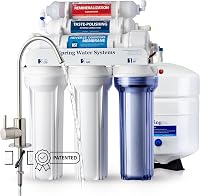
The iSpring RCC7-BN NSF Certified is a 75 GPD, 5-stage under-sink reverse osmosis system with a brushed nickel faucet, NSF/ANSI 58 certification, and no power requirement.
Its 5-stage process uses reverse osmosis, activated carbon, and carbon block filtration. Those details help you compare system types, but they don't mean the system was made in the USA.
How do you compare a gravity filter with a portable filter?
Compare the intended use before comparing country of origin. A household gravity system, an under-sink reverse osmosis system, and a personal hiking filter solve different water access problems.
A personal filter may be useful for travel or emergencies, but it isn't a countertop gravity system. The LifeStraw Personal Water Filter for Hiking is a blue, 1PK personal filter with a hollow fiber membrane and no electricity or battery power required.
It weighs 1.62 ounces and is designed for potable drinking water. Its stated protection covers bacteria, parasites, microplastics, dirt, sand, and cloudiness, but those use details don't verify American manufacturing.
For household gravity systems, compare the best countertop gravity water filter systems after confirming the origin of the system and its replacement elements.
What are warning signs of a weak origin claim?
A weak claim uses broad American language without naming the manufacturing location or the parts covered. Treat missing detail as a reason to ask questions before you buy.
Watch for:
- An American flag with no country-of-origin wording
- An American company address presented as proof of production
- “Designed in the USA” used beside a made-in-USA implication
- “Assembled in the USA” without imported-part details
- A USA claim for the housing but no origin information for the elements
- Different origin statements on the package and the brand website
- Support replies that avoid naming the manufacturing location
One unclear phrase doesn't prove that a product is imported or misleading. It means you need a more precise answer before treating the filter as made in the USA.
How should you record your verification?
Record the model, element number, origin statement, and date you checked them. This matters because manufacturing locations and suppliers can change.
Use a simple note with these fields:
- Brand and complete model name
- Filter element model or part number
- Country-of-origin wording
- Parts covered by the wording
- Source of the evidence
- Date checked
- Any unanswered questions
Keep the note with your replacement-filter records. If you later buy a new element, verify its origin again instead of assuming it matches the original.
You can also compare the system with best gravity water filters for home when the main goal is household use. Check the exact model and element combination, since a brand's origin claim may not cover every product.
What should you do before buying?
Buy only after the brand clearly explains where the complete gravity system and its filter elements are made. If the answer covers only assembly, design, or the housing, describe the product more narrowly.
Use this decision rule:
- Choose a product with a clear full-system USA claim when domestic manufacturing is your priority.
- Ask for separate element information when the filtration media matters most.
- Treat assembly, design, ownership, and support claims as different from manufacturing.
- Keep certification evidence separate from country-of-origin evidence.
- Recheck the origin when you replace the filter element.
A gravity water filter made in the USA should have a specific, consistent origin explanation that matches the model you plan to buy. If the brand cannot explain which parts are domestic, keep comparing before you commit.
Frequently asked questions
How can I tell if a gravity water filter is made in the USA?
Check the brand's country-of-origin statement and ask whether it applies to the complete system, the filter elements, or only final assembly. Then compare that answer with manufacturer records, packaging, and certification information.
A company location or American support address alone does not prove that every part was made in the USA.
Does assembled in the USA mean made in the USA?
No. Assembled in the USA can mean that imported parts were put together domestically.
Ask which components are imported and whether the claim covers the stainless steel body, filter media, housings, seals, fittings, and other parts that make up the complete gravity system.
Are gravity water filters always made in the USA if the brand is American?
No. An American brand may design, sell, or support a filter while manufacturing happens elsewhere.
Verify the country of origin for the complete system and the replacement elements separately, because the body, filtration media, and accessories may come from different locations.
What evidence should a gravity water filter brand provide?
Look for a clear country-of-origin statement that identifies what the claim covers, along with consistent information on the brand website, packaging, and customer support replies. Useful evidence names the manufacturing location and distinguishes domestic production from assembly, design, testing, or distribution.