Can a Berkey Water Filter Remove Fluoride?
A standard Berkey water filter element should not be treated as a fluoride filter. Fluoride reduction depends on using a dedicated fluoride-reduction accessory and following its current instructions.
On this page (9 sections)
- Can a Berkey Water Filter Remove Fluoride?
- Do standard Berkey filter elements remove fluoride?
- What is the difference between standard elements and fluoride accessories?
- Is reverse osmosis a stronger fluoride option?
- How does the standard iSpring RCC7 compare?
- Is LifeStraw suitable for fluoride removal?
- How should you choose a fluoride filter?
- What should you verify before buying?
- Can a Berkey water filter remove fluoride?
Can a Berkey Water Filter Remove Fluoride?
A standard Berkey water filter should not be treated as a fluoride-removal system. If fluoride is the reason you are buying a filter, you need a setup that documents fluoride performance for the exact element or accessory you will use.
The key distinction is between standard filtration elements used for general water treatment and an accessory designed for fluoride reduction. A filter can improve taste and clarity without reducing every dissolved mineral or ion in the water.
Fluoride is especially easy to misunderstand because it dissolves and leaves no visible sign. Clear water can still contain fluoride, so appearance alone cannot tell you whether a system is working for that specific purpose.
That is why a broad claim about removing contaminants is not enough on its own. You need to see fluoride named specifically, along with the model it applies to and the conditions under which it was tested.
Compatibility matters just as much as the claim itself. A dedicated accessory may need a particular arrangement, may work alongside standard elements, or may have its own replacement schedule that differs from the main filters.
Care also affects results over time. Following the current instructions for installation, cleaning, and replacement is part of using any fluoride-focused accessory as intended.
If fluoride is your main concern, start with the exact claim, testing details, compatibility, and replacement instructions before you compare prices or features. Our guide to drinking water filters explains how different filter types handle contaminants and household needs.
Do standard Berkey filter elements remove fluoride?
You should not assume that standard Berkey elements remove fluoride. Standard elements may target a broad group of contaminants, but that does not prove fluoride reduction.
Fluoride is dissolved in water, so it is different from visible sediment, dirt, or cloudiness. A filter that improves taste or catches particles may still leave dissolved fluoride in the water.
That is why a fluoride question needs a specific answer from the manufacturer or an independent test. Look for a fluoride-reduction claim tied to the exact element or accessory, not just a general statement about cleaner water.
The same rule applies when comparing gravity filters. Our guide to the best gravity water filters can help you separate gravity flow, filter media, and contaminant claims.
What is the difference between standard elements and fluoride accessories?
Standard elements handle the main filtration job, while a dedicated fluoride accessory is intended to address fluoride reduction. They should not be described as interchangeable unless the system instructions say they are.
A dedicated accessory may require a particular arrangement, installation step, or replacement schedule. Check whether it works with your Berkey model and whether it is used with the standard elements or in a separate stage.
Do not judge a fluoride accessory by its name alone. Confirm the exact fluoride claim, the water conditions used for testing, the expected service life, and the steps needed to maintain it.
For a similar comparison involving another gravity system, see can a British Berkefeld water filter remove fluoride?. The same principle applies: the exact element matters more than the brand name.
Is reverse osmosis a stronger fluoride option?
Reverse osmosis is often the more direct choice when fluoride reduction is the main goal. It uses a membrane-based process and is commonly selected for dissolved contaminants that ordinary sediment filters do not target.
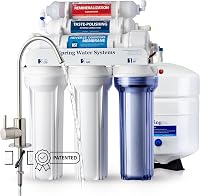
The iSpring RCC7AK-BN is an under-sink, 75 GPD, alkaline 6-stage reverse osmosis system with NSF/ANSI 58 certification. Its stated filtration performance includes a fluoride reduction claim of more than 97.4%, along with reduction claims for several other contaminants.
This model suits a kitchen where you want a dedicated drinking-water system under the sink. It has a top-mounted faucet design, a transparent first-stage housing for checking buildup, and no electricity requirement.
The alkaline stage adds natural mineral media after reverse osmosis. Choose it if that extra stage matters to you; choose a simpler system if you only want the core reverse osmosis process.
The system includes the RO system, brushed nickel faucet, storage tank, and extra tool set. Its stated operating pressure range is 70 psi, so check your home's water pressure and installation space before choosing an under-sink system.
How does the standard iSpring RCC7 compare?
The iSpring RCC7-BN offers a simpler 5-stage reverse osmosis setup with a stated fluoride reduction claim. It is designed for under-sink installation and does not need a power source.
The system uses reverse osmosis, activated carbon, and carbon block filtration. Its stated performance includes fluoride reduction, lead reduction up to 98%, and reduction of more than 1,000 harmful contaminants.
The RCC7-BN includes housings, filters, parts and tubing, a faucet, and a mounting bracket. Its transparent first-stage housing lets you inspect the sediment filter, while push-to-connect fittings are intended to simplify setup.
Its dimensions are 23.62 in L x 15.75 in W x 11.81 in H. Measure the cabinet space first, especially if your sink has plumbing, a disposal unit, or storage items below it.
The choice between the two iSpring systems is mainly about the filtration layout and added alkaline stage. The RCC7AK-BN includes alkaline remineralization, while the RCC7-BN uses a 5-stage reverse osmosis process without that named stage.
For a broader comparison, read Berkey water filter vs reverse osmosis. If you are comparing water treatment to hardness control, see reverse osmosis vs water softener.
Is LifeStraw suitable for fluoride removal?
LifeStraw Personal Water Filter for Hiking is not a fluoride filter. Its stated functions focus on bacteria, parasites, microplastics, dirt, sand, silt, and cloudiness.
The blue, 1-pack filter uses a hollow fiber membrane and requires no electricity or battery power. It is made from plastic and weighs 1.62 oz.
LifeStraw states that the filter removes 99.999999% of waterborne bacteria and 99.999% of waterborne parasites. It also states that the filter removes microplastics down to 1 micron and reduces turbidity down to 0.2 microns.
Those functions make it useful for outdoor and emergency water treatment, but they do not guarantee fluoride reduction. Do not choose this type of personal filter when dissolved fluoride is the contaminant you need to address.
Its stated purification capacity is 1,000 gallons, or 4,000 liters. Use it for the water conditions and purposes it is designed for, rather than treating it as a replacement for a home reverse osmosis system.
How should you choose a fluoride filter?
Choose a filter with a specific fluoride-reduction claim that matches your water source and daily use. Then confirm installation, compatibility, maintenance, and replacement requirements.
A gravity system may suit you if you want filtration without a connection under the sink. A dedicated fluoride accessory can make sense when you already have a compatible gravity system and want to add fluoride-focused treatment.
An under-sink reverse osmosis system may suit a household that wants a separate drinking-water faucet and a stated fluoride reduction claim. It needs cabinet space, plumbing connections, and regular filter changes.
A portable straw is for outdoor or emergency use when bacteria and parasites are the main concern. It is not a substitute for fluoride treatment.
If lead is also a concern, compare options in best water filters for lead removal. For a different cartridge-based approach, see best Brita water filter replacement cartridge.
What should you verify before buying?
Verify the exact element, accessory, or system model before you order. Fluoride performance can differ between a base filter and an optional add-on.
Check these points:
- Does the product name or documentation identify fluoride reduction?
- Is the claim tied to the exact model or replacement element?
- Does the accessory fit your Berkey system?
- Does it work alongside the standard elements or replace them?
- What water conditions were used for the claim?
- How often should the filter or accessory be replaced?
- Does the system need a faucet, tank, drain connection, or cabinet space?
Do not rely on a general phrase such as “removes contaminants.” Ask whether fluoride is named and whether the claim applies to the complete setup you plan to use.
Can a Berkey water filter remove fluoride?
A Berkey water filter can address fluoride only when the specific setup includes a suitable, documented fluoride-reduction accessory. Standard filtration elements should not be treated as proof of fluoride removal.
Pick a dedicated Berkey fluoride accessory if you want to keep a compatible gravity system and its instructions support that setup. Pick the iSpring RCC7AK-BN if you want reverse osmosis with an alkaline stage and a stated fluoride reduction claim, or the iSpring RCC7-BN if you prefer a 5-stage under-sink system without that added stage.
Use LifeStraw for portable bacteria and parasite filtration, not fluoride treatment. For more Berkey-specific buying context, read our Berkey water filter reviews.
Frequently asked questions
Can a standard Berkey water filter remove fluoride?
A standard Berkey water filter element should not be assumed to remove fluoride. Fluoride reduction is a separate filtration task, so check whether your setup includes a dedicated fluoride-reduction accessory and follow the current instructions for that accessory.
What removes fluoride from drinking water?
Reverse osmosis is one common approach for reducing fluoride. A dedicated fluoride-reduction filter may also be suitable when it is designed and documented for that purpose; check its tested claims, installation requirements, and replacement schedule before choosing it.
Do Berkey fluoride filters replace the standard elements?
Not necessarily. A dedicated fluoride-reduction accessory may work alongside standard elements or require a specific setup, depending on the system and accessory.
Confirm the current compatibility and installation instructions before changing the elements in your Berkey system.
Does LifeStraw remove fluoride?
The LifeStraw Personal Water Filter for Hiking is designed for bacteria, parasites, microplastics, dirt, sand, and cloudiness. Its stated features do not identify fluoride reduction, so it is not the right choice when fluoride removal is your main goal.