7 Best Water Drop Reverse Osmosis System (November 2026)
The best Waterdrop reverse osmosis systems include the iSpring RCC7AK-BN NSF Certified for certified alkaline filtration, the Waterdrop G2 Reverse Osmosis System for compact tankless value, and the Waterdrop G3P600 Tankless Reverse Osmosis Water Filter for high daily output.
On this page (6 sections)
- Which water drop reverse osmosis system is best?
- The best water drop reverse osmosis system picks
- Which countertop reverse osmosis systems are easiest to place?
- How do you choose a water drop reverse osmosis system?
- How do you install and care for an RO system?
- Best water drop reverse osmosis system verdict
The best water drop reverse osmosis system for most homes is the Waterdrop G3P600, because its 600 GPD output, 8-stage filtration and 2:1 pure-to-drain ratio fit a busy kitchen. The G2 is a smaller tankless choice, while the DREO and Bluevua are simpler countertop options.
The right choice also depends on where the unit will sit, whether power is available, and how often you fill bottles or cook with filtered water.
This comparison includes Waterdrop models plus closely matched reverse osmosis systems for shoppers deciding between under-sink and countertop filtration. For help weighing treatment approaches, see reverse osmosis vs water softeners.
We compared capacity, filtration stages, power needs, installation style, output and maintenance details. Each pick is judged on what the stated specs mean in daily use, not on the headline number alone.
For broader background, start with our drinking water filter guide. It explains the main filter types and the questions to answer before choosing an RO system.
Our score weighs specs, features and buyer feedback against what you are shopping for. Use the score as a starting point, then check size, power and filter care against your own setup.
Our picks at a glance
-
1
 Best for certified alkaline filtration
iSpring RCC7AK-BN NSF Certified
9.7/10 our score
See it on Amazon -
2
 Best for compact tankless value
Waterdrop G2 Reverse Osmosis System
9.6/10 our score
See it on Amazon -
3
 Best for high daily output
Waterdrop G3P600 Tankless Reverse Osmosis Water Filter
9.5/10 our score
See it on Amazon
- 4
 Check it
DREO Reverse Osmosis Water Filter System Countertop
Best for easy countertop setup - 5
 Check it
Bluevua RO100ROPOT Countertop Reverse Osmosis Water Filter
Best for glass-carafe countertop use - 6
 Check it
[Dual Flow] Waterdrop WD-T4-A Alkaline pH+ Reverse
Best for two purified water options - 7
 Best for low water pressureCheck it
Which water drop reverse osmosis system is best?
The Waterdrop G3P600 is the strongest overall Waterdrop choice for high daily output, while the G2 is better for a tighter cabinet. The WD-T4-A is the better fit if you want standard RO water and an alkaline stream from the same system.
Think about output first, because GPD shapes how the system feels in a busy kitchen. A higher rating helps when several people fill bottles through the day, while a lower rating can still suit steady drinking and cooking use.
Cabinet space matters just as much as flow. Tankless models save storage space compared with a tank system, but their height and width still need to clear pipes, valves and cleaning supplies under the sink.
Power is the next practical check for the Waterdrop tankless picks. The G2, G3P600 and WD-T4-A all need electricity under the sink, so look for a reachable outlet before you plan the install.
Filtration options then help narrow the field. Some buyers want one standard RO stream, while others value an alkaline or mineral stream for taste and remineralization.
If you are comparing several tankless systems, our guide to the best tankless reverse osmosis system covers the design choice in more detail. You can also see whether an apec tankless reverse osmosis system fits your cabinet before you commit to a brand.
Maintenance also differs by layout, even within the same brand. Filters that twist out quickly suit busy users, while systems with several cartridges need a clearer plan for tracking replacement dates.
Choose by matching the system to your kitchen, not by chasing the largest number. Output, space, power and care together decide whether a pick will work well day after day.
The best water drop reverse osmosis system picks
Waterdrop reverse osmosis systems for under-sink use
The best under-sink system depends on your needed output, available cabinet space and access to electricity. Tankless Waterdrop models save storage space, while the iSpring systems offer traditional tank-based or pump-assisted layouts.
iSpring RCC7AK-BN NSF Certified: Best for certified alkaline filtration
- 75 GPD
- 6-stage filtration
- NSF/ANSI 58 certified
- Top-mounted faucet design
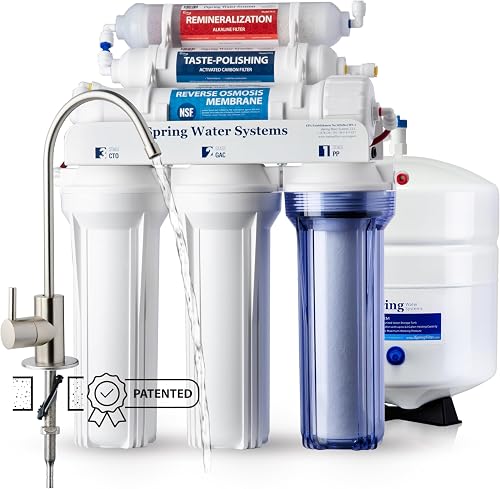
The iSpring RCC7AK-BN adds alkaline remineralization to a 6-stage under-sink system. Its 75 GPD capacity and top-mounted faucet design suit buyers who want a traditional system with certified filtration.
Pros
- NSF/ANSI 58 certified
- Alkaline remineralization
- Transparent first-stage housing
Cons
- Lower stated output than the tankless picks
- No electricity required, but under-sink storage is needed
The iSpring RCC7AK-BN is the highest-scoring pick because it combines NSF/ANSI 58 certification, 6-stage filtration and alkaline remineralization. Its 75 GPD capacity suits regular drinking and cooking use rather than a household that needs very fast filling.
The top-mounted fastener is designed to make faucet installation easier from above the countertop. The transparent first-stage housing also lets you watch for visible buildup before changing that filter.
This system does not need electricity, which can simplify placement under a sink without a nearby outlet. It includes the RO system, a brushed nickel faucet, a storage tank and an extra tool set.
The 15.5 x 16 x 18 in size needs careful cabinet planning because the storage tank takes part of the available space. The stated filter life for the first cycle is 6 months.
Choose it when certification, alkaline remineralization and a traditional under-sink layout matter more than tankless storage savings.
Waterdrop G2 Reverse Osmosis System
The Waterdrop G2 is the best water drop reverse osmosis system for a compact tankless setup with 400 GPD output. Its 17.3 x 5.9 x 14 in body is narrower than many tank-based systems, but it needs an under-sink electrical outlet.
Waterdrop G2 Reverse Osmosis System: Best for compact tankless value
- 400 GPD
- 1:1 pure-to-drain ratio
- 7-stage filtration
- Two pre-installed filters
The Waterdrop G2 is a compact tankless system with 400 GPD output and a 1:1 pure-to-drain ratio. It fits buyers who have an under-sink outlet and want faster flow without a storage tank.
Pros
- 400 GPD output
- Compact tankless design
- 1:1 pure-to-drain ratio
Cons
- Requires under-sink electricity
- Requires drilling holes for installation
The G2 uses 7-stage filtration and has a 1:1 pure-to-drain ratio. Waterdrop states that it can provide a cup of filtered water in about 12 seconds, which suits normal kitchen filling and drinking needs.
That speed is a guideline for a single cup, not a promise for every container. Filling a large bottle or a pot will take longer, and flow can vary with your home water pressure.
Two pre-installed filters are included, which saves a first step during setup. You should still read the manual so you know which filter does what and how to shut off water before removing a cartridge.
The system operates across a stated pressure range of 14.5 to 87 psi and supports a maximum water TDS level of 300 ppm. Check your pressure and water profile against those limits before ordering.
Its 0.28 GPM maximum flow rate is lower than the G3P600's stated flow rate. That gap matters most for households that fill several large containers back to back.
The 17.3 x 5.9 x 14 in body is compact, yet it still needs an under-sink outlet and drilled holes. Measure the cabinet and locate the power source before you commit.
Choose the G2 when you want tankless storage savings and a smaller footprint. It suits a modest household that values space and steady flow over maximum output.
Waterdrop G3P600 Tankless Reverse Osmosis Water Filter
The Waterdrop G3P600 is the best water drop reverse osmosis system for fast under-sink output. Its 600 GPD capacity, 0.42 GPM maximum flow rate and 2:1 pure-to-drain ratio make it the leading choice for a high-use kitchen.
Waterdrop G3P600 Tankless Reverse Osmosis Water Filter: Best for high daily output
- 600 GPD
- 8-stage filtration
- 2:1 pure-to-drain ratio
- Smart display faucet
The Waterdrop G3P600 combines the highest stated under-sink output here with an 8-stage system and smart faucet. It suits busy kitchens that want fast filling and filter-life information at the faucet.
Pros
- 600 GPD output
- Smart TDS and filter-life display
- 2:1 pure-to-drain ratio
Cons
- Requires under-sink electricity
- Needs cabinet clearance and drilled holes
The G3P600 uses 8-stage filtration and includes a silver smart display faucet. The faucet can show TDS information and filter-life status, so routine maintenance does not rely only on a calendar reminder.
Its 18.12 x 5.67 x 17.72 in dimensions are compact in width but taller than the G2. Measure the cabinet before installation, especially if the drain connection and power outlet share a crowded space.
Waterdrop states that an 8 oz cup fills in 8 seconds. The system requires under-sink electricity and drilled holes for the faucet and drain connection.
The three pre-installed filters simplify the initial setup. Filter replacement uses a rotate-and-remove process, so you can change a cartridge without moving the main system.
Choose the G3P600 for a busy household that values speed, display information and reduced drain water. Pick the G2 if your cabinet is shorter or your daily demand is more modest.
Waterdrop WD-T4-A Alkaline pH+ Reverse Osmosis Water Filter
The Waterdrop WD-T4-A is the best water drop reverse osmosis system for households that want two purified water choices. Its 10-stage system provides a standard RO stream and a mineral-enhanced alkaline stream.
[Dual Flow] Waterdrop WD-T4-A Alkaline pH+ Reverse: Best for two purified water options
- 10-stage filtration
- 450 GPD
- Alkaline mineral stream
- 2:1 pure-to-drain ratio
The Waterdrop WD-T4-A offers standard RO water and a mineral-enhanced alkaline stream from one tankless system. It suits households that want a choice between the two water flows.
Pros
- 10-stage filtration
- Dual water flow
- 450 GPD capacity
Cons
- Requires electricity
- Faucet installation requires drilling
The WD-T4-A reaches 450 GPD and uses a 2:1 pure-to-drain ratio. Its tankless design saves under-sink storage space compared with a system that depends on a separate storage tank.
The 450 GPD rating sits between the G2 and the G3P600 in this group. That middle position can suit a busy household without pushing toward the largest output option.
Dual LED indicators support the two water flows, while filter reminders use indicator lights and buzzer alerts. Those cues help you track which stream you are using and when a filter is due.
The stated replacement intervals are 6 months for the CF filter, 24 months for the RO membrane, 12 months for the CB filter and 12 months for the alkaline mineralizer. Plan ahead for those different dates, since the cartridges do not all change at once.
The 16.54 x 6.22 x 17.95 in body needs a cabinet measurement before installation. Height can be the limiting factor once pipes and the drain connection are in place.
The system is plug-in powered, and faucet installation requires drilling a countertop hole. Confirm outlet access and faucet placement before you drill anything.
Choose it when the alkaline option is central to your decision. If you only want standard RO water and a simpler control layout, the G2 may be easier to match to your needs.
iSpring RCC7P-AK
The iSpring RCC7P-AK is the best under-sink pick for homes that need a booster pump. Its electric pump supports RO filtration where lower water pressure could make a standard setup less suitable.
iSpring RCC7P-AK: Best for low water pressure
- 6-stage filtration
- Electric booster pump
- Alkaline remineralization
- 100-240V power adapter
The iSpring RCC7P-AK adds an electric booster pump to a 6-stage alkaline system. It suits homes where low water pressure makes a boosted under-sink setup more useful.
Pros
- Electric booster pump
- Alkaline remineralization
- 100-240V, 50/60Hz adapter
Cons
- Heavier than the RCC7AK-BN
- Needs an electrical connection
This 6-stage system adds alkaline remineralization after the RO stages. It has a stated 75-gallon capacity and includes housings, filters, parts, a faucet, a pump and a 100-240V, 50/60Hz power adapter.
The booster pump is the key difference from a standard non-electric setup. It is meant to support consistent filtration in homes where lower pressure could make a plain system less suitable.
The transparent first-stage housing helps you see filter condition. That visual check can make it easier to plan a change before the filter is fully used up.
Its 15 x 8 x 18 in size is slightly narrower than the RCC7AK-BN, but the 20 lb weight is higher. The extra weight and pump also mean you need a stable spot under the sink.
The RCC7P-AK supports a maximum water TDS level of 2,000 ppm. That stated limit is useful for comparing the model, though your actual water profile should still guide the final choice.
Its power requirement means you should plan the outlet before placing it under the sink. Keep the adapter accessible for service, but keep it clear of water and cleaning supplies.
Choose this system when water pressure is your main concern. For a non-electric system with NSF/ANSI 58 certification, the RCC7AK-BN is the clearer match.
Which countertop reverse osmosis systems are easiest to place?
The DREO and Bluevua are the easiest choices when you do not want to modify under-sink plumbing. Both use countertop installation, but the DREO has a 3 L tank and 1.1 L pitcher, while Bluevua uses a 1,700 ml glass carafe.
DREO RO Water Filter 112
The DREO is the best countertop choice for 1 to 2 people who want a larger countertop reservoir and automatic filling. Its 14.5 x 6.7 x 13.4 in footprint fits kitchens, offices and other rooms with a nearby power source.
DREO Reverse Osmosis Water Filter System Countertop: Best for easy countertop setup
- Countertop installation
- 3 L tank
- 1.1 L pitcher
- TDS and filter-life monitoring
The DREO RO Water Filter 112 avoids plumbing and uses a 3 L tank with a 1.1 L pitcher. It fits renters, offices and small households that prefer countertop filtration.
Pros
- No plumbing installation
- Auto-fill pitcher
- Self-cleaning system
Cons
- Counter space is required
- Best suited to 1 to 2 people
The DREO uses a 0.0001 μm RO membrane and a 7-in-1 filtration system. The stated filtration claims include reductions for lead, hexavalent chromium, chlorine, PFOS, PFOA and fluoride under laboratory conditions.
Those claims are tied to laboratory conditions, so read them as comparative information rather than a guarantee for every home supply. Your incoming water and how you maintain the filter still matter.
A built-in TDS monitor shows raw and purified water readings. That display gives a quick daily check, but it should not replace the stated filter schedule.
The filter-life reminder helps you plan replacement, while the self-cleaning system flushes internal tubes. Both features suit users who want less manual tracking.
The 3 L tank works with a 1.1 L auto-fill pitcher. That pairing suits 1 to 2 people who want a ready reserve without refilling the main tank constantly.
The filter is stated to last for 265 gallons, or about 1,000 L, and the filter change uses a twist-to-install design. Keep the replacement filter type on hand so you do not wait for a delivery.
Choose DREO when countertop convenience and a larger water reserve matter more than keeping the unit hidden. Its countertop location also makes filling and cleaning easy to see.
Bluevua RO100ROPOT Countertop Reverse Osmosis Water Filter
The Bluevua is the best water drop alternative for shoppers who prefer a glass carafe. Its 6-stage system includes UV light and a remineralization filter in a countertop unit that needs no plumbing installation.
Bluevua RO100ROPOT Countertop Reverse Osmosis Water Filter: Best for glass-carafe countertop use
- 6-stage filtration
- UV light
- Borosilicate glass carafe
- Remineralization filter
The Bluevua RO100ROPOT uses a countertop design with a borosilicate glass carafe, UV light and remineralization filter. It suits buyers who want portable filtration without an under-sink connection.
Pros
- No plumbing installation
- Glass carafe
- Filter-life monitor
Cons
- Smaller carafe capacity than the DREO tank
- Requires a power connection
The borosilicate glass carafe holds 1,700 ml. Bluevua also includes a power adapter, cleaning brush, user guide, 4 filters and a mineral filter, so the setup has several maintenance parts to track.
The glass carafe is a practical draw for buyers who prefer glass over plastic for the water they drink. It also needs care, since glass can chip if it is knocked against the faucet or sink.
The RO100ROPOT has a stated 0.26 L per minute flow rate and a 2:1 pure-to-drain ratio. That flow suits filling the carafe and small containers, while large pots will take more time.
Its filter monitor tracks service life and water quality, while the system enters power-saving standby mode when not in use. Standby helps at home, but the unit still needs a power connection to run.
The 10.9 x 15.4 x 14.3 in dimensions need more horizontal space than the DREO. Measure the counter around the unit and leave room to remove the carafe.
That extra room matters during refills and cleaning, not just during setup. A crowded counter can make a portable system feel less convenient than expected.
Choose Bluevua if the glass carafe, UV light and remineralization filter fit your priorities. Choose DREO if you prefer its larger 3 L tank and auto-fill pitcher.
How do you choose a water drop reverse osmosis system?
Choose a Waterdrop system by installation type first, then compare output, drain ratio, power and filtration options. A tankless under-sink unit saves cabinet space, while a countertop unit avoids plumbing changes.
For more detail on the layout choice, read our guide to tank vs tankless reverse osmosis. Tank systems may suit homes that prefer stored filtered water, while tankless models focus on on-demand flow.
Under-sink space and electricity
The G2, G3P600 and WD-T4-A all need electricity under the sink. The G2 is the smallest of those three by width and height, while the G3P600 and WD-T4-A provide higher stated output.
The iSpring RCC7AK-BN does not need electricity, but its storage tank needs cabinet room. The RCC7P-AK adds a booster pump and therefore needs a power connection.
If you are unsure whether a full RO system fits your kitchen, read What Is a Water Dispenser System? The Quick Version.
It explains how dispenser layouts differ from filtration systems.
Output and drain ratio
A higher GPD rating is useful when your household fills several bottles, pitchers or cooking containers during the day. The G3P600 leads this group at 600 GPD, followed by the WD-T4-A at 450 GPD and the G2 at 400 GPD.
The drain ratio describes purified water compared with water sent to the drain. The G2 uses 1:1, while the G3P600 and WD-T4-A use 2:1.
The countertop Bluevua also uses 2:1, and DREO states a 3:1 pure-to-drain ratio.
Alkaline and remineralization features
Alkaline remineralization is included with the iSpring RCC7AK-BN, iSpring RCC7P-AK and Waterdrop WD-T4-A. Bluevua also includes a remineralization filter.
The WD-T4-A is different because it offers both a standard RO-purified stream and a mineral-enhanced alkaline stream. Choose that model only if having two water options is worth the extra installation and maintenance planning.
How do you install and care for an RO system?
Install an RO system only after checking cabinet dimensions, faucet holes, drain connections, water pressure and power needs. After installation, follow the model's manual for flushing, filter changes and cleaning.
Under-sink systems need more preparation than countertop systems. Measure the cabinet, locate the electrical outlet when required, and confirm whether the faucet or drain connection needs a drilled hole.
Countertop systems still need care even though they avoid plumbing. Empty standing water as directed, clean the reservoir and carafe, and replace filters at the stated interval or when the system indicates a change.
Do not use a TDS reading alone to judge every water-quality issue. TDS measures dissolved material, while the filtration claims and certifications differ by model.
For a broader comparison, see our guide to the best reverse osmosis systems. If you also use a pitcher filter, our article on PUR water filter battery replacement explains a separate maintenance question.
Best water drop reverse osmosis system verdict
Choose the Waterdrop G3P600 for the highest stated under-sink output and a smart display faucet. Choose the G2 for a smaller tankless body, the WD-T4-A for dual RO and alkaline flows, and DREO or Bluevua when countertop installation is more practical.
That split keeps the decision simple at the top level. Under-sink buyers should focus on output, cabinet space and power, while countertop buyers should focus on reservoir size and daily filling.
The iSpring RCC7AK-BN remains the strongest traditional choice for NSF/ANSI 58 certification and alkaline remineralization. It suits buyers who prefer a tank-based layout and do not need electricity.
The RCC7P-AK is the better iSpring option when a booster pump is central to your setup. Its pump, adapter and higher weight make outlet planning part of the decision.
Before you order any pick, measure the space and check the power and plumbing needs. A short check at that stage can prevent a return and make the install far smoother.
Also confirm the filter type and replacement schedule for the model you choose. Good water over time depends on keeping filters current, not only on the first purchase.
If your kitchen is busy and space allows, the G3P600 is the clearest overall pick. If space, plumbing or power limits are tighter, one of the narrower or countertop options may serve you better.
Our top 3 picks at a glance
-
1
Best for certified alkaline filtration
iSpring RCC7AK-BN NSF Certified
9.7/10 our score
See it on Amazon -
2
Best for compact tankless value
Waterdrop G2 Reverse Osmosis System
9.6/10 our score
See it on Amazon -
3
Best for high daily output
Waterdrop G3P600 Tankless Reverse Osmosis Water Filter
9.5/10 our score
See it on Amazon
Frequently asked questions
What is the best water drop reverse osmosis system?
The Waterdrop G3P600 is the best water drop reverse osmosis system in this comparison for high-output kitchens. It provides 600 GPD, 8-stage filtration, a 2:1 pure-to-drain ratio and a smart faucet with TDS and filter-life information.
Choose the G2 if you want a smaller 400 GPD tankless unit.
Are Waterdrop reverse osmosis systems tankless?
Several Waterdrop reverse osmosis systems here are tankless, including the G2, G3P600 and WD-T4-A. Tankless designs save cabinet space and produce water on demand, but these models require electricity.
A traditional system such as the iSpring RCC7AK-BN uses a storage tank instead.
Is a countertop reverse osmosis system easier to install?
Yes. The DREO and Bluevua countertop systems avoid under-sink plumbing changes, so you fill their water containers and plug them in.
They still need counter space and regular filter care.
An under-sink system takes more planning but keeps the filtration unit out of sight.
How do you choose between 400 GPD and 600 GPD?
Choose 400 GPD for normal household drinking and cooking needs, and choose 600 GPD when you fill containers often or want faster flow. The Waterdrop G2 reaches 400 GPD, while the G3P600 reaches 600 GPD.
Your cabinet space and plumbing setup matter as much as the capacity number.